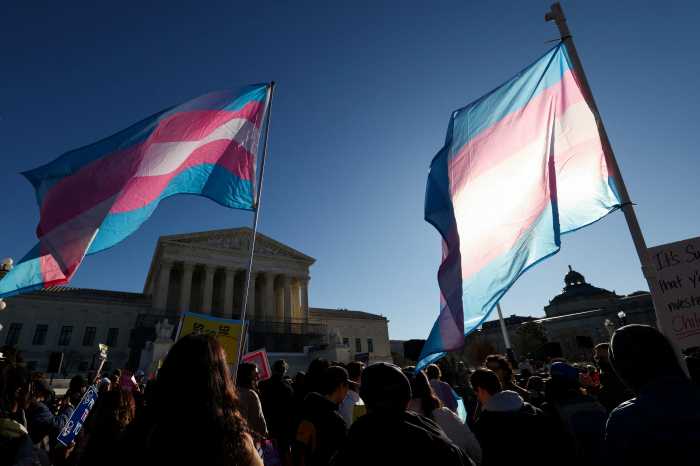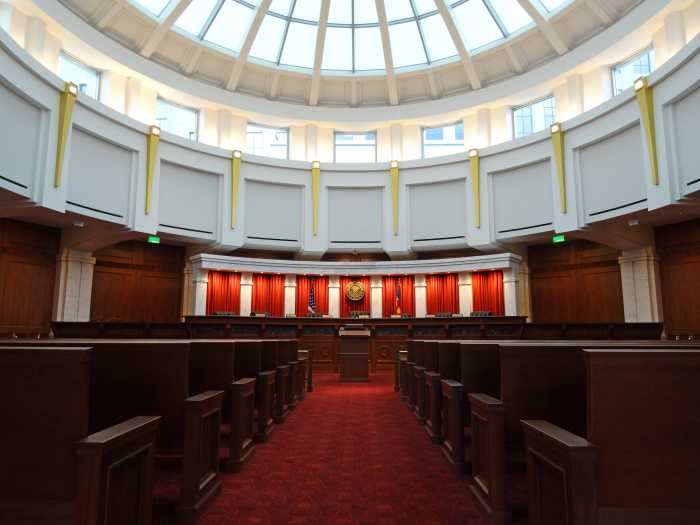
Two appellate courts — one state, one federal — have issued recent decisions that could be labeled victories for transgender rights. On April 14, the Supreme Court of Montana, interpreting the Montana Constitution, ruled that a recently-enacted law depriving transgender people of appropriate birth certificates and drivers’ licenses is most likely unconstitutional, upholding a preliminary injunction issued by the district court. On April 15, the US Eighth Circuit Court of Appeals, ruling on an appeal from a Minnesota district court opinion, upheld the dismissal of a complaint by an organization of cisgender female athletes who are challenging the Minnesota State High School League’s policy of allowing transgender students to compete in varsity sports, claiming that it violated Title IX of the federal Education Amendments of 1972.
The Montana Supreme Court’s ruling in Kalarchik v. State stands out because Montana is, by all accounts, a politically conservative state where Supreme Court justices have been appointed to mid-term vacancies mainly by Republican governors or otherwise elected at large in non-partisan votes by the public, so one would expect that it is a rather conservative court, but time and again it has defied prognostication in its rulings on LGBTQ issues, in part because of the libertarian heritage that imbues Montana’s Constitution.
That Constitution has a provision that makes the heart sing. Article II, Section 4, states: “Individual Dignity. The dignity of the human being is inviolable. No person shall be denied the equal protection of the laws. Neither the state nor any person, firm, corporation, or institution shall discriminate against any person in the exercise of his civil or political rights on account of race, color, sex, culture, social origin or condition, or political or religious ideas.”
The Montana Supreme Court has correctly ruled several times that the “Individual Dignity” clause goes beyond the US Constitution’s Due Process Clause in protecting individual rights, so federal precedents are not followed by the Montana courts. When the state legislature and governor enacted a law that prohibited changing birth certificates or drivers’ licenses to reflect the gender identity of transgender or non-binary people, the district court and the Supreme Court found a clear violation of the individual dignity of such individuals, thus upholding the district court’s decision that plaintiffs were likely to win and were entitled to immediate preliminary injunctive relief.
Writing for a 5-2 majority of court, Justice Laurie McKinnon wrote, “The District Court found that Plaintiffs must present identification documents that do not reflect their gender identity and, as a result, must disclose that they are transgender each time an inquiry is made. Government issued identification documents are necessary to access public life. When they do not accurately reflect a person’s sexual identity, the transgender Montanan is prevented, based on their sex, from obtaining the same attributes of public life that a cisgender Montanan may obtain. Hence, the inability of transgender Montanans to received government-issued identification documents accurately reflecting their gender identity is fundamentally about the nature of sex and suspect class discrimination under Article II, Section 4 — a clause that enshrines individual dignity, equal protection, and nondiscrimination.”
The dissenters showed their colors by the way they described the court’s opinion, accusing it of forcing the State to “issue falsified legal documents.” Indeed, Justice Jim Rice oddly protested the majority’s use of the term “cisgender” as somehow demeaning to people who are not transgender. He insisted that the law was not discriminatory when it required everybody’s birth certificate and driver’s license to accurately state their biological sex, and too bad for people with gender dysphoria. Rice claims that people who are not transgender do not have a “gender identity” but are just who their genes say they are.
The Eighth Circuit decision, Female Athletes United v. Keith M. Ellison (Attorney General of Minnesota), turns on an important technicality of Title IX, the federal law that forbids educational institutions that receive federal funding from depriving anybody of equal access to educational programs on account of sex. The Supreme Court has ruled in the past that individuals who claim to have suffered discrimination by an educational institution may sue under Title IX by showing intentional discrimination, but that the statute does not provide a “private right of action” to challenge educational policies on the basis of their disparate impact on particular groups.
In this case, one transgender woman in particular who has turned out to be a spectacular star in women’s softball has incurred the ire of cisgender women high school athletes who formed an organization to challenge the Minnesota State High School League’s bylaw providing that the League “allows participation for all students consistent with their gender identity or expression in an environment free from discrimination with an equal opportunity for participation in athletics and fine arts.”
The court found that the organization had standing to challenge the bylaw, because one of its members is on a team that is scheduled to play against “Jane Doe” in a future game. However, both the district court and the court of appeals consider that this lawsuit is a “disparate impact” lawsuit, not subject to an individual right to sue by somebody who considers themselves to be disadvantaged by the challenge rule.
When FAU first challenged the bylaw, claiming it violated Title IX, the league turned to Ellison for legal advice, and he opined that under Minnesota’s Human Rights Law the league was required to allow transgender athletes to “participate in extracurricular activities according to their gender identity,” and that President Trump’s interpretation of Title IX to the contrary did not preempt Minnesota law. This led then-Attorney General Pam Bondi to initiate a Title IX investigation into the league.
FAU sued under Title IX and has run up against the lack of authorization under the statute to bring a federal lawsuit on behalf of its members to protest the disparate impact that the policy may have on them. Perhaps surprisingly, the Eighth Circuit panel that issued this decision consists of three Republican appointees, two by Trump, and one by George W. Bush, but actually the decision that disparate impact claims can not be asserted in individual litigation under Title IX is consistent with a conservative view of how that statute should be enforced.
This is certainly not the end of the matter, however. FAU can ask the US Supreme Court to intervene, but more to the point, the US Department of Education’s Office of Civil Rights, which has adhered to Trump’s view of Title IX, might threaten to cut off federal funding to Minnesota schools based on a violation of their interpretation of Title IX, as a result of the investigation initiated by Bondi.
In the meanwhile, we await the US Supreme Cout’s ruling on two argued cases presenting the question of whether it violates Title IX for public schools to forbid trans girls and women from competing in women’s sports. That ruling could come at any time between now and the end of the Court’s term in June.