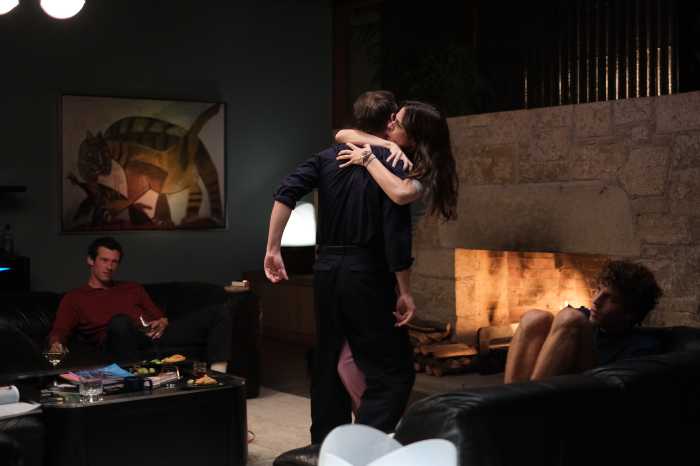

At this year’s Cannes Film Festival, there were many queer films, several by prominent out gay filmmakers. Ira Sachs’ “The Man I Love,” the sole American film in official competition, a “musical fantasy,” starring Oscar winner Rami Malek, received a lengthy standing ovation. Malek plays an actor in New York City during the late 1980s who encounters a turning point in his life and career. “Bitter Christmas,” by gay icon Pedro Almódovar, has a woman (Bárbara Lennie) coping with loss and love while a parallel storyline depicts a gay filmmaker (Leonardo Sbaraglia) writing a script of her story. And out gay filmmaker Lukas Dhont’s (“Close”) new film, “Coward,” concerns two men who meet and fall in love during World War I. Costars Emmanuel Macchia (his debut) and Valentine Campagne, shared the Best Actor Award at the Festival.
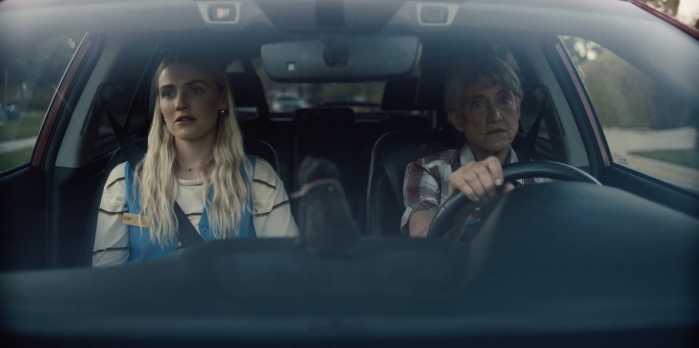
The opening selection in the “Un Certain Regard” category was trans and non-binary filmmaker Jane Schoenbrun’s “Teenage Sex and Death at Camp Miasma,” about a queer filmmaker and a horror actress. The film won this year’s Queer Palm Award. Also in this section of the festival was out gay Jordan Firstman’s feature directorial debut, “Club Kid,” about a flailing party promoter in New York City starring him and Diego Calva. It received a rapturous response.
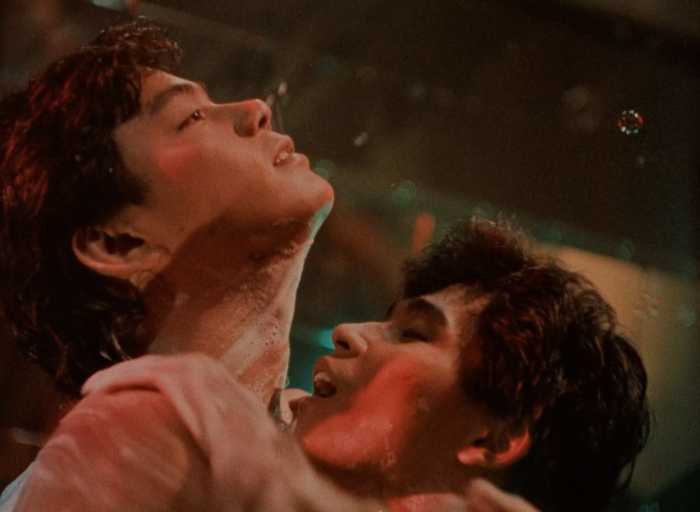
Four features that screened at the Cannes Film Festival were available for preview. “Flesh and Fuel,” which won the Queer Palm jury’s Discovery Prize, is a moving love story between two gay truckers. Étienne (Alexis Manenti) is French and works almost non-stop, driving around Europe. He is dependable and looked up to by his colleagues, who probably don’t know he is gay. One night, after cops chase him out of a wooded cruising area, Étienne meets Bartosz (Julian Swiezewski), a Polish trucker who works for another company. After a hot and heavy sexual encounter, Étienne and Bartosz stay in touch, but the demands of their jobs — Étienne starts making trips to England — keep them apart. In his feature film debut, director and cowriter Pierre le Gall has crafted a terrific slow-burn romance that has viewers invested in this unlikely relationship. Manenti conveys Étienne’s hunger for Bartosz well, from jerking off during a video call to racing across a dangerous highway just to spend less than an hour with his lover. But can their relationship consist of more than just a series of booty calls? “Flesh and Fuel” features some intense sex, but the achingly beautiful romantic moments linger. Manenti delivers a superb performance, and he is ably supported by Julian Swiezewski’s strong turn as Bartosz, a man who helps the lonely trucker break out of his shell.

Writer/director Gessica Généus plays the title character, a sex worker, in “Marie Madeleine” a compelling drama set in Jacmel, Haiti. Joseph (Béonard Monteau) is the son of Jacques (Edouard Baptiste), a Pastor, who befriends Marie Madeleine, who works at the brothel across from Jacques’ church. His lack of interest in her sexually — she eats fruit he brings her erotically — prompts Marie to wonder if Joseph is gay. One night, he rejects the affections of Kadou (Kevin Mesidor), but his ability to be with a woman sexually may not just be him “saving himself for marriage.” “Marie Madeleine” shows how Marie cares for Joseph, inviting him into a space where there is “no men, no women, just souls,” and while he does reconnect with Kadou, there are dangers for Joseph to be queer. The film considers how homosexuality is viewed negatively in this very religious country, and the biblical allusions are deliberate, if sometimes heavy-handed. But Généus, who is radiant on screen, has crafted a provocative film about freedom and sexuality, and she fills it with some fabulous imagery — such as one sequence featuring Marie floating above the city, and another set at Carnival.
“Six Months in a Pink and Blue House” is an engrossing autofiction by writer/director Bruno Santamaría Razo about his childhood in Mexico in the early 1990s. The film features a framing device where Bruno interviews his mother, Diana (portrayed by Sofía Espinosa in the film), about the time when his father, Mundo (Lázaro Gabina), was diagnosed with HIV. Young Bruno (Jade Reyes Vásquez) is certainly upset by the news of his father’s condition, especially since he is secretly crushed on his best friend Vladimir (Eduardo Gómez), among other boys, and is fearful of his budding sexual desires. When Diana tries to contract trace the disease and discovers drawings of nude men in Mundo’s sketchbook — he is an illustrator — tensions start to rise between the couple. Meanwhile, Bruno learns about French kissing, tries to steal cable TV, and in one of the sweetest sequences, asks his dying dad for his watercolors. “Six Months in a Pink and Blue House” has light moments, such as a cross-dressing party, but also emotional ones, such as a nonfiction scene where Bruno’s mother turns the camera on him and asks what he hopes to achieve by reopening these wounds as well as why he waited so long to tell his mother that he was gay. Razo’s film is a highly personal story, but the feelings he presents, especially about the way AIDS is feared and depicted, are impactful.
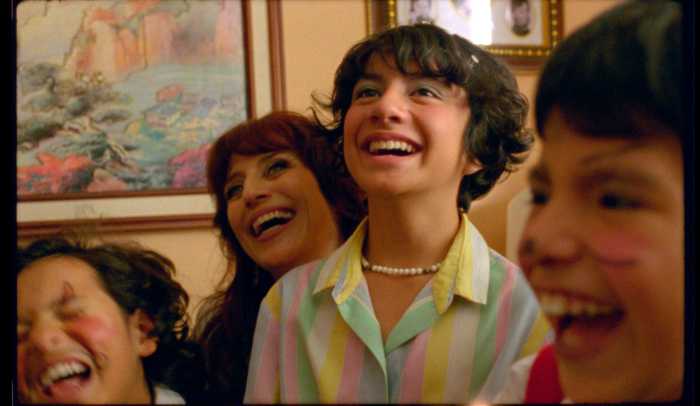
Out gay writer/director Christophe Honoré’s latest feature, “Orange-Flavored Wedding,” set in 1978, is an immersive drama that unfolds during a wedding when Jacques (Paul Kircher from Honoré’s “Winter Boy”), the youngest of the Puig family’s seven children, marries Martine (Malou Khebizi). As this leisurely film unfolds, the Puig family’s chaotic dynamics come to light. Jacques’ emotionally fragile sister, Claudie (Adèle Exarchopoulos), is bitter after her husband, Pierre-François (Andranic Manet), left her for another woman. Dominique (Vincent Lacoste) has just lost his job and needs money. Roger (Alban Lenoir) is battling PTSD from military service, and fights with his son, Frédéric (Joann Brezot), whom he thinks may be gay. There is also gossip, as when Jacques tells Marie-Do’s (Nadia Tereszkiewicz) that Odette (Victoire de Bois) thinks her young son, Christophé (Arthur Louis), is gay. (The film has autobiographical elements, and there is an interesting scene of Frédéric and Christophé sharing a cigarette).
“Orange- Flavored Wedding” is absorbing throughout as secrets are shared, unsolicited advice about raising children is offered, and sibling rivalries and father/son dramas emerge. (Both Roger and Dominique hit their sons, while Jacques beats up his estranged father (Javier Cruz), who is not welcome in the family or at the wedding.) Viewers become invested in these character — in part because the ensemble cast of actors give lived-in performances. This is also why the film is quite moving when Honoré periodically fast forwards to “a few years later” to reveal the futures of some of the siblings.
Named perhaps after the packages of Tang that Guy (Xavier Lacaille) shares with the kids at the reception, Honoré’s film is never sugary. Mostly, this involving family drama is bittersweet.
In addition, a trio of striking queer shorts are screening in the Emerging Filmmaker Showcase at Cannes.
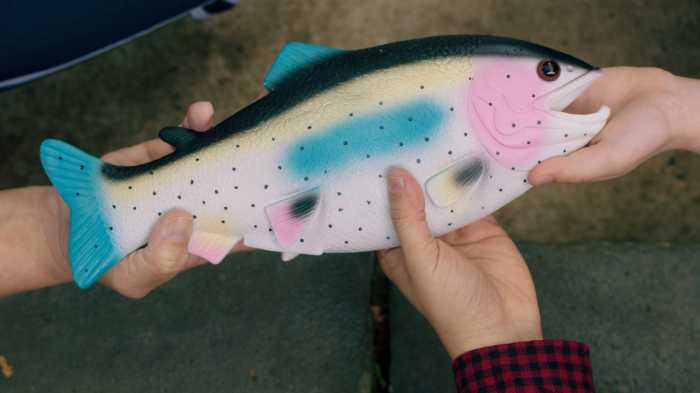
The excellent “Big Bass,” has Drew Dickler returning to her high school to reconnect with her former gym teacher, Cheryl Bruttomesso. As a tomboy growing up, Drew admired Cheryl, but she also feared her. Closeted as a teen, Drew avoided the out-and-proud Cheryl and felt guilty about that. “Big Bass” has the women meeting years later to talk about a conversation they had when Drew was in second grade. Their interview is quite emotional, with each woman describing their self-acceptance, how they saw the other, and how they each navigated their queer journeys in ways that viewers should relate to.
“Welcome to Tool Shed” takes viewers inside the eponymous rehabbed gay dive leather bar in Palm Springs, CA. It is here that owner Robert Cole wants to create a space where his patrons — mostly seniors — could fee safe. However, when Trump wins the 2024 election, Cole and his customers feel the homophobia that threatens to destroy the queer community. Featuring poignant interviews along with images of both hate and resistance, “Welcome to Tool Shed” emphasizes how the gay community must continue to fight to survive.
“Zari” is a winning short about Neelu (Aesha Soni) who does not want to wear a sari at her sister Rita’s (Richa Kalra) wedding. When shopping for her sister, Zeyb (Kamal Batra) models a sari, and when Neelu returns to the store a few days later to pick up a blouse, she catches Zeyb dressed as “Zari” in a sari making videos. Director Shruti Parekh scores points for the bonding between these queer youths, as well as for balances themes of tradition and acceptance.