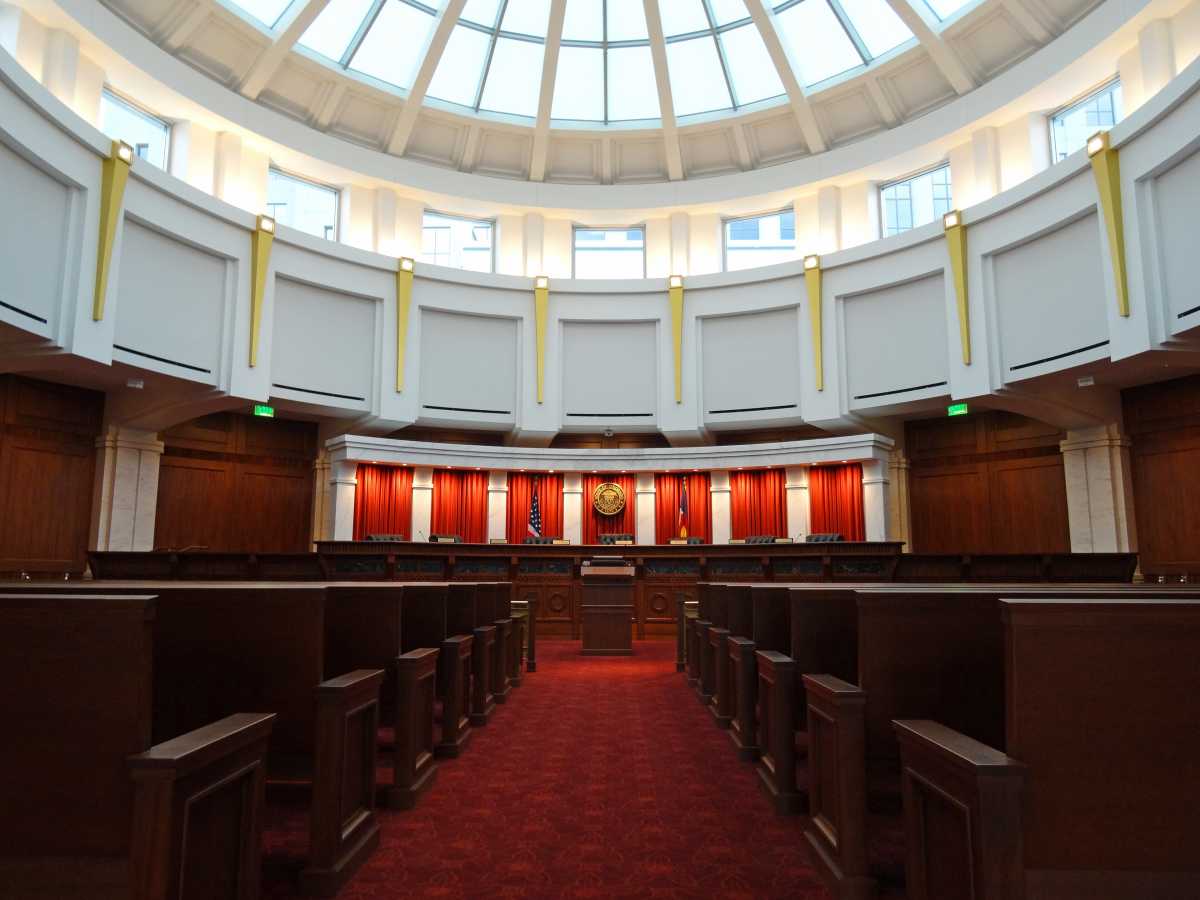
In recent days, LGBTQ plaintiffs have won preliminary victories in three lawsuits concerning restrictions on gender-affirming care. In one, the Colorado Supreme Court reversed a trial judge on May 18 and ordered a preliminary injunction requiring Children’s Hospital Colorado (CHC) to resume providing gender-affirming care to minors. In another, a state trial judge in Kansas granted a temporary injunction on May 15 to block enforcement of Kansas’s recently enacted ban on gender-affirming care for minors. And also on May 15, a federal judge in Connecticut denied a motion by an insurer to stay a preliminary injunction requiring the insurer not to categorically deny coverage for gender-affirming facial reconstruction surgery for the plaintiffs.
In light of the setbacks that transgender rights suffered at the Supreme Court last year, the occurrence of three trans-positive rulings within a short time is a hopeful sign on progress.
The Colorado Supreme Court’s 5-2 ruling in Boe v. Children’s Hospital Colorado addresses the fallout from a “Declaration” issued on Dec. 18 by U.S. Health and Human Services (HHS) Secretary Robert F. Kennedy, Jr., in which he proclaimed that performance of gender-affirming care for minors was neither safe nor effective and “fails to meet professionally recognized standards of health care.” This declaration was intended to place in question eligibility for federal funding under programs such as Medicare and Medicaid by health care institutions and practitioners who provide such care.
Then the general counsel of HHS announced on social media that he was referring CHC to the HHS Inspector General for investigation for providing medical gender-affirming care for minors, which would be the first step toward suspending CHC from receiving federal funds, which are a substantial part of the hospital’s operating budget. CHC responded to this news by notifying patients that it could no longer provide hormone therapy or puberty blockers to transgender patients under the age of 18, potentially leaving those taking these medications high and dry. This announcement affected people from a five-state area who were relying on CHC for such care, as it was unavailable in neighboring states where it was legally banned.
CHC’s notification was startling because Colorado is a state that specifically approves of providing such care, and had joined a lawsuit by the State of Oregon and many other states filed in the federal district court in Oregon, seeking an order vacating Kennedy’s Declaration and any HHS action to enforce it. On April 18, that court issued an order in Oregon v. Kennedy vacating the RFK Declaration and barring its enforcement while the litigation proceeds.
In the Colorado case, the plaintiffs, two transgender minors and their parents, sought a preliminary injunction requiring CHC to continue providing care (restoring the status quo from prior to the Kennedy Declaration) while the case is being litigated. The trial judge, Denver District Court Judge Ericka F. H. Englert, denied their motion. Although she concluded that the plaintiffs were likely to prevail on the merits of their claim, she found the equities to be in favor of CHC’s suspension of services, explaining that the harm suffered by a small number of transgender patients was outweighed by the harm that would be suffered by thousands of people if CHC had to go out of business due to suspension of Medicaid and Medicare funding.
The majority of the Colorado Supreme Court agreed with the trial judge that plaintiffs were likely to prevail on their claim that suspending the services violated plaintiffs’ rights under Colorado’s anti-discrimination law, finding that the suspension was targeted on transgender youth and thus constituted discrimination because of gender identity, which is explicitly prohibited under the state law. Writing for the court, Justice William W. Hood, III, emphasized that CHC was continuing to provide puberty blockers and hormone therapy for cisgender youth who suffered from other conditions, such as premature or delayed puberty, which are treated using those medications.
The court held that Judge Englert erred in ruling that the harm suffered by a small number of transgender patients was outweighed by the harm that would fall on CHC and its other patients if it lost federal funding. The majority of the court said that at the time CHC suspended the service, the possibility of funding being withheld was speculative and far off, describing the protracted administrative process that would have to be undertaken under the Medicaid and Medicare Acts before funding could be cut off and, of course, now HHS is restricted by the preliminary injunction in the Oregon case from enforcing RFK’s Declaration while that case is litigated. The court also pointed out that preserving the status quo while litigating was appropriate in light of the harms that transgender minors would suffer if their treatment was suspended.
In opposing the injunction, CHC argued that it had no discriminatory intent and had suspended the services with regret under the pressure of losing federal funding. It raised the holding last year by the U.S. Supreme Court that Tennessee had not violated the Equal Protection Clause when it outlawed gender-affirming care for transgender minors. The Colorado Supreme Court majority rejected this argument, emphasizing that this case was being litigated under Colorado’s antidiscrimination law, not the 14th Amendment of the U.S. Constitution, and noting the U.S. Supreme Court’s ruling in 2020 under Bostock v. Clayton County, Georgia, that discrimination against somebody because of their transgender status violates Title VII, a federal law banning discrimination because of a person’s sex. The Colorado court majority found Bostock to be the more appropriate precedent for interpreting an anti-discrimination statute.
Two Colorado Supreme Court justices dissented, arguing that discriminatory intent was required to find a violation of the Colorado law, and that it was clear that CHC had no discriminatory intent. They empathized with the hospital, facing a possible financial disaster, and also disagreed with the trial judge and the majority of the Supreme Court about whether plaintiffs were likely to prevail on the merits, a sine qua non of obtaining preliminary relief.
The Kansas decision by Douglas County, Kansas, District Judge Carl Folsom, III, was issued in response to a challenge to provisions of Kansas Statutes 65-28, a law that prohibits the use of puberty blockers or hormones as a treatment for gender dysphoria. Judge Folsom produced a lengthy, detailed opinion describing the plaintiffs, their treatment, and the impact that passage of the law already had on their well-being. The ACLU of Kansas filed suit on their behalf invoking only the Kansas Constitution, avoiding the possibility of this case going to the U.S. Supreme Court and rendering irrelevant that court’s ruling last year upholding the Tennessee ban on such treatment. Immediately on filing suit, the plaintiffs sought what is called in Kansas a “temporary injunction” to block the law from being enforced while the case continues.
Judge Folsom held a two-day hearing with expert witnesses testifying both in person and by affidavits and decided that the state’s experts’ opinions were worth little weight and that the plaintiffs’ experts were better qualified and more informative. He rejected the state’s contention that the treatment ban was necessary to “protect” minors, convinced by the plaintiffs’ experts that these treatments are safe and effective for treating gender dysphoria in minors by reference to the procedures followed at Children’s Mercy Hospital in Kansas City, whose GPS Clinic is the only provider of such services in the state.
Based on the expert testimony, he concluded that “it is harmful to transgender adolescents with gender dysphoria to remove the option of receiving gender-affirming medical care because that is the treatment with the most evidence of being helpful to treat gender dysphoria. It is harmful to withhold medical treatment or withdraw medical treatment in progress that is safe, effective, and medically indicated. In addition to the harms of withholding this treatment,” he continued, “transgender youth feel threatened, unwelcome, and targeted by laws that prohibit their medical care, and families without the financial means to travel are under tremendous stress. The risks of not providing puberty blockers or hormone therapy when medically indicated for an adolescent with gender dysphoria, include exacerbated distress for gender dysphoria and significant mental-health consequences, including worsening depression and anxiety and social isolation.”
Furthermore, he noted, “The State has identified no other medical care that Kansas has restricted only to adults,” and observed, based on the testimony from plaintiffs and their health care providers, that “transgender adolescents who have remained patients of the GPS Clinic since [the law] went into effect are experiencing mental-health crises — their anxiety and depression have returned, and they feel society has rejected them and does not value them as individuals.” They would only have had to read President Trump’s Executive Order from Jan. 21, 2025, to reach that conclusion.
The Kansas Constitution adopts language from the U.S. Declaration of Independence, whose 250th anniversary we celebrate this year, stating in Section 1, its Bill of Rights: “All men are possessed of equal and unalienable natural rights, among which are life, liberty, and the pursuit of happiness.” The judge pointed out that this language has no textual counterpart in the U.S. Constitution, and the U.S. Supreme Court’s interpretation of the limitations of human rights protection under the federal constitution are thus “inconsistent with state sovereignty,” according to a Kansas Supreme Court ruling from 2013. “The Kansas Constitution protects personal autonomy in Section 1 of the Kansas Bill of Rights,” he wrote. “This personal autonomy includes the fundamental right of parents to the care, custody, and control of their minor children,” and the challenged law “infringes on that fundamental parenting right, which triggers strict scrutiny,” which the law fails. “Defendant has failed to carry its burden to demonstrate that [the law]’s prohibitions on puberty blockers and hormone therapy are narrowly tailored to a compelling government interest.”
The law also prohibits gender-affirming surgery for minors, but Judge Folsom found that the plaintiffs are not seeking such surgery as minors, and that the GPS Clinic does not provide such surgery for minors, so surgery is not included in the “temporary injunction” that he issued.
“Plaintiffs are likely to prevail in their claim that [the law] does not substantially further Defendant’s interest in protecting children or the medical profession because the evidence presented to the Court demonstrated that puberty blockers and hormone therapy offer proved mental-health benefits when used to treat gender dysphoria in adolescents,” wrote Judge Folsom. He concluded that allowing the law to be enforced while this case proceeds would harm the plaintiffs, that later money damages would not remedy their injuries, and the harm they would suffer outweighs whatever damage the proposed injunction might cause to the State. He also found that issuing the injunction would “not be adverse to the public interest,” and that a statewide injunction against enforcement of the law was appropriate, since limiting its effect to the plaintiffs “would substantially limit the GPS Clinic’s practice in this field of medicine, which may ultimately affect the clinic’s ability to serve Plaintiffs.” A statewide injunction is necessary to uphold the status quo while this lawsuit proceeds.
As soon as this opinion was issued, Kansas Attorney General Kris Kobach, named as a defendant in his official capacity, announced that he would appeal the ruling to the Kansas Supreme Court. In light of the court’s factual findings, it is unlikely that Judge Folsom would agree to stay his temporary injunction while Kobach appeals, although it is possible that the Kansas Supreme Court would grant a stay.
Finally, on May 15, U.S. District Judge Victor A. Bolden, who had previously issued a preliminary injunction in Gordon v. Aetna Life Insurance Company, requiring Aetna to make “individualized coverage determinations” about covering gender-affirming facial reconstruction surgery “when used to treat gender dysphoria,” denied a motion by Aetna to stay the injunction while it appeals his ruling to the U.S. Court of Appeals for the 2nd Circuit.
The lawsuit by a group of transgender plaintiffs argues that Aetna’s position that the policies it is administering exclude coverage for such procedures violates the sex discrimination ban in the Affordable Care Act. Judge Bolden found that the plaintiffs are likely to succeed on that claim, noting as well that language in the policies and Aetna’s guidance publications might be interpreted to extend such coverage.
In seeking a stay of the preliminary injunction, Aetna argued that if it was required to pay the two doctors who had performed the procedures on the plaintiffs, that would effectively “moot” the appeal, but Judge Bolden responded that “the majority of courts in this Circuit have found that the mooting of an appeal, without more, does not constitute irreparable injury.” A party seeking a stay has the burden of showing that denying a stay would subject it to irreparable injury.
Judge Bolden was appointed to the court by President Obama. Aetna filed an appeal to the 2nd Circuit Court Appeals of Judge Bolden’s award of preliminary relief to the plaintiffs on April 2. It is possible that the 2nd Circuit would be more open to granting Aetna’s request for a stay. Lawyers associated with Advocates for Trans Equality Education Fund and volunteer attorneys from several law firms represent the plaintiffs.