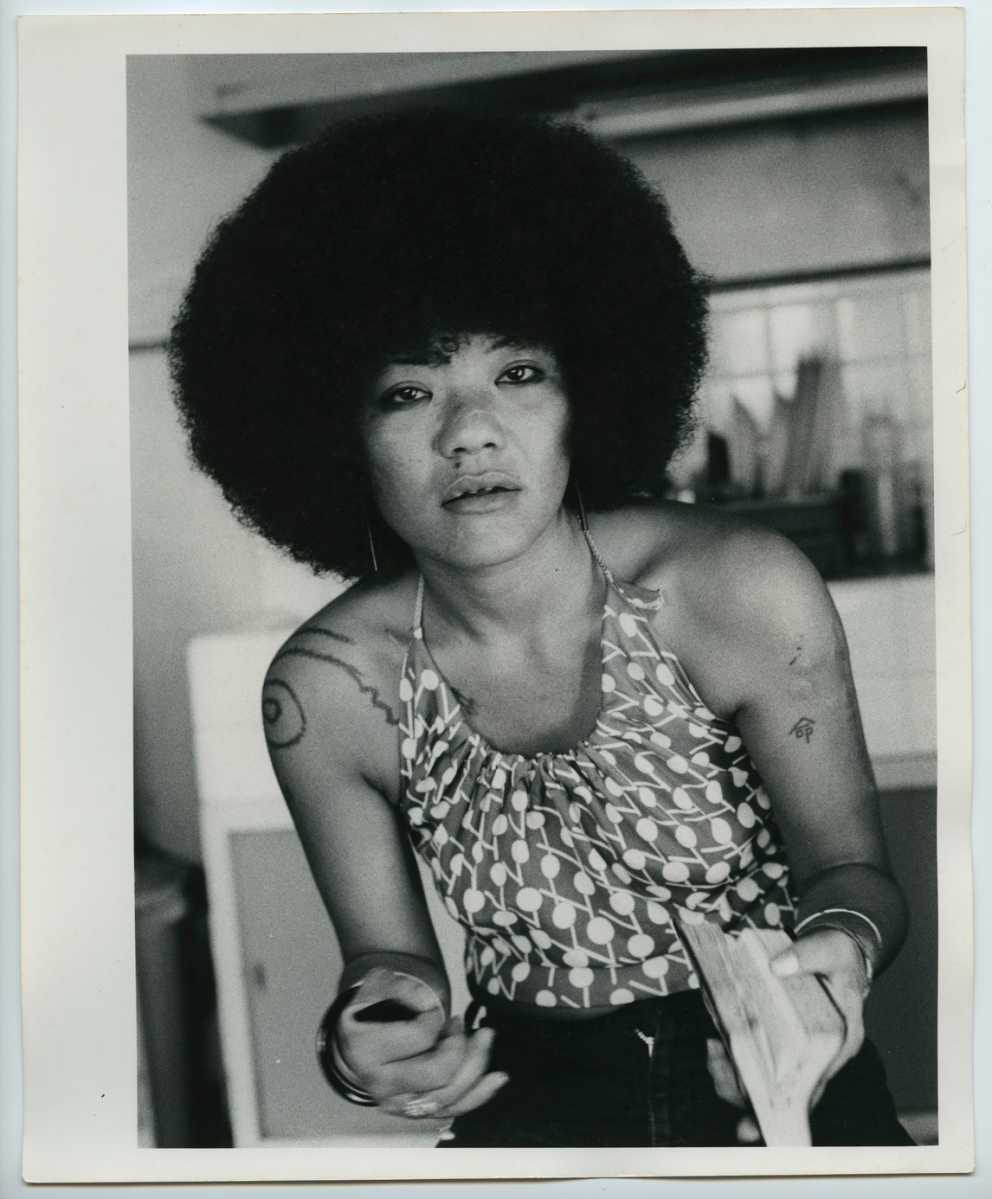
Two photographic portraits currently on display separately in two of New York’s major museum exhibitions pay homage to the iconic image of Black activist and intellectual Angela Davis.
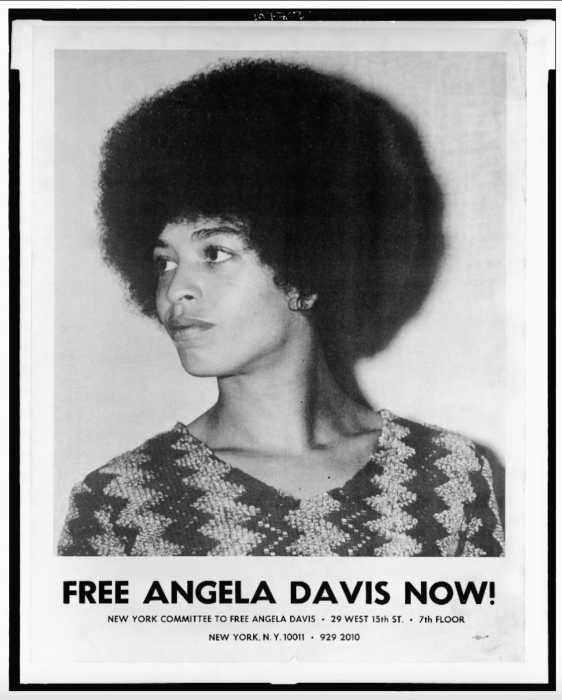
One is candid; the other is staged. Both pieces are untitled and belong to thematic series by their creators. Yet both, with uncanny concurrence, given that they were created decades and continents apart, evoke Davis’ image in not only a generic sense, but specifically how she appeared on posters designed and circulated circa 1971 to advocate for the then 25 year-old in a widely publicized criminal trial that concluded in her full acquittal in 1972. What stood out most about her physical appearance was her helmet of natural hair in the hairstyle known internationally as “The Afro.”
“Free Angela” posters, originals of which are now treasured collectibles, and other media coverage, played a large part in making Davis into an internationally-recognized face of radical politics for decades after the fact.
Contemporaneous to Davis’ rise to prominence, the U.S. military had a significant presence in Okinawa, Japan, which it occupied for 27 years, between 1945 and 1972. Widespread objection to the formal occupation led to protests and ongoing tension on the island. The Okinawan photographer Mao Ishikawa, in her early twenties at the time, set out to document the military presence but instead found her subject in a unique community she encountered while working in a bar frequented by U.S. servicemen. Young Japanese women like herself employed as bartenders and servers mingled amicably and intimately with American patrons their age, many of whom were Black, cutting through the surrounding tensions.
With the comfort of an insider reflected on the faces and poses of her subjects, Ishikawa photographed her friends, colleagues and patrons, producing the series, “Red Flower (Akabanaa), 1975-77.” One image in that series, now on view in the Whitney Museum Biennial 2026, is of a young woman wearing her hair in Afro style reminiscent of Angela Davis. She is clad in a halter top whose geometric pattern has a flavor of the designs Davis was often captured wearing. What the portrait strongly conveys is that not only did Davis’ style travel, so did her politics of resistance.
But, while Angela Davis’ Afro entered into popular culture as a characteristic all Davis’ own, it is crucial to remember that it was a collective expression of racial pride by African American women and men activated by the civil rights and Black Power movements of the 1960s and ‘70s.
Ishikawa’s series makes this point in another portrait (not included in the Biennial exhibition) of a young Black American man leaning against a jukebox on the wall above which is an artwork of a Black woman head held high with a full, round Afro framing her face.
The Okinawan women’s and African American men’s racialized and gendered positions in their respective societies drew lines of solidarity across social and political tensions surrounding them, with Davis’ aesthetic an outward expression of their affinity.
Upcoming as part of the Whitney Biennial’s public programming, on Sunday, May 31, a panel of critics and curators will discuss this series in a roundtable titled, “Considering Mao Ishikawa: A Conversation.”
Whereas Ishikawa’s portrait is a candid, shot in the early ‘70s amid the fray of U.S. military occupation in Japan, the Cameroonian-born Nigerian photographer Samuel Fosso’s Davis-inspired portrait was produced in the studio. In fact, it is a self-portrait of the artist himself, created as part of one of his most well-received series, “African Spirits” (2008), in which he photographs himself in the guise of historic activist figures from across the African diaspora, including Kwame Nkrumah, Malcolm X, and Martin Luther King, Jr. Davis is the only female icon in the series.
To portray Davis, Fosso dons an Afro wig, geometric-pattered blouse, tinted wide-frame glasses, hoop earrings, and light makeup. The portrait is currently on view as part of the Museum of Modern Art’s exhibition, “Ideas of Africa: Portraiture and Political Imagination.”
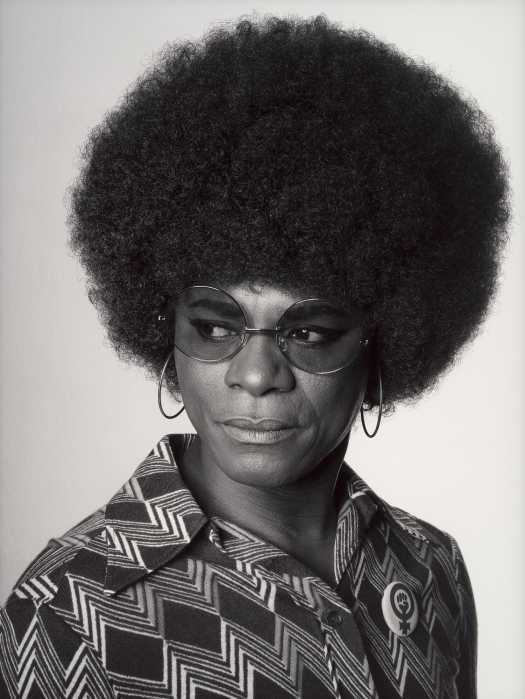
Fosso’s embodiment of Angela Davis as she looked in or around 1972 is a nod to both a political history and a personal one. That year, Fosso, age 10, experienced his own upheaval, having to flee Nigeria in the wake of a civil war, to live with an uncle in the Central African Republic, where he commenced making self-portraits to send to family he left behind.
While the “African Spirits” series is an homage to diasporic figures such as Davis, who Fosso channels in his stagings, he does not name them. Not only because each is so iconic as to be readily identified, but because ultimately it is Fosso’s insertion of himself in their representation that is most meaningful.
“For me, there’s this sense of recognition,” says Togolese-Italian visual artist Silvia Rosi in a pre-recorded commentary for the exhibition. “Also, his own presence makes us question what it means to embody these figures.”
Ideas of Africa: Portraiture and Political Imagination | Museum of Modern Art | Through July 25
Whitney Biennial 2026 | Whitney Museum of American Art | Through August 23
Nicholas Boston, Ph.D., is a professor of media sociology at Lehman College of the City University of New York (CUNY). Follow him on Twitter @DrNickBoston and Instagram @Nick_Boston_in_New York