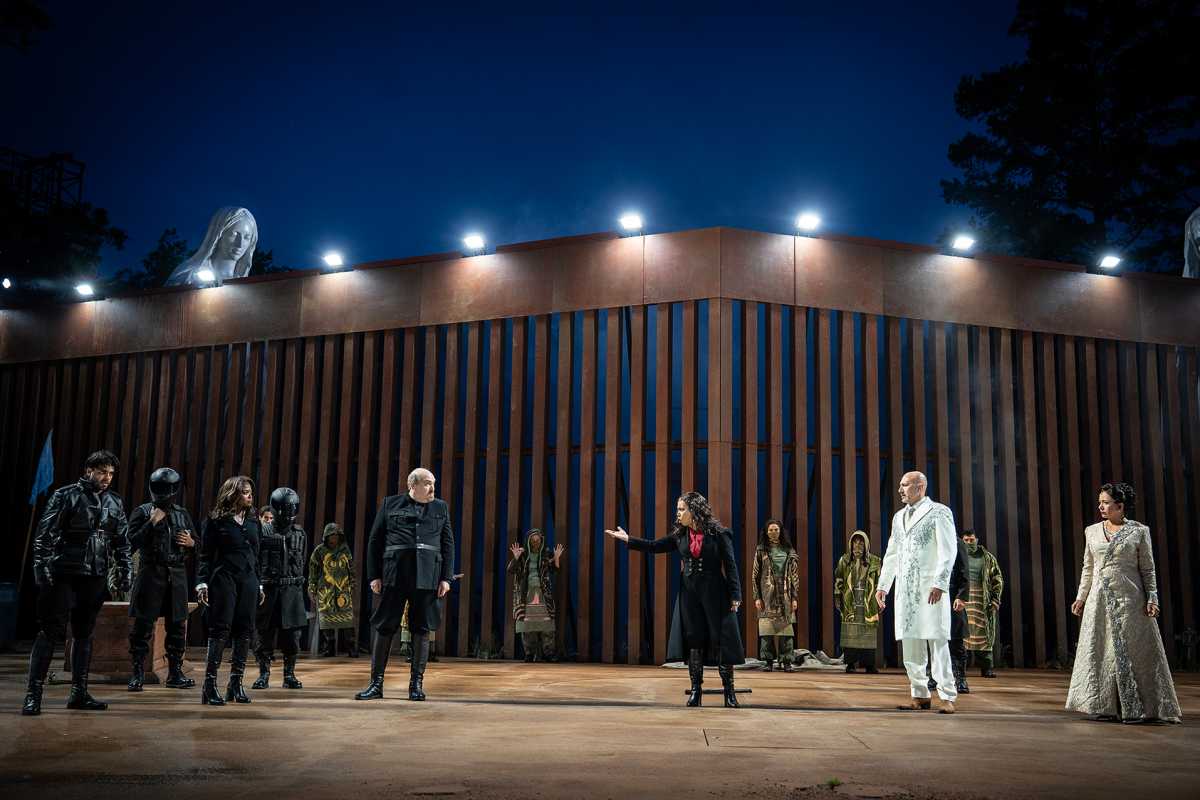
It’s unclear why director Saheem Ali has set his Public Theater production of “Romeo and Juliet,” now at the Delacorte, in the town of Nueva Verona, a border wall community. In the moments before the play begins, the audience faces a barren landscape designed by Maruti Evans, marked with graves in the shadow of a replica of the current border wall.
Knowing the play as so many do, it seems natural to wonder what this might mean conceptually as we sit outside amid the lush beauty of Central Park on a nearly perfect summer night. Is the wall a stark reminder of the senseless bigotry and hatred that consumes so much of our country right now — as reflected in the “ancient grudge” between the Capulets and the Montagues? Does it stand as a representation of the cruel ways in which “civil blood makes civil hands unclean?” Or, more simply, does it underscore the inherent futility of trying to wall up the heart? It is certainly provocative, if not immediately evident.
What is absolutely clear, however, is that these questions set the stage, literally and figuratively, for the spellbinding, visceral, and lyrical production that unfolds in the “two hours traffic of our stage.” (Well, two hours and 40 minutes, but who’s counting?) While there’s always a temptation among some to ask, “Do we really need another ‘R&J’?” In this case, the answer is a resounding yes.
Ali preserves all the beauty of the original while giving the play a contemporary sensibility, which underscores the timelessness of passion and tribalism, in other words the inherent humanity, of the oft-told tale. In that vein, it’s imperative to give a shout out to voice and text coaches Andrew Wade and Julie Congress. They have ensured that every word, every inflection, is pristine and comprehensible and serves the direction and the text, something too often missing in lesser Shakespeare productions. To quote Hamlet, “T’is a consummation devoutly to be wished.”
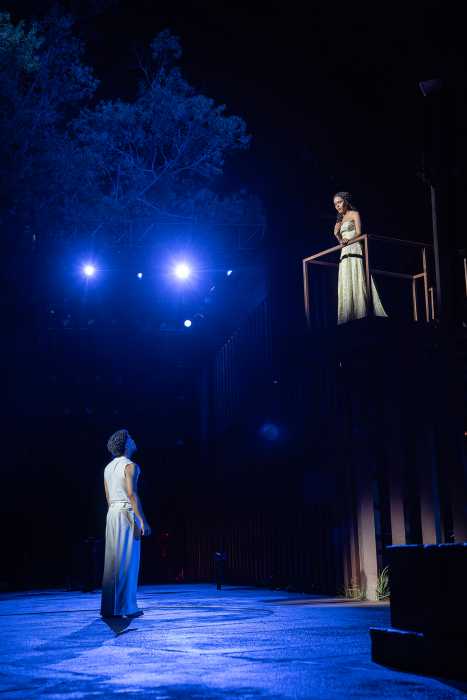
As for the setting, Nueva Verona is a Spanish town, and as in the original Italian Verona, the heat and the restlessness it engenders amplifies the brawls between the young people of the houses of Capulet and Montague. As the character Benvolio warns Mercutio, a cousin of Romeo’s who seems always spoiling for a fight, later in the play, “these hot days, is the mad blood stirring.” Aggression and rage are ignited, and tragedy is the inevitable outcome. Just as heated on the opposite end of the emotional spectrum is Romeo’s sudden love for Juliet — and hers for him — and the plots of love, loss, and revenge are set in motion.
As he regularly does, Ali evokes performances of range and nuance from every one of his actors. Even for a story as “familiar as household words,” he creates a dynamic world where one is swept into the story and the characters. Without giving anything away, Ali’s treatment of Mercutio, the most lyrical and edgy of the Montagues, is shocking, as is all the fighting, under the direction of Thomas Schall.
Ali goes further, interspersing Spanish translations into the text, particularly in the interactions of Romeo and Juliet. As he did by introducing Swahili into last summer’s “Twelfth Night,” this expands the scope and universality of the play, particularly when one hears well-known lines, often expressing intimacy, in a different language.
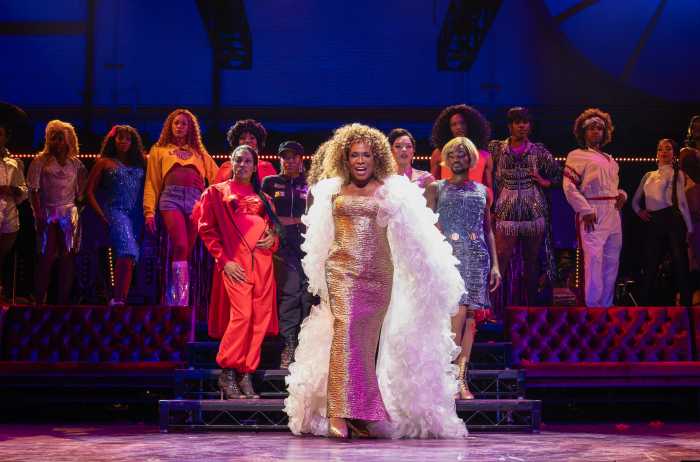
Despite the hardscrabble setting, Ali also fills the stage at times with brilliant color, as in the magnificent costumes, designed by Oana Botez, for the ball where Romeo meets Juliet. The ball is a joyful counterpoint to the arid landscape and threatening presence of the wall; even under oppression, joy cannot be constrained. There is also cultural iconography in the form of three goat gods who haunt the stage periodically. They appear to represent the god Baphomet, a figure believed in some Spanish-speaking sects to be able to balance and resolve conflicts between opposites. Their ghostly and otherworldly appearance here underscores and highlights the human conflicts of the story, which does find resolution, although in tragedy.
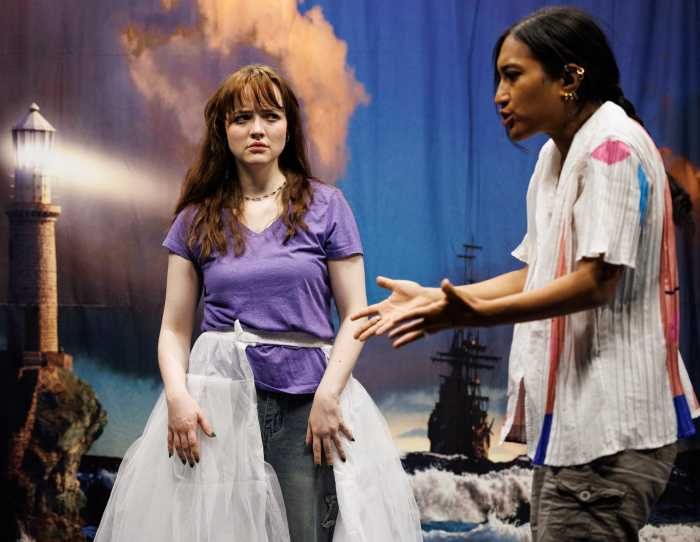
The richness and clarity of the production is enhanced by the superlative cast. At the center of it are Ra’Maya Latiah Aikens and Juliet and Daniel Bravo Hernández as Romeo. Aikens’ portrayal has a contemporary feel — a very modern teenager. A lesser actor might rely on shallow mannerisms, but Aikens imbues her Juliet with depth and urgency that lets us see that her tragedy is at least partially due to her youth. She is alternately exhilarating and heartbreaking. Hernández, too, is remarkable. He beautifully embodies the ungoverned range of emotions of a besotted youth. He is one of the most sympathetic, complex, and believable Romeos I have seen.
In secondary roles, Caleb Joshua Eberhardt is a spectacular Mercutio, all explosion and hormones, poetry, and conflict. It is this character who precipitates his demise, and Eberhardt is electric in the role. Lachanze as Lady Capulet (who we have the pleasure of hearing sing in the ball scene), Glenn Flsehler as Capulet, Francis Jue as Friar Lawrence, and Ariayn Kassam as Tybalt are all outstanding.
Deirdre O’Connell plays the nurse with a bawdy earthiness and a wry perspective juxtaposed against the formality of the Capulets. She understands the elemental feelings that drive Juliet and the comedy comes largely from stripping away the pretensions of the nobility — a recurring theme in Shakespeare, which is, in part, what made him such a populist playwright.
Whether as a cautionary tale or a tragic romance, we keep coming back to “Romeo and Juliet” because wherever we are in life, it speaks to something in each of us.
We keep coming back to the Delacorte, an annual gift to the city, to see how we will be engaged and challenged to look at old stories with new eyes and experience our shared humanity.
Romeo and Juliet | The Public Theater at the Delacorte Central Park | Tues-Sun 8 p.m. through June 28 | Free | How to Get Tickets | 2 hours, 40 mins, 1 intermission