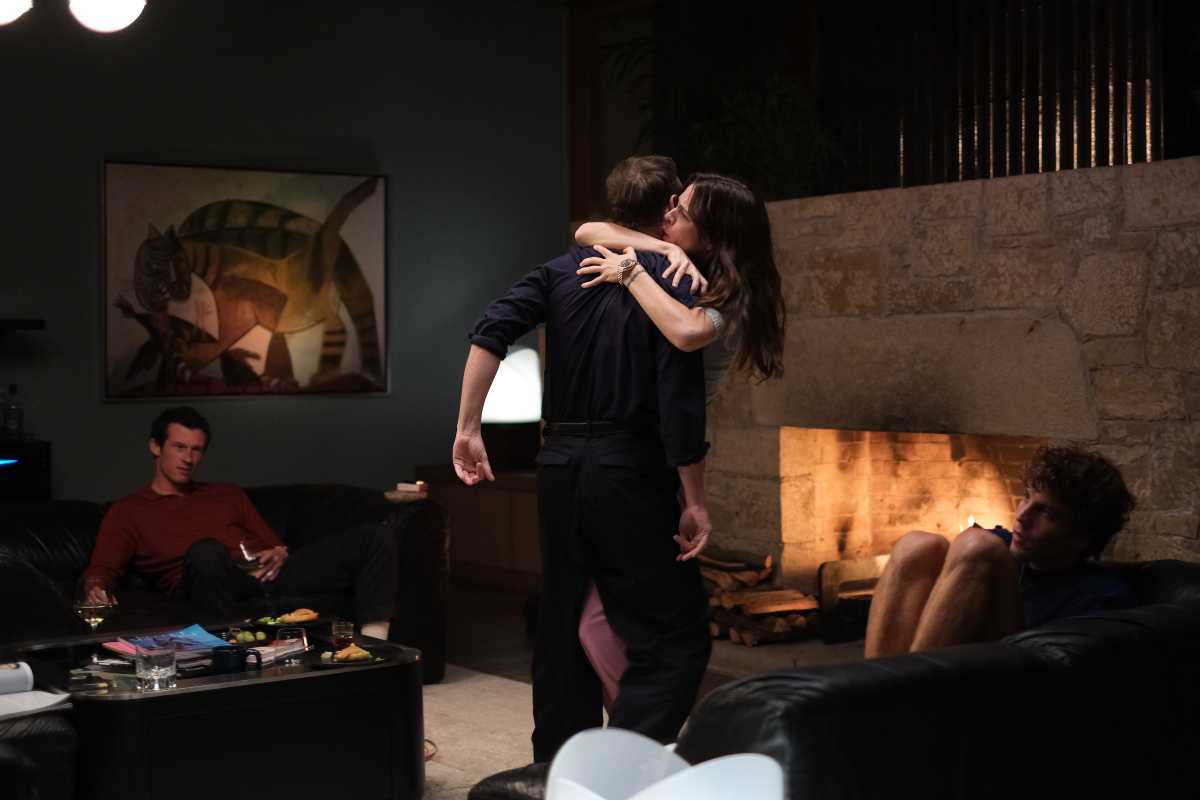
Out gay filmmaker Karim Aïnouz’s new film, “Rosebush Pruning,” is a delicious tar-black comedy about a wealthy, dysfunctional family. Ed (Callum Turner), who lives in Spain with his father and siblings, is suddenly keen to see George — a Greek man he very recently met — naked. But leaving his family is difficult; Ed’s mother (Pamela Anderson) has died, and his father (Tracy Letts) is blind. Moreover, Ed, along with his sister Anna (Riley Keough) and brother Robert (Lukas Gage) are “lazy, mediocre, vapid egotists,” which leaves his brother Jack (Jamie Bell) to mostly take care of the family. But Jack wants to move in with his girlfriend Martha (Elle Fanning). When Ed makes a startling discovery, it might just upset everyone’s plans.
Working from a script by Efthimis Filippou, and based on Marco Bellocchio’s film, “Fists in the Pocket,” Aïnouz presents a world that shifts between reality and surrealism as the characters all look out for themselves. Bursting with vivid color, courtesy of Hélène Louvart’s dazzling cinematography, and boasting some fabulously outrageous moments, “Rosebush Pruning” is all about rich, beautiful people behaving very, very badly.
Aïnouz spoke with Gay City News about making his gleefully naughty film.
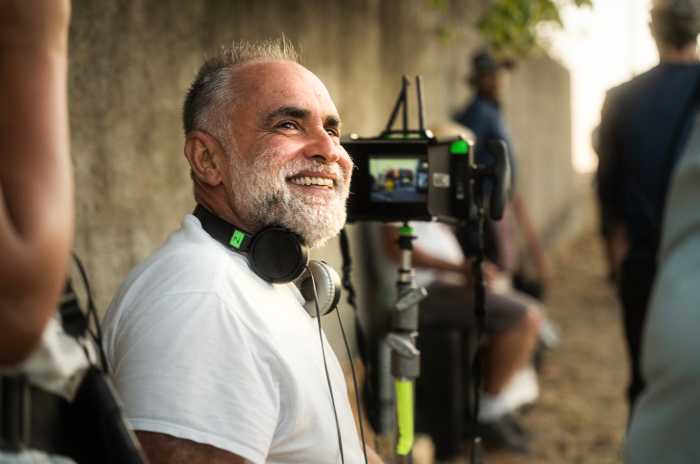
Karim, what character do you identify with in “Rosebush Pruning” and why?
[Laughs.] That’s a wild question, Gary! I don’t, because the characters are so far from my daily life. But I do feel a certain kind of empathy for them in different ways. I love Martha for her strong will to resist and her sense of revenge. There is something beautiful about her. She is an outsider who has come to settle the score. At the same time, I’m touched by the vulnerability of Robert and Anna. They are kind of damaged children who have never grown up. I also love the mother. There is something that feels really exciting, and fresh, and a bit off about her that I really appreciate. People have asked me: How can we relate to the characters? Except for the father, I like a lot of them, and I feel moved by them despite the fact that they are not likable people. It is like they have no superego or filter.
There are some wonderfully absurdist moments in the film, but also some rather shocking scenes. How did you find the tone for this story?
It was an ongoing process. I wanted to bring what was on the page to life in a way that you can relate to the characters. The writing keeps them at a distance. I think the tone was the key question of making this film. It couldn’t be cold. The characters needed to have real, human hearts, and not just be mouthpieces. The tone was something we crafted during rehearsals. For the scene where Anna is talking to Martha about her dad, it was, how do you keep it artificial and believable? That was the biggest challenge in finding the tone — not making fun of the characters, but, at the same time, having something there that is not real. The film is always navigating between what is real, not real, and surreal. It was figuring out the shades of gray between the artificial and the real.
The film has moments that are outrageous, but much of the sex and some of the violence is not very explicit and mostly left to the imagination. Can you talk about your decisions in presenting those scenes?
This movie comes immediately after my film “Motel Destino,” which was very explicit sexually. I wanted to take on the challenge of telling without showing. There were a lot of possibilities, but also a question — particularly in the scene of abuse in the film which is really key for the story — how do you stage violence? Here, it is sexual violence. I was very interested in suggesting more than showing, triggering the viewer’s imagination. There are a lot of moments in the film when you don’t know if it was real or not. The moment that you show it, it stops being possible and is very realistic. How can I suggest through sound? Also, it was important that the film was not rated R. I did not want to alienate viewers with explicit sex scenes. I learned with “Motel Destino” that people don’t like to see explicit sex scenes — or they don’t want to see them in the cinema.
The look of the film is absolutely stunning with Hélène Louvart’s gorgeous cinematography. The colors just pop. What was your visual strategy here?
I was inspired by the technicolor hues used in classic American melodrama from the 1950s. This is a family saga with touches of a thriller and surrealism. I admire the classic beauty that emanates from how those melodramas look. It was an interesting way to play against the grain. There is something so dark here that the use of colors could lighten up the story or take things to a place of fantasy. There is something over the top both in the scenes of play and in the way the film looks and sounds. We wanted to have saturated colors and a world elevated from reality. Colors helped create the sense of something unreal. It is not a naturalist way of looking at the world, but a constructed way of looking at the world. It was also a question of softness in whiteness — not only the whiteness of family, but the lighting, which was intuitive in our minds. There is a sense of harmony through colors that is in opposition to the lack of harmony between the characters and the story itself.
Can you talk about creating the family dynamic? There is an intimacy that is both appealing and disturbing.
These are kids that have been completely sheltered and isolated. The family dynamics were based on how infantile they were and how they lack a sense of subjectivity. The rivalry and envy between the siblings is very mundane but also twisted. The dynamics were forged by lies, which is the mortar of certain families. This has been haunting me in most of my movies, and in “Rosebush Pruning,” it was important to figure out how these people relate to each other. There is a lot of bickering, but I didn’t want to lose the sense of tenderness. These are not monsters. People say they are dysfunctional, or horrible, but the siblings are very damaged, and some of them are able to come out of it and some are trapped.
What message do you want viewers to take away from “Rosebush Pruning”?
I’m not a big fan of deciphering things, but the biggest theme for me was this confluence of wealth and privilege and whiteness and patriarchy. It is a breeding ground for poison. The father expels it. It is a chronicle of the days we live in. with wealth being accumulated in the hands of a few, powerful men. But I also wanted to bring to storytelling a sense of absurdity. When you read the news and see what’s happening in the world, it is looking at that with a sense of irony. We can almost not talk about these things. “Rosebush Pruning” is a film about the abuse that happens within the domestic space and how that abuse is made exponentially more toxic when it is in the hands of very powerful rich men. But beyond all of this, I wanted to make a movie that was entertaining, that is fun, that is critical and exciting and had an appeal beyond that theme.
“Rosebush Pruning” | Directed by Karim Aïnouz | Opening July 24 at the Angelika Film Center | Distributed by MUBI