“Children’s Art Carnival in Harlem: The Making of Contemporary Artists” is the most alive and colorful exhibition I have seen this year. If it were a person, I would call it “vivacious.”
On view at Columbia University’s Wallach Art Gallery until Sept. 13, the show brings together works from 24 individual artists and one art collective, all affiliated at some point with the Children’s Art Carnival, a non-profit organization instituted in 1969 by artist and Studio Museum in Harlem co-founder Betty Blayton-Taylor to provide children with the instruction and resources to make art. The Carnival offers afterschool and weekend programs and workshops in a range of art forms, including painting, printmaking, and puppetry.
For some attendees, like Tschabalala Self, a mixed-media artist whose work is shown internationally and who has collaborated with Louis Vuitton, the Carnival was the incubator for a career in the art world.
For instructors, such as master puppeteer Brad Brewer, whose creations are collected in the Smithsonian, it was an opportunity to give back to the community. Emerging artists did stints at the Children’s Art Carnival: Jean-Michel Basquiat, the world-renowned painter, was an intern there in the mid-to-late 1970s. Blayton-Taylor herself, who died in 2016, produced a body of artwork influenced by children’s creative visions during her tenure as executive director from 1969 to 1998.
“Children are wonderful teachers,” she once stated. “During the Carnival’s early years, I worked with all the different age groups. The four-year-olds used to blow my mind; everything came in clear because they were still mystics at that age. I have been inspired by the older students, too. Their spontaneous use of color and design is very special.”
The exhibition carries a strong flavor of Blayton-Taylor’s words. Marvelously organized by the curator Souleo, whose own personal style favors bold colors and fanciful designs, the selected works in the show sparkle with vibrancy and imagination.
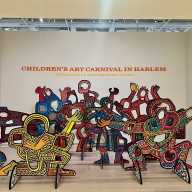
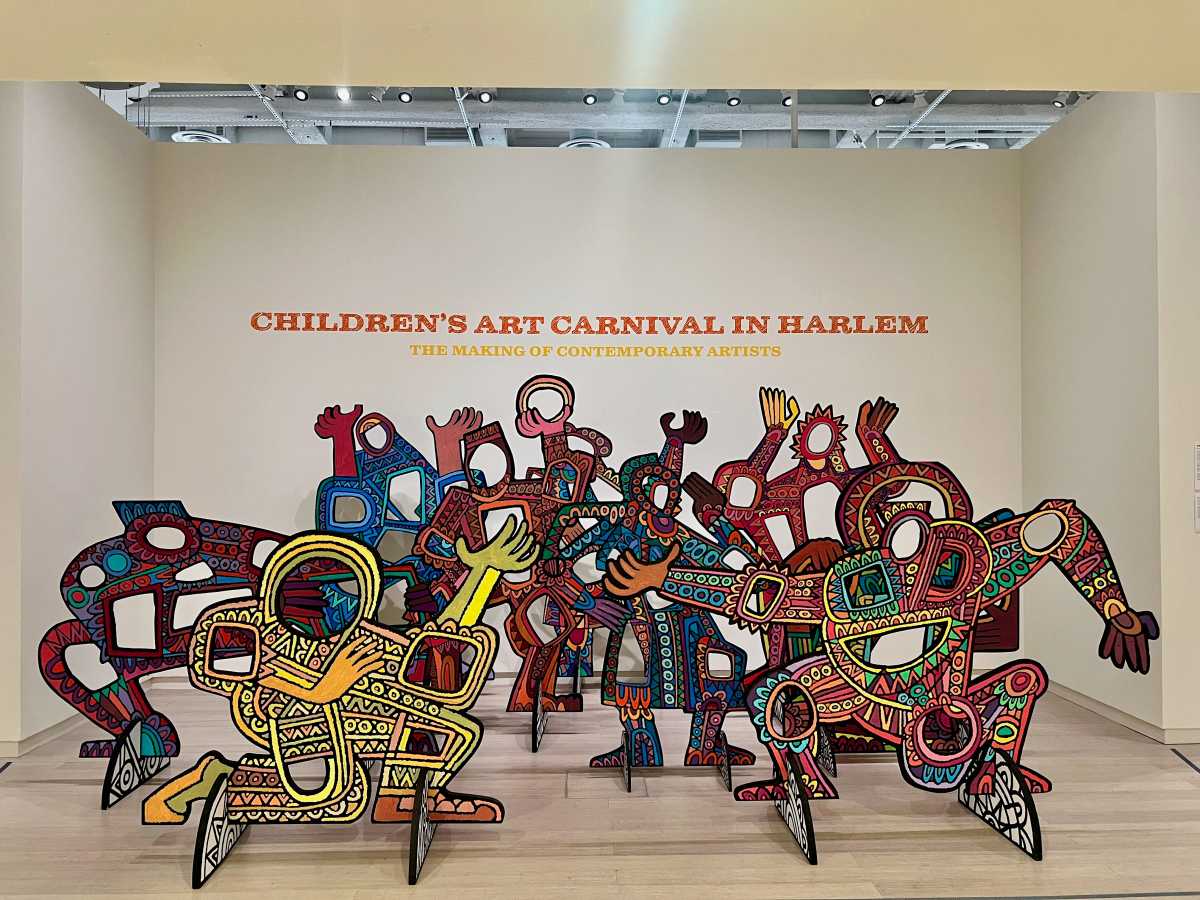
At the gallery’s entrance, you are greeted by an animated crowd of child-size, human-like figures with dazzlingly multicolored motifs all over them. This is Emmett Wigglesworth’s installation of painted sculptures, titled, “It Is Not Enough to See, One Must See Through to Find Truth.” The designs draw from traditional murals and textiles historically related to particular regions and ethnic groups in Africa, most commonly-recognized among them Ghanaian Kente cloth. The figures dance and gesticulate with the whimsy of childhood. Wigglesworth, an instructor at the Carnival for roughly 30 years beginning at its inception, was known to students and fellow teachers as “Brother Emmett.” His figures give quite a spectacular introduction to the exhibition.
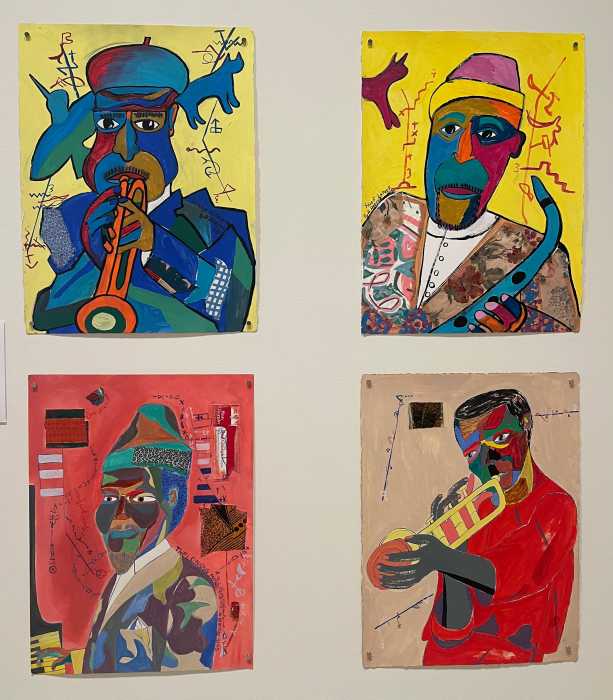
Armando Alleyne interned at the Carnival alongside Basquiat. He blossomed into a painter creating brightly-hued portraits of African American and Afro-Latin cultural icons, musical giants, and his own family members and friends. He is represented in the exhibition by his quartet of paintings of the jazz greats Miles Davis, Dizzy Gillespie, Yusef Lateef, and Thelonius Monk.
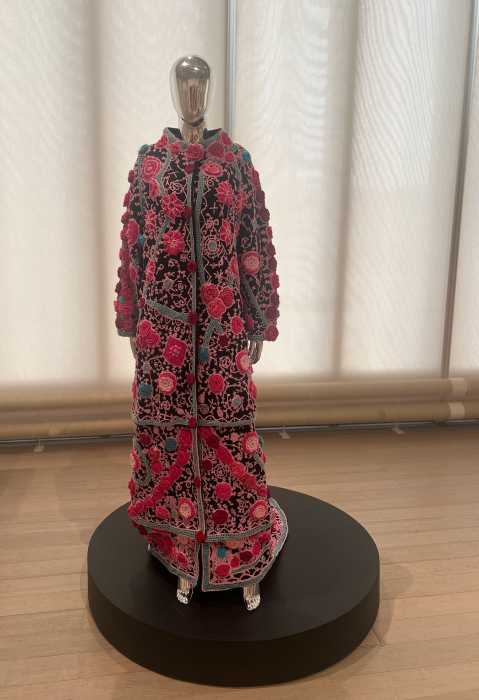
The community the Carnival fosters has brought in many figures prominent in the Black Arts Movement and other collectives of the 1970s and ‘80s, their visits inspirational to resident artists. Such is the case with the work of Milagros Batista. From a chance meeting with the iconic model Sikolo Brathwaite, whose Afrocentric style in photographs by husband Kwame Braithwaite made her the face of the slogan, “Black is Beautiful,” Batista created the wearable art piece, “Sikolo the Beautiful,” a richly embroidered upcycled coat.
The show reflects the Carnival’s appreciation and inclusion of a diversity of communities. Japan-born, Harlem-based artist Tomo Mori, a current affiliate, presents her giant, hanging installation, “Eve-Mother of Collaboration,” a depiction of the female pelvis constructed of community-sourced fabrics and wire. Asian-American artist Tomie Arai, who taught at the Carnival from 1986 to ’87, became intrigued by the history of Chinese migration to the Caribbean and Latin America in the 19th and early 20th centuries. She interviewed families with such background who had immigrated to the United States from Cuba, the Dominican Republic, Haiti, Jamaica, Trinidad, and Peru. The resulting artwork, “Stories from La Colonia China,” is comprised of ten identical wooden panels jutting out of the wall, each of which features an interview quote on one side and an archival family photograph on the other.
Friendships and interests formed between Carnival members is the theme of textile artist Michael A. Cummings’ “Sana Goes to Japan,” an homage to his fellow instructor, Sana Musasama, whose own work is also featured. The two taught together in the 1970s. In Cummings’ piece, an appliqued quilt of a woman, Musasama, is dressed in a kimono, hair festooned, holding a piece of her handmade ceramic work.
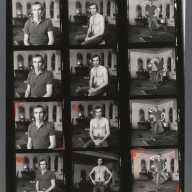
Continuing in the spirit of collaboration, Hamilton Heights Darkroom is a collective based at CAC that cooperates with the Carnival in a series of workshops. Members learn and practice traditional photography. Selections of the work of teachers and students on display span several decades, beautifully showing the changing urban landscape of New York City.
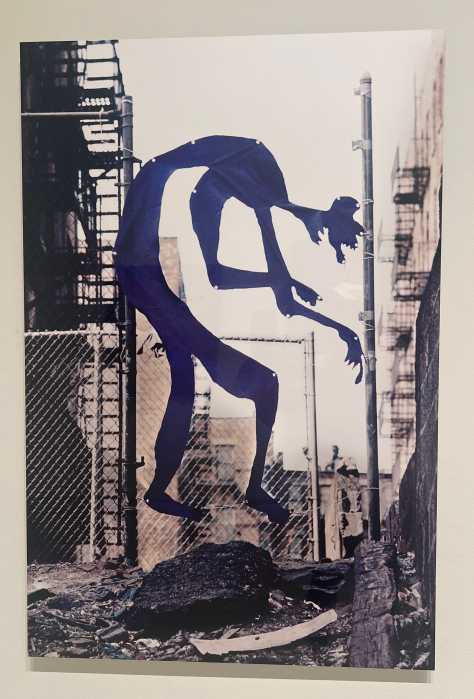
New York, more specifically Harlem, being the home of the Carnival, the city has served as setting and muse for a number of works. During artist Senga Nengudi’s years living in East Harlem from 1971 to 1974, she created her “Spirit Flags” series, photographs set in her neighborhood where she adhered elongated ghostlike forms representative of the unhoused.
This exhibition presents the myriad ways in which the Children’s Art Carnival has created a home for artists, established and emerging alike.
Children’s Art Carnival in Harlem: The Making of Contemporary Artists| Wallach Art Gallery | Until Sept. 13, 2026
Nicholas Boston, Ph.D., is a professor of media sociology at Lehman College of the City University of New York (CUNY). Follow him on Twitter @DrNickBoston and Instagram @Nick_Boston_in_New York