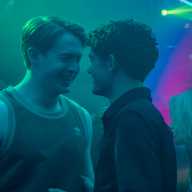
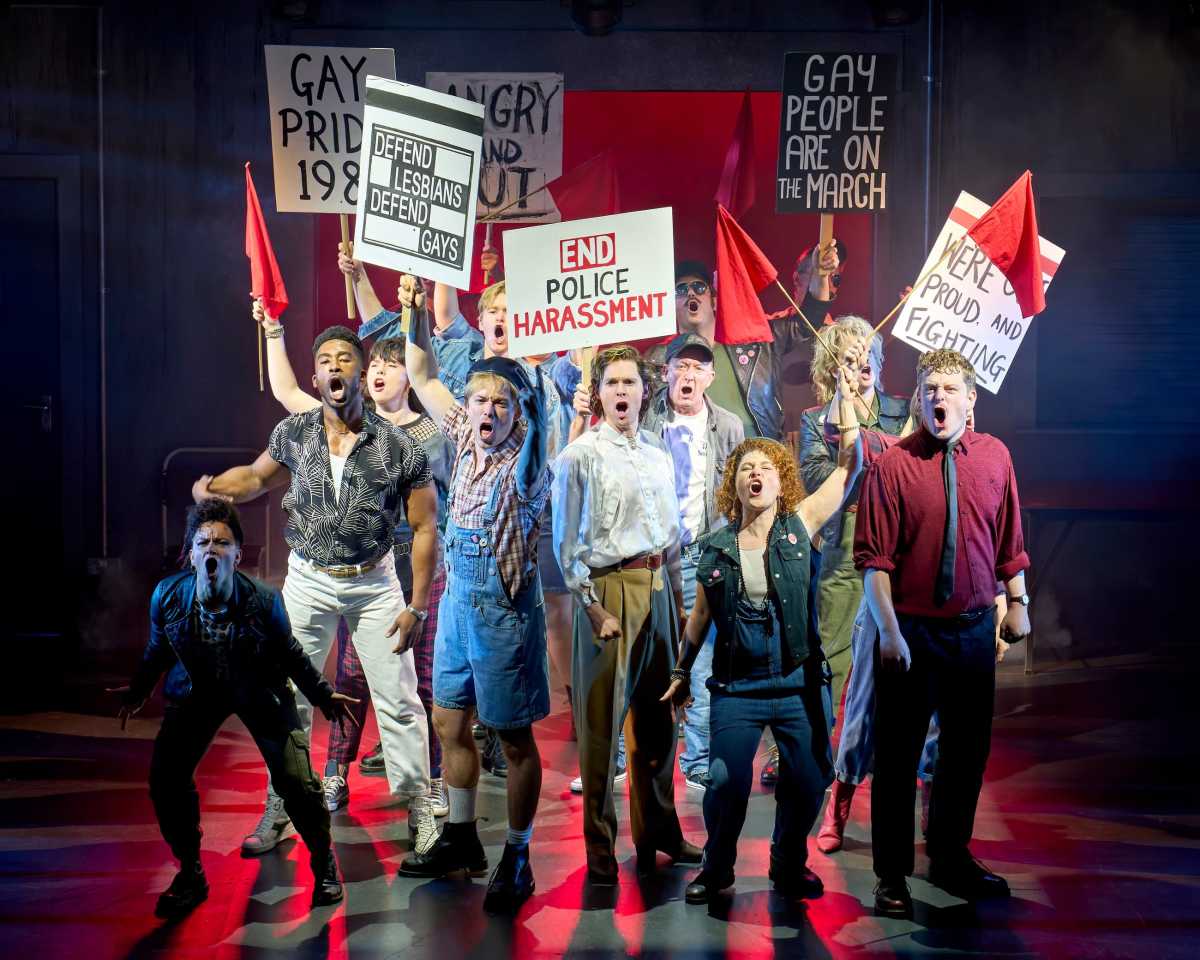
“Pride,” the 2014 film based on the true story of gay activists in London in 1984 raising money for striking miners in Wales, is an almost perfect film — not only with great heart and a serious message about cooperation across disparate cultures, but graced with such stars as Imelda Stanton, Bill Nighy, Andrew Scott, Paddy Considine, and Dominic West, as well as young actors such as George MacKay and Ben Schnetzer, who went on to much greater heights. I worried that a musical version couldn’t enhance the story, but in the hands of Matthew Warchus, who directed the film, “Pride” sings anew with a less famous (except for Samuel Barnett as Jonathan) but well-cast company.
I looked at the audience of mostly gray heads at the matinee at the National Theatre’s small Dorfman house and wondered if they would “get” this story, but then realized 1984 is when we were all young and fighting injustice. The patrons were all in. Mark Ashton (Jhon Lumsden), the leader of Lesbians and Gays Support the Miners, would be 65 today had he not died of AIDS in 1987 shortly after the events of this show. And Jonathan Blake (Barnett) had already been diagnosed with HIV in 1984 and miraculously still lives.
This show, with stirring as well as funny songs, is just as moving as the movie. It deftly integrates the immediate concern of the gay community with the burgeoning AIDS crisis with the need for solidarity with other oppressed groups — which miners surely were under Margaret Thatcher’s reactionary rule.
Solidarity between labor and the gay movement was not uncommon more than 40 years ago at a time when ours was not a professionalized and well-funded movement. New York’s 50-group Coalition for Lesbian and Gay Rights had several major unions as members in our campaign to pass the city gay rights bill in the ‘80s — and they had our support when they went on strike or needed help passing pro-worker legislation.
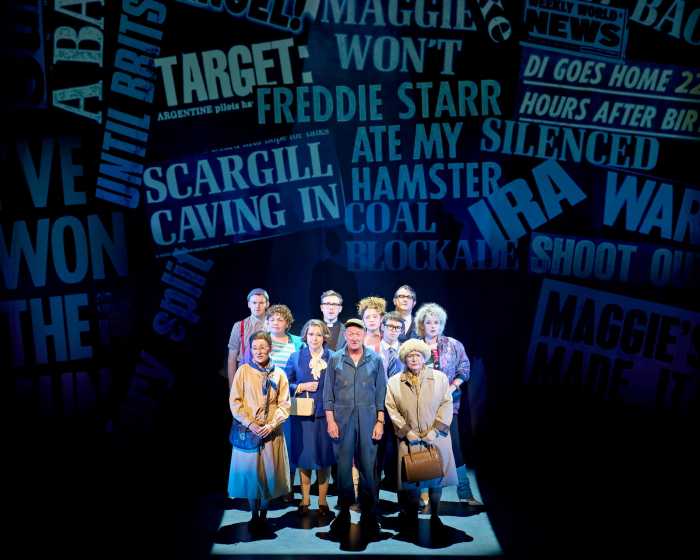
With rave reviews, “Pride” deserves a transfer to the West End and Broadway, though there are no immediate plans to do so. It might be even more valuable as a staple of regional theater playing in parts of our countries that have been hit hard by downsizing and corporate greed.
Footnote: when the Durham in the UK under Nigel Farage’s far right “Reform” Party town council recently defunded the local LGBTQ pride parade, the miners unions came through with funding for it — an alliance that has lasted more than 40 years.
(The National Theatre has also mounted an exhibit of historic LGBTQ photographs, “Queer Britain,” on loan from the small museum of the same name. Free on the 2nd floor of the Lyttleton Theatre through September.)
That old war horse, “War Horse,” is riding again at the National’s Olivier Theatre almost 20 years after it was an improbable hit in London and New York. Directed by Marianne Elliott and Tom Morris — an adaptation of Michael Morpurgo’s novel by Nick Stafford, with horses brought to vivid life by the Handspring Puppet Company — this tale of horses in World War I has lost none of its power to move us.
The emotional heart of the story is the love of young Albert Norrocott (Tom Sturgess) for a foal named Joey, who he nurtures into adulthood only to see Joey sold off to the Army by his abusive father (Stephen Beckett). Albert enlists and vows to bring back Joey and therein lies the tale.
Steven Spielberg made a decent movie out of this story in 2011, but nothing matches the theatrical magic created by this fine ensemble, especially the puppeteers. They fill the Olivier Theatre with heart. (Through July 30.)
Sandra Oh shines (and curses and carries on) as the lead in “The Misanthrope” by Martin Crimp after Molière at the National’s Lyttleton Theatre. She’s an uncompromising, controversial, award-winning novelist named Alice — roughly fashioned on the Alceste role that Molière himself played in his 17th century play.
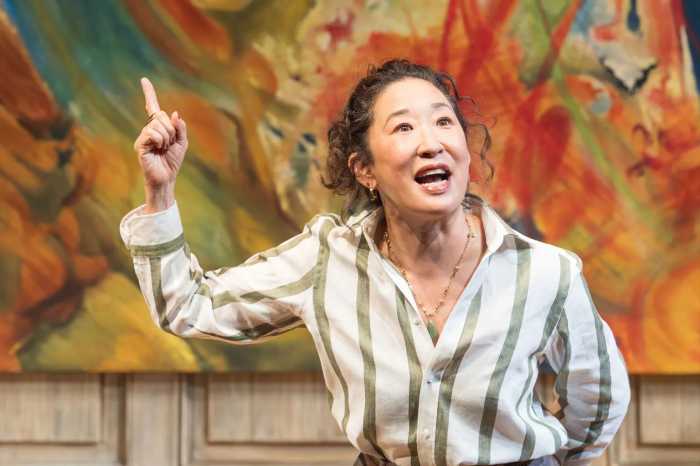
While Alice presents herself as someone who is upholding standards of taste and honesty against a world of fakers, there’s not much to admire in her as she berates her gay best friend John (Paul Chahidi) just for trying to be polite to a woman he can’t remember who is complimenting him.
Directed by Indhu Rubasingham, the artistic director of the National, there’s humor aplenty as the ways of the artistic class are mocked, but there is no one really to root for. Molière took his life into his hands satirizing the aristocrats of his day at a time when going too far could easily lead to the death penalty or at least financial ruin. The stakes are no longer as high, much as our present-day hypocrisies need puncturing. (Through Aug. 1 and in US cinemas thru NT Live <ntlive.com> on Sept. 27.)
Simon Stone reaches further back (5th century BC) for material in his new version of “The Oresteia” (after Aeschylus and “others”) at the Bridge Theatre (through Sept. 19). It stars two of my favorite actors — Mary-Louise Parker as Montie and David Morrissey as her husband Christopher — very roughly modeled on Clytemnestra and Agamemnon in an upper middle class family setting literally viewed almost entirely behind glass (Lizzie Chalcan’s rotating modern house in the country).
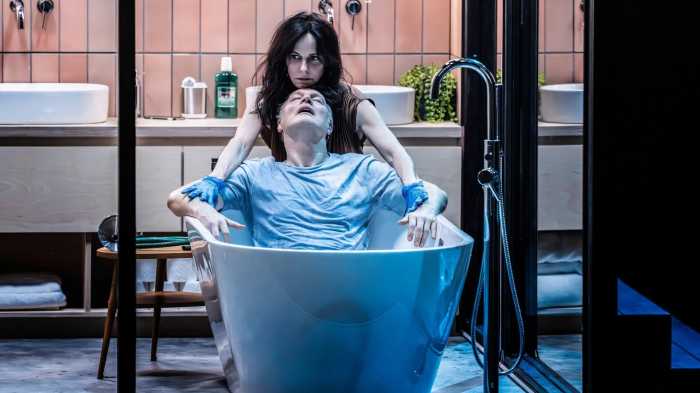
This choice of presentation puts this tale of family betrayal at a remove from the audience in a genre — live theater — that ought to put us in first class. Cannot fault the acting of the leads or the rest of the cast, but once again there’s no one to root for. It’s almost entirely about people being unspeakably ugly to each other. The bodies do pile up as the lust for revenge is satisfied, but while Aeschylus was writing about mythic figures, Stone’s are earthbound and have feet of clay.
This production has gotten some five-star reviews and the opening night audience laughed heartily at the insults (particularly from Montie), but was anyone moved by this intergenerational group of killers?
GONE BUT NOT FORGOTTEN
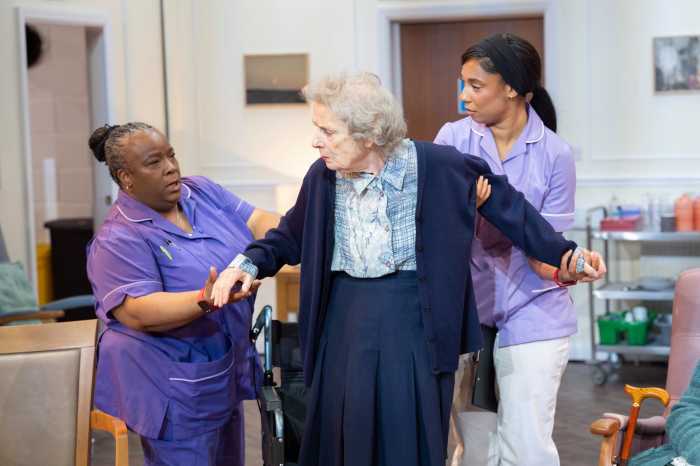
Alexander Zeldin is the master of holding an audience’s attention on forgotten people and finding the drama in quiet lives of desperation. He did it in “Love” for asylum seekers and now at the Young Vic in “Care” for people in nursing homes, led by a transcendent Linda Bassett (“Call the Midwife’), taking her from anxious new admission to what is the end for almost everyone in care. She is backed by a supporting cast that gives painfully spot-on performances. (I speak as someone who has been a regular visitor to friends and loved ones in these homes for half a century.) The nurses (Llewella Gideon Aoife Gaston) are portrayed in all their compassion and exhaustion. Yet the overall effect is uplifting. St. Ann’s Warehouse in Brooklyn took in “Love.” Let’s hope they take “Care.”
David Hare’s new “Grace Pervades” (just closed at the Theatre Royal Haymarket) starred Ralph Fiennes and Miranda Raison as the leading actors of the 19th century, Henry Irving and Ellen Terry. It’s an illuminating meditation on the art of acting, a profession these two raised exponentially in esteem — suffering greatly in the process. Might be “too English” for a transfer to New York, but if Fiennes wanted to keep doing it then it could happen.
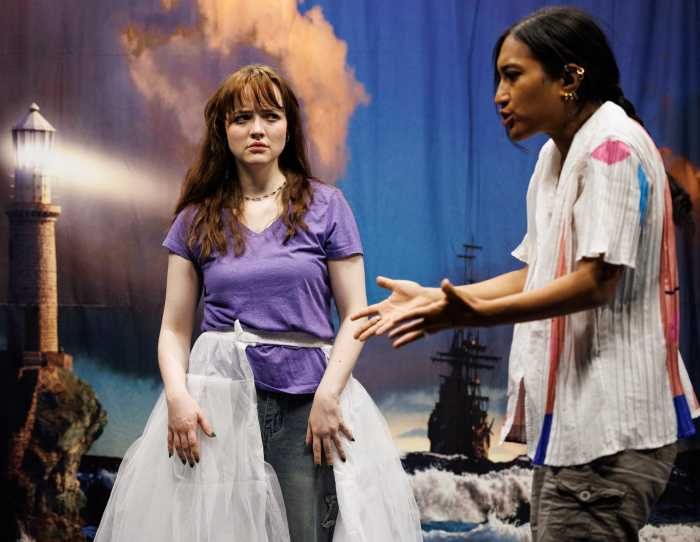
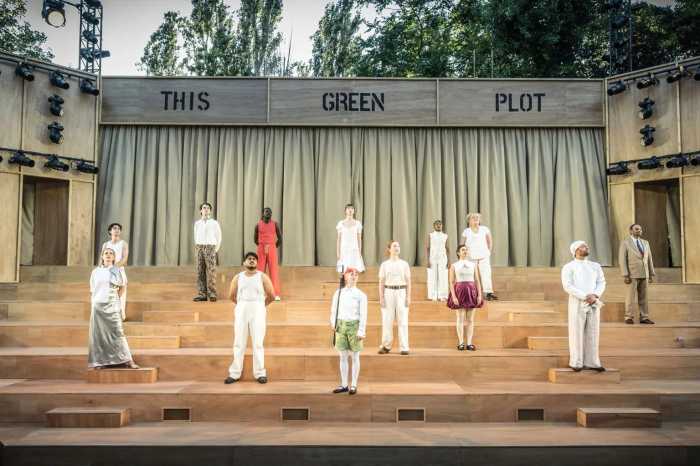
The Open Air Theatre in Regent’s Park first did “A Midsummer Night’s Dream” in their second season in 1933 — a show that begs to be done under the stars and the old-growth trees swaying in the breeze. It should be easy to make it magical, but this production, directed by Artri Banarjee, loses a lot of fairy dust with a bare plywood set stamped “THIS GREEN PLOT” in a failed attempt at humor. It had some interesting innovations: deaf actor Nadeem Islam was a loud, engaging, and animated Puck and trans Molly Malone played the forlorn (until she’s not) Helena. But while the rude mechanicals can and should be dressed down and played low, portraying the Duke of Athens and Queen of the Amazons — no less the King and Queen of the Fairies — that way in modern dress robs the play of much of its enchantment.
While I’m a fan of the King’s Head Theatre in Islington, famous for its LGBTQ-themed shows, I resisted “Here Comes J. Edgar! A Comedy Musical” (to Aug. 16) because it was written by non-gays Harry Shearer (“The Simpsons) and Tom Leopold (“Seinfeld”),” fearing it would just be one long joke about the notorious FBI Director being homosexual and traffic in stereotypes.
I went after it got four-star reviews but many of my fears were confirmed. Out gay Bryan Batt (a star of “Mad Men”) plays Hoover and does very well as a singer and dancer — as does the rest of the spirited ensemble, especially Hugo Bolton as Hoover’s top aide and lover, Clyde Tolson, and his man-eating secretary, Helen (Laura Medforth). But Batt’s portrayal is nothing like the gruff, taciturn Hoover. (I kept thinking it might have been funny in the hands of someone like a young Robert Duvall, an actually gruff right-winger.)
The audience was easily amused and laughed heartily at the escapades as the show trips through Hoover’s life, career, and manifold sins though they pull some punches. Yes, it shows how he blackmailed Presidents (FDR, Ike, JFK, and LBJ are featured here) and others to keep him in perpetual power and how he tried to destroy Martin Luther King, Jr. with recordings of King’s sexcapades. But in the spirit of keeping things light, we’re never confronted with the deep ugliness of Hoover’s racism—such as his nickname for Dr. King (“Martin Lucifer Coon”).
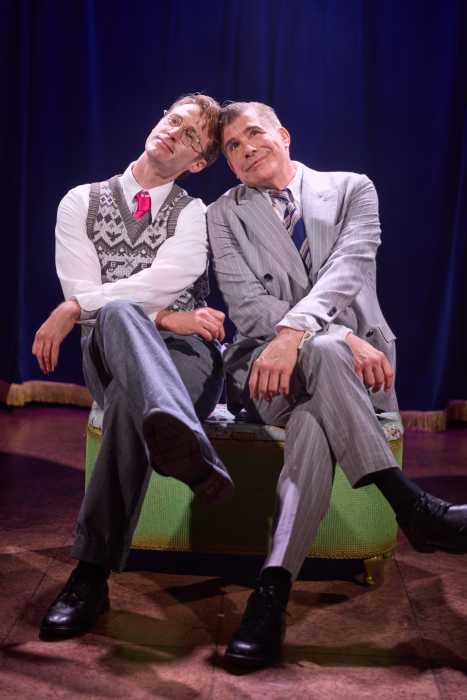
There is resonance here with our present fascist regime in Hoover’s crackdowns on dissent—especially Communists—and affection for mob bosses. His collaboration with right-wing columnist and radio personality Walter Winchell (Marc Elliott who is spot on) is well done.
But the show gives full credence to a disputed aspect of Hoover’s sexuality—the assertion of Susan Rosenstiel that she saw him in drag and called himself “Mary” at a private party at a room the Plaza Hotel in 1958. As delicious as the tale is, she is the sole source for it and notoriously unreliable. But J. Edgar’s love of drag gets a big number here. And much as I hate everything Hoover stood for, that he might have liked to cross-dress would be a redemption he does not deserve.
I’d love to see what Cole Escola could do with this story—or any story for that matter.
COMING UP OF NOTE IN THE WEST END:
- At the National Theatre: Cate Blanchett in “Electra/Persona” at the Lyttleton, Aug. 19 – Oct. 10. “The Story” by Tracey Scott Wilson at the Olivier, Aug. 27 – Oct. 24. Anne-Marie Duff in “Some Woman” at the Dorfman, Oct. 7 – Nov. 21. Caryl Churchill’s “Cloud 9” at the Lyttleton, Nov. 2 – Jan 13. And the new holiday show at the Olivier is “The Jungle Book,” directed by Indhu Rubasingham, Nov. 13 – Feb. 6. More info at nationaltheatre.co.uk and check out which productions past and present will be shown on cinemas worldwide at netlive.com.
- Sophie Okonedo in “A Month in the Country” by Brian Friel after Ivan Turgenev at the Donmar Warehouse, Aug. 22 – Oct. 3.
- Christine Baranski and Richard E. Grant in Noël Coward’s “Hay Fever” at Wyndham’s, Sept. 22 – Dec. 12.
- Kristin Scott Thomas and Stephen Mangan in Chekhov’s “The Cherry Orchard” adapted by Conor McPherson and directed by Ian Rickson.
- Billy Crudup and Gillian Anderson in Albee’s “Who’s Afraid of Virginia Woolf” at Soho Place from Oct. 14 – Dec. 19.
- Two at the Young Vic: a new musical of “Thelma and Louise,” Sept. 3 – Oct. 24 and “Eurotrash” starring Ben Whishaw, Nov. 13 – Jan. 9.
For more listings, go to londontheatre.co.uk
MUSEUMS AND HISTORIC SITES:
The National Portrait Gallery’s massive exhibition, “Marilyn Monroe: A Portrait,” runs through Sept. 6 and is well worth the price of admission. She was photographed by all the greats, from Cecil Beaton and Eve Arnold to Alfred Eisenstaedt and Richard Avedon — all well represented here and made even more iconic by artists like Andy Warhol after her death. Her image has been ubiquitous since the mid-20th century, but this show puts her story in the context of her tumultuous life as a model and screen goddess and actress struggling to be taken seriously and, the evidence is plain, succeeding.
The Tate Britain has mounted “James McNeill Whistler,” the largest exhibit of his work in Europe for 30 years. He was born in Massachusetts in 1834 and raised in St. Petersburg, Russia, where his father oversaw the building of that country’s first railroad for Tsar Nicholas I, only to have to return to the states on his father’s death and enroll in West Point, where he was dismissed by none other than Col. Robert E. Lee for too many demerits. But his devotion to drawing and art was already well established by then, and it is art — “for art’s sake,” he would say — that he pursued through thick and thin living throughout Europe, including France, England, and the Netherlands, creating iconic paintings (such as Whistler’s Mother or, more formally, “Arrangement in Grey and Black, No. 1,” and cultivating a rakish self-image with self-portraits.
Many of his “nocturne” paintings are featured here. He tested the limits of how nature could be depicted in art. “Nature is very rarely right,” he once proclaimed, “and usually wrong.” He found beauty in how the artist can transform it. “Seldom does nature succeed in producing. A picture.” He befriended Oscar Wilde — and later had a falling out with him over how they perceived each other’s art. (One of his contentious late-in-life lectures about art is enacted in a short video by actor Anton Lesser.)
Made my first visit to Kensington Palace, the current home of Prince William and Princess Catherine and former home of Prince Charles and Princess Diana — and toured the rooms (filled with great art) where dwelt King William III and Queen Mary II, King George II and Queen Caroline, and Queen Anne and where Queen Victoria was born and raised. But they’re running a special exhibit on “The Last Princesses of Punjab,” centered on Sophia Duleep Singh (1876-1948) whose father had lost the Sikh Empire (to the East India Co.!) and who became a godchild of Victoria, enjoying her patronage — and a major suffragist. Her sister, Princess Catherine, was also a suffragist who lived her adult life with Lina Schäfer, a German national. It’s a fascinating neglected history of colonialism, feminism, and, it emerges, lesbianism in the early 20th century. Remarkable to encounter it in a British palace.