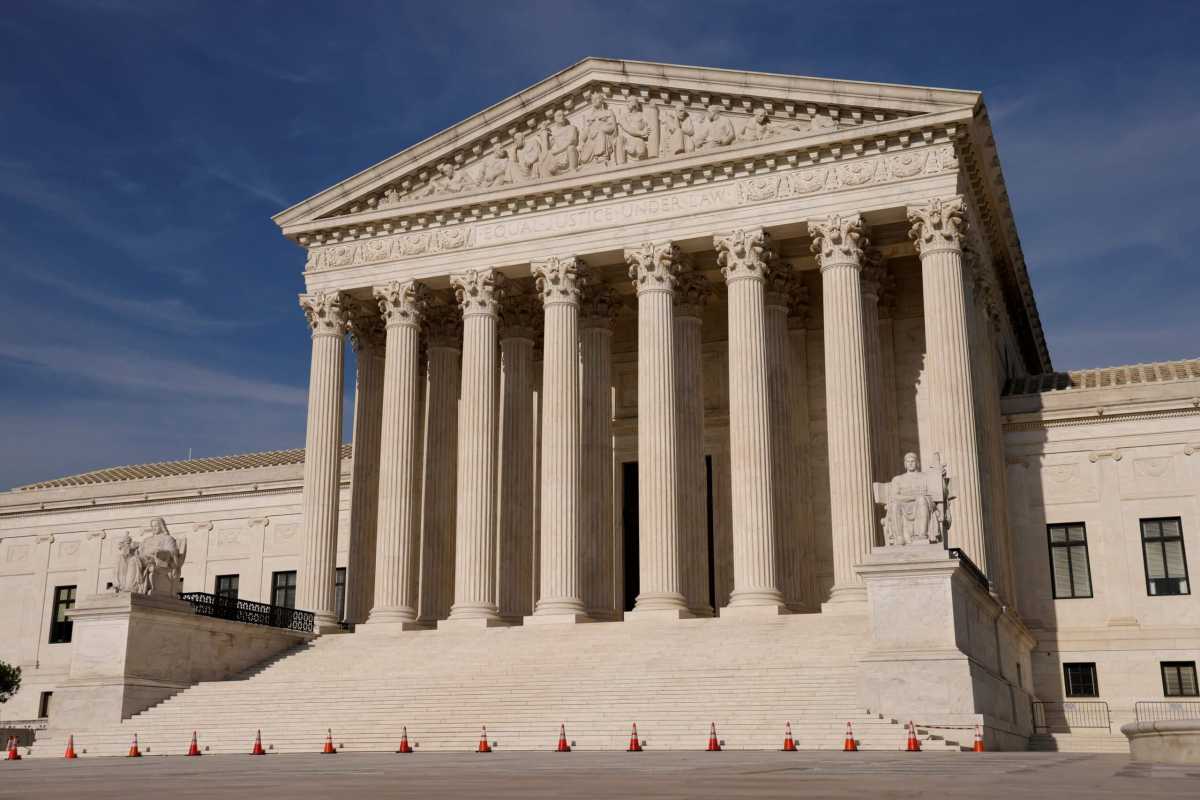
The US Supreme Court unanimously ruled on June 17 that the City of Philadelphia violated the constitutional right to free exercise of religion of Catholic Social Services (CSS) when the city refused to renew the agency’s contract to evaluate and certify prospective foster parents because the agency categorically would not provide this service for married same-sex couples. But the court declined the invitation by CSS and numerous religious freedom groups to create a general religious exemption from complying with neutral state laws of general application, emphasizing the narrowness of this decision, which turned on specific language in the contract between the city and CSS.
Chief Justice John R. Roberts, Jr., wrote the opinion for the court, joined by Justices Stephen Breyer, Sonia Sotomayor, Elena Kagan, Brett Kavanaugh, and Amy Coney Barrett. Justice Barrett also wrote a concurring opinion, joined by Justice Kavanaugh and, in part, by Justice Breyer. Justice Samuel Alito wrote a concurring opinion, joined by Justices Clarence Thomas and Neil Gorsuch, and Justice Gorsuch wrote a concurring opinion, joined by Justices Thomas and Alito.
A battle within the court over whether to overrule its 1990 decision in Employment Division v. Smith probably explains why a case argued so early in the term (November 4, 2020) was not decided until June 17, even though the bottom line result was unanimous. Chief Justice Roberts figured out how to rule for CSS without overruling that Employment Division, while at least three members of the court were so eager to overrule it that they produced two concurring opinions totaling almost 90 pages arguing that the court should have taken that step. By contrast, Roberts’ opinion for the court was only 15 pages.
The court avoided deciding some of the most hotly contested issues in the case. It found that Philadelphia’s Fair Practices Ordinance, which forbids sexual orientation discrimination by public accommodations, was irrelevant to this case, because — disagreeing with the federal district court and the court of appeals on this point — the Supreme Court agreed with CSS that it is not a public accommodation, based on a close reading of the statutory language. The court also discussed Pennsylvania’s anti-discrimination statute, which it found similarly would not apply to CSS, but this discussion was not strictly necessary, since the state law does not list sexual orientation as a prohibited ground of discrimination.
The court concluded, based on its reading of the anti-discrimination provisions in the city’s contract with CSS, that the contractual requirement not to discriminate based on sexual orientation was not a rule of “general application” because one of the provisions reserves to the commissioner of the Department of Human Services the “sole discretion” to grant exceptions to its anti-discrimination requirement, thus rendering the precedent of Employment Division irrelevant to this case as well.
Under Employment Division, a law that does not directly target religious practices or beliefs (that are “neutral” with respect to religion) and that applies across the board — (is of “general application”) — must be complied with even if it incidentally burdens some religious practices. However, a law that was specifically passed to prevent a particular religious practice, or that is applied only selectively at the discretion of government officials, would not come within the Employment Division precedent. In the famous Masterpiece Cakeshop case, for example, involving the baker who refused to make a wedding cake for a gay couple, although the court reiterated the general rule from Employment Division, it found that the proceedings before the Colorado Civil Rights Commission were tainted by overt anti-religious bias expressed by some of the commissioners who were ruling on the complaint against the baker, and thus the “neutrality” requirement of Employment Division was not met.
In this case, under the terms of the city contract, the commissioner retained discretion to grant exceptions to the anti-discrimination requirement. Because the provision “incorporates a system of individual exemptions,” wrote Roberts, “made available in this case at the ‘sole discretion’ of the Commissioner,” the city “may not refuse to extend that [exemption] system to cases of ‘religious hardship’ without compelling reason,” quoting language directly from Employment Division, in which Justice Antonin Scalia had described the limit of the court’s holding in that case.
The bottom line for Chief Justice Roberts was that this case fell cleanly within other recent free exercise decisions by the court, calling for “strictest scrutiny” of the city’s argument as to why it had a “compelling interest” to refuse to make an exception for CSS so that it could continue to carry on the mission of caring for orphans dating back to the yellow fever epidemic of 1798. Finding the city’s articulated interests to be “insufficient” to withstand such scrutiny, the court sent the case back to the lower courts “for further proceedings consistent with this opinion,” a rather unhelpful formulation according to Justice Gorsuch’s concurring opinion, contending that this dispute could remain in litigation for years.
The case arose in 2018 when a Philadelphia newspaper reported that only two of the more than two dozen foster care agencies contracting with the city to evaluate potential foster parents were refusing to deal with married same-sex couples: CSS, and one Protestant agency that eventually capitulated to the city’s non-discrimination demand. CSS stood firm on its religious objection to same-sex marriages, and the city responded by stopping referrals of children needing foster placement to CSS and allowing its annual contract to lapse when CSS refused to sign a new contract with the anti-discrimination language. CSS is still involved in foster care activities using charitable funds, but it cannot evaluate and certify prospective foster parents without the city contract and it has lost vital revenue from the city as a result.
Some of CSS’s foster parents and the agency itself collaborated on this lawsuit, seeking a preliminary injunction from the US District Court in Philadelphia, which the judge denied. The denial was upheld by the Third Circuit Court of Appeals. Those courts found that CSS was a public accommodation subject to the requirement under Philadelphia’s ordinance not to discriminate because of sexual orientation. The courts concluded that this was a religiously neutral rule of general application, so under Employment Division v. Smith, CSS was unlikely to prevail on its claim that the city was violating its First Amendment rights.
The lower courts also rejected CSS’s argument that requiring it to certify same-sex married couples was a form of unconstitutional compelled speech. The courts found that because the speech involved applying standards prescribed by a state statute, it was government speech rather than CSS’s own speech. The Supreme Court did not address this argument on the appeal, as it resolved the case in favor of CSS on its religious freedom argument.
CSS petitioned the Supreme Court for review, asking that it decide the First Amendment issues and that it overrule Employment Division v. Smith, a decision that overturned more than 40 years of First Amendment precedents and was so controversial when it was issued that Congress twice voted to overrule it, resulting in the Religious Freedom Restoration Act and many similar state laws seeking to restrict government actions that burden religious practices.
Chief Justice Roberts produced the narrowest rationale possible for ruling in favor of CSS, essentially finding, contrary to the lower courts, that CSS is not a public accommodation within the meaning of Philadelphia’s ordinance, and that because the contract used by the city to deal with foster care agencies reserved to the Commissioner the sole discretion to make exceptions to its non-discrimination requirement, that requirement could not be seen as a law of “general application.” Under Employment Division, people and institutions do not have a free exercise right to refuse to comply with religiously-neutral laws of general application. Given Roberts’ conclusion about the “exception” provision, he found that Employment Division v. Smith just did not apply to this case.
In the absence of the Employment Division precedent, the court recurred to traditional free exercise tests, asking whether the city had a compelling interest to refuse to make an exception to its anti-discrimination rule so that CSS could continue the Church’s centuries-old tradition of providing services to orphans. That there are numerous other foster care agencies in Philadelphia that welcome same-sex couples as potential foster parents, and that in the past same-sex married couples have not even applied to CSS for services, undoubtedly factored in to the ruling. It certainly played a key role in the oral argument before the court last November.
By avoiding the most difficult constitutional and statutory questions, Roberts was able to get five co-signers, including all the “liberals” and two Trump appointees, Kavanaugh and Barrett. But this result caused consternation to those justices who were chomping at the bit to overrule Employment Division, led by Justice Alito, who issued a 77-page concurring opinion going on at tiresome length about how terrible that decision was and why it was imperative that the court discard it. Justice Gorsuch agreed, but in a much shorter concurring opinion that focused on picking apart Roberts’ evasion strategy in a most entertaining fashion. Justice Barrett, in her own brief concurrence joined by Justice Kavanaugh and, in part, by Justice Breyer, agreed that Employment Division is troublesome, but also agreed, as indicated by her signing the Chief Justice’s opinion, that it did not have to be reversed to reach the correct result in this case. Either way, with or without Employment Division standing as a precedent, strict scrutiny applied to this case, and even the “liberal” Justices agreed that Philadelphia’s action in this case could not survive strict scrutiny.
However, although the reality is taxpayers in Philadelphia may end up paying a Catholic agency to provide a service from which married same-sex couples are excluded, the victory for “religious freedom” is mixed. Employment Division still stands as a precedent. And the City of Philadelphia may escape this holding by revising its foster care contracts to remove the discretion of the commissioner to waive the anti-discrimination provisions. But that is easier said than done, because there is an important waiver that allows foster care agencies to take account of race and other characteristics in making placement decisions for foster children.
Justice Gorsuch’s concurrence emphasized that the court’s failure to confront Employment Division has costs that “fall on the lower courts.” “As recent cases involving COVID-19 regulations highlight, judges across the country continue to struggle to understand and apply” that decision, “even 30 years after it was announced,” Gorsuch wrote. He concluded: “We owe it to the parties, to religious believers, and to our colleagues on the lowers courts to cure the problem this court created.”