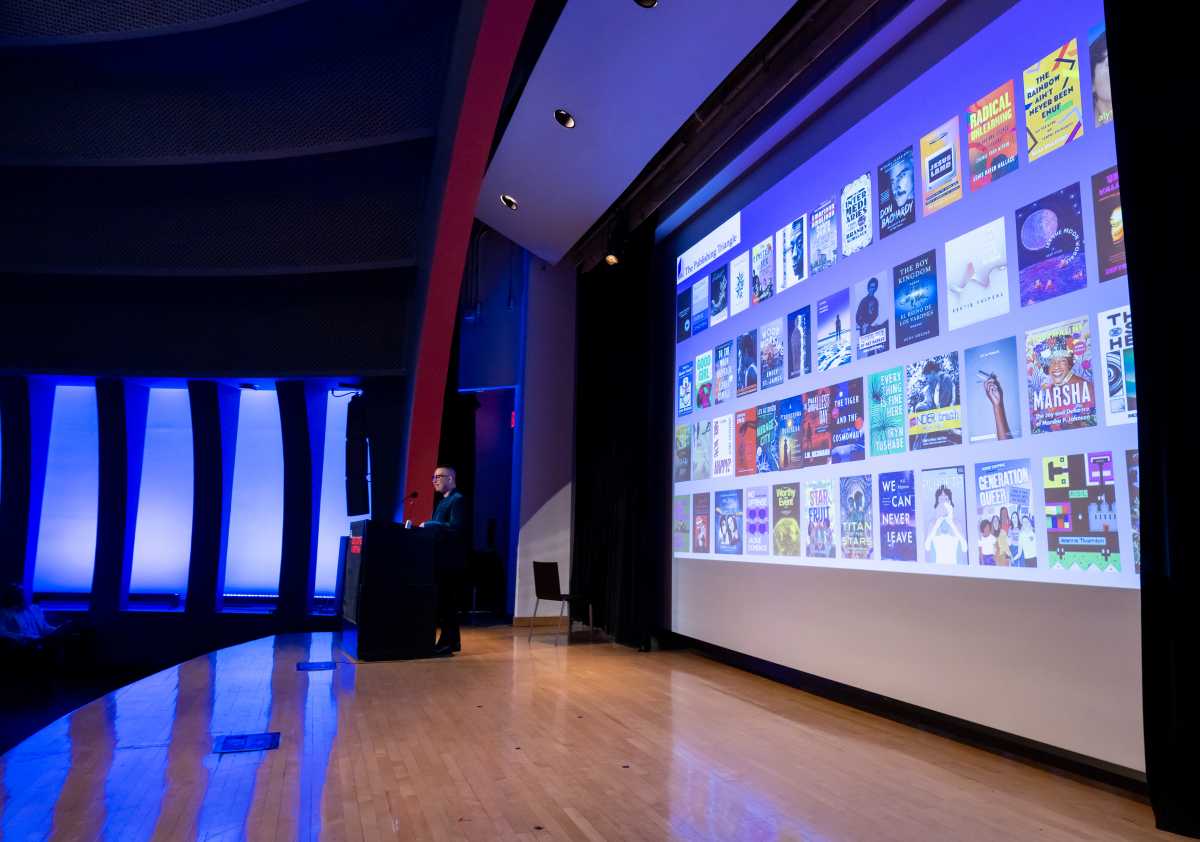
“This is community,” poet and host Emanuel Xavier declared at the Publishing Triangle’s 38th annual awards ceremony April 16 at the New School to honor LGBTQ books, their authors, and community leaders. “The fight is real. We are being targeted again and again, but we are not going anywhere. Every book is an act of resistance.”
With defiant joy, the presenters and winners spoke about what they see around them, and how important it is to hold space for community and to keep writing and speaking out. Each of the recipients of an award receives a cash prize.
“Even revolutionaries deserve a little cash,” presenter Karen Finley remarked.
Playwright/actor/legend Charles Busch led off the evening, giving the Torchbearer Award to The Other Side of Silence (TOSOS) Theater, New York’s longest running LGBTQ professional theater, in its 51st year.
“[TOSOS founder] Doric Wilson was one of the most fascinating, outrageous people I ever met. His activism informed his playwriting.” Busch said he used to see Wilson striding down streets in the Village, in full leather, red hair blazing, and “I was afraid he’d tie me up and give me acting notes.”
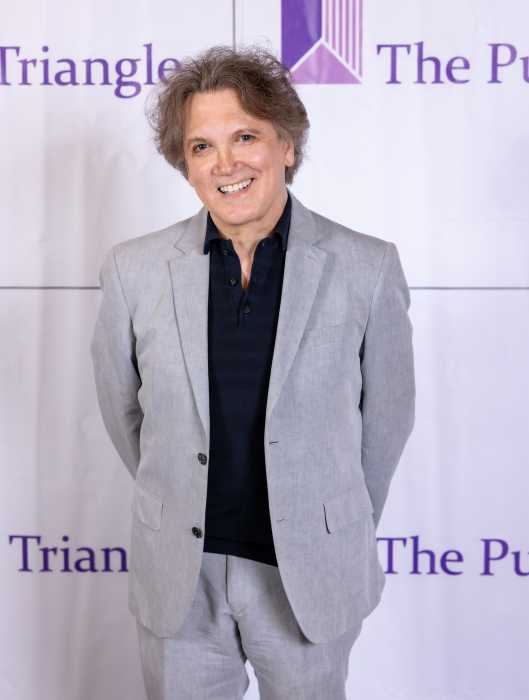
TOSOS artistic director Mark Finley accepted the award and spoke of his friend and the company’s founder as “a leader of a movement or a crusade. He inspired and led us with necessary work, holding our place and lighting the way in really bad times.”
Next, the Triangle presented an award for Community Legacy Recognition to the founders of the Bureau of General Services-Queer Division bookstore, Greg Newton and Donnie Jochum, who received the evening’s first standing ovation.
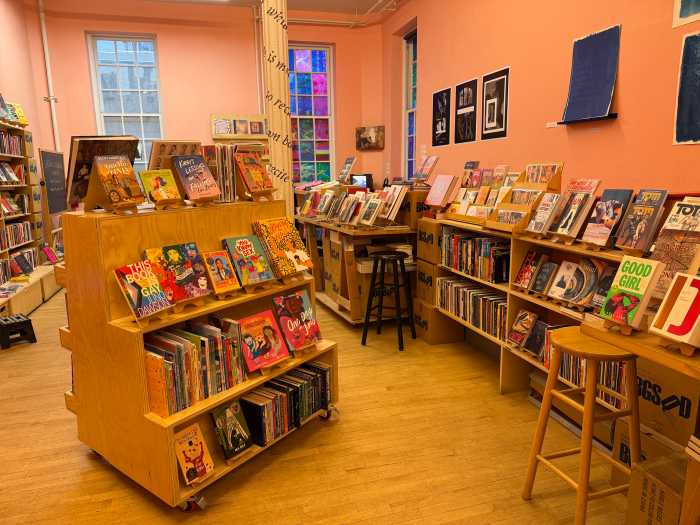
The founders recently announced that they are leaving New York, and Jules Wernersbach, novelist and owner of Brooklyn’s Hive Mind Books set up a funding campaign to keep “Manhattan’s last queer bookstore” open. The campaign has already reached its initial goal, and Hive Mind will keep operating BGS-Queer Division at The Center.
Patricia Spears Jones, poet laureate of NY State in 2023, ascended the stage to present the Audre Lorde Award for Lesbian Poetry. “The Boy Kingdom/El reino de los varones,” by Achy Obejas, took top honors. In a video message, Obejas said the book “has a lot to do: exploring legacy, history, the ex-wife who crushed me…I could write a part two!” Obejas thanked her two sons, “great men, great allies.”
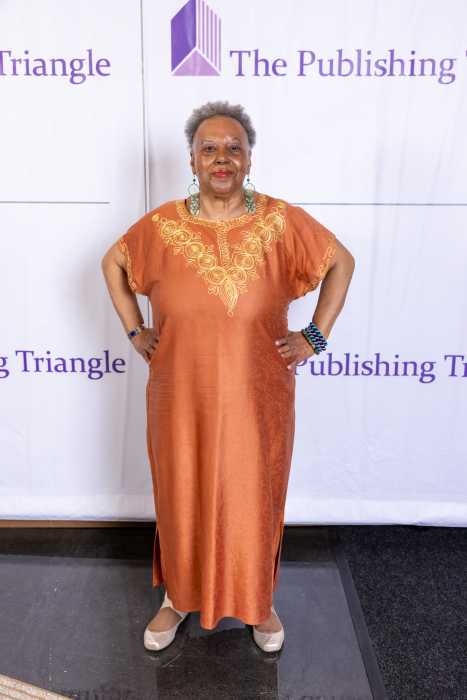
Reggie Harris, the multi-award-winning poet, presented the Thom Gunn Award for Gay Poetry. Richard Siken’s “I Do Know Some Things” won the award, and in his speech, the poet talked about when he published his first book, “Crush,” in 2005, some people called it a “brave book, but I didn’t think I needed to be ashamed.” Siken had a stroke in 2019 and said his current book “started out as an act of reclamation. My language was still queer, full of doubt and questions, and more flexible and open to transformation.”
Daniel Handler, aka Lemony Snicket, the sponsor of The Leslie Feinberg Award for Trans and Gender-Variant Literature, appeared via video, and displayed an envelope, on which he’d written THE WINNER, and scattered handfuls of glitter confetti when he announced the award went to Local Woman by Jzl Jmz, “A pulpy, mytho-poetic dispatch from an ‘anarchist jurisdiction’ that explores the liberatory possibilities of community and womanhood,” according to publisher Nightboat Books.
The Jacqueline Woodson Award for LGBTQ+ Young Adult and Children’s Literature, was presented by its namesake, who said in a recorded message from Italy: “I am still living!”
The award went to “We Can Never Leave,” by H. E. Edgmon, who says they: “write cross genres, their work prioritizes the righteous rage of survivors, the sanctity of queer love in all its forms, and an unkillable hope for an Indigenous future.”
The Joseph Hansen Award for LGBTQ+ Crime Writing was presented Michael Nava, the author of the award-winning series featuring gay, Latino criminal defense lawyer Henry Rios.
“Mirage City,“ by Lev AC Rosen, took home the prize, and the surprised author said he didn’t expect to win. He thanked the queer editorial assistant on his first book who “read it and said: this needs to go to my straight editor NOW,” and helped Rosen publish the first book of the series, which now numbers four.
Karen Finley, the interdisciplinary artist, poet and performer, came to the stage to present the Michele Karlsberg Leadership Award. Finley, the named plaintiff and one of “the NEA Four” in a case that went to the Supreme Court (they won) said: “it feels so good to be here! Outside feels so…challenging.”
Finley presented the award to her friend and colleague, Amy Scholder, the longtime editor and publisher of a canon of great queer books, and recently the producer of documentaries “that empower underserved communities to tell their stories.”
Scholder said she had learned in publishing “to believe in the wisdom of colleagues.” And that “publishing is really about relationships.” She said she appreciated an audience of “a bunch of book nerds who would probably rather be at home,” but came out to celebrate queer literature.
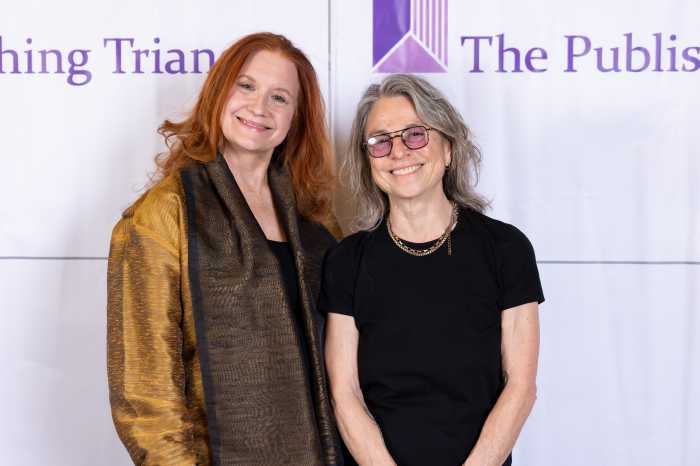
Writer and editor Jim Berg presented The Randy Shilts Award for Gay Nonfiction to “Baldwin: A Love Story,” by Nicholas Boggs. Boggs sent word with his editor, Oona Holahan, thanking the Triangle, and dedicating the award to the late poet Richard McCann.
Julie R. Enzer, the storied editor of the lesbian publication “Sinister Wisdom,” which is celebrating its 50th anniversary this year, presented The Judy Grahn Award for Lesbian Nonfiction to “Beyond the Lesbian Vampire: Reclaiming the Violent Lesbian in Contemporary Queer Horror” by Sam Tabet, a study of the rebirth and subversion of the violent lesbian trope in queer horror.
Poet, educator, literary activist, and community builder JP Howard presented the Betty Berzon Emerging Writer Award, reminding the audience that Berzon was both an author and a medical practitioner, whose spearheaded the successful effort to have homosexuality as a mental illness.
This year’s winner, Mariah Rigg, describes herself as “Samoan-Haole writer who was born and raised on the island of O‘ahu” said she “started crying in my car when I heard I won.”
The Edmund White Award for Debut Fiction was presented by novelist and editor Rakesh Satyal, who counted White as one of his mentors, and urged everyone in the audience to buy the winning books.
The award went to “Lonely Crowds: A Novel,” by Stephanie Wambugu. Wambugu sent a message, in which she thanked the Triangle, and said she misses New York, because “each day, you’re pushed into proximity with interesting strangers.”
One of the top awards on the queer literary scene is the Ferro-Grumley Award for LGBTQ Fiction, presented by Stephen Greco and Sarah van Arsdale, who remarked that needs night like this “to get through the next 1009 insufferable days.”
“Drought,” by Scott Alexander Hess, won the Ferro-Grumley, much to his own amazement. “Boy, am I honored!” he declared. He used the rest of his speech to praise, independent publishing houses, and to support “all the indie authors!”
Before the final awards, the audience settled into silence for the “In Memoriam” presentation. To Brandi Carlisle’s “The Story,” photos of people we lost in 2025 and early 2026 lingered on the screen, including Edmund White, Andrea Gibson, Don Weise, M. Christian, Victoria Brownworth and more, concluding with the poet Renee Nicole Good, murdered by ICE.
Essayist and editor Parrish Turner presented the Amber Hollibaugh Award for LGBTQ+ Social Justice Writing to “What is Queer Food?: How We Served a Revolution” by John Birdsall. Birdsall’s book is “A celebrated culinary writer’s expansive, audacious excavation of the roots of modern queer identity and food culture.”
For people who have spent a life serving queer literature, the Bill Whitehead Award for Lifetime Achievement marks all that they have done.
Award-winning journalist Morgan Grenwald said “her gender is a dyke” when she introduced this year’s Whitehead winner, the poet, artist, activist Chrystos.
Chrystos, who lives in Washington State, made an appearance via video, along with her cat. She spoke of a long career as a two-spirit writer and activist whose work explores Native American civil rights, social justice, and feminism.
Chrystos’s many books are, she noted, out of print, and she used the opportunity to ask the audience to “bring me a publisher at long last!” Out of print books by Chrystos include “This Bridge Called my Back,” “Not Vanishing,” “Dream On,” “In Her I Am,” “Fugitive Colors,” “Fire Power,” and more.
As the ceremony prepared to adjourn to the afterparty, Host/MC Xavier called out: “Your work matters. You are changing the world one page at a time.”