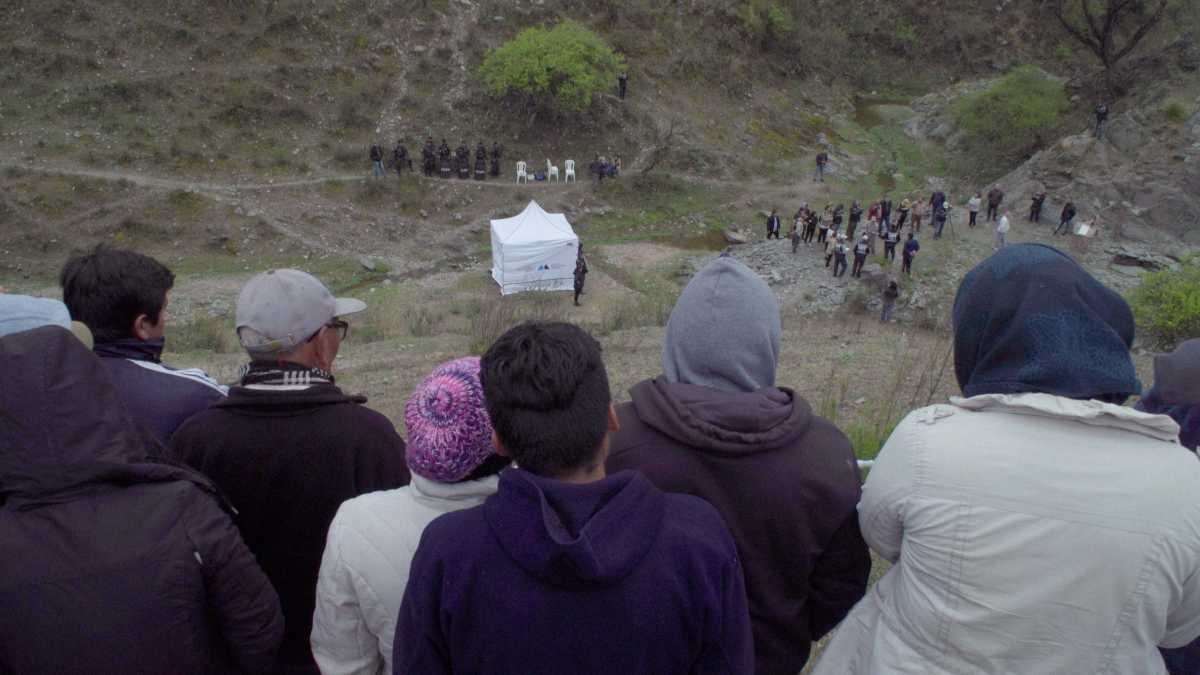
Lesbian director Lucrecia Martel’s “Our Land” offers both a micro and macro vision of Argentina’s violence towards its indigenous people. Much of it was shot during the trial of three men accused of killing Javier Chocobar in the midst of an attempt to steal the Chuchagasta community’s land at gunpoint. She’s not satisfied simply by bringing her camera to court. “Our Land” also directs our gaze to the circumstances which led to this murder. Their history stretches back to the start of Spanish colonialism in the 1600s. The title phrase holds varied meanings for different audiences: indigenous people of Argentina, whites in the same region, and a worldwide one unfamiliar with the country’s history.
“Our Land” begins with an incident in 2009. A leader of the Chuchas, living in the Tucaman province, Chocobar and his village were about to be evicted. Mine owner Dario Amin and former cops Luis Humberto Gomez and Eduardo José Valvediso barged onto their land, claiming possession of a quarry. In the ensuing struggle, Amin shot Chocobar. For years, the Argentine government ignored the case. Only after extensive protests were Amin, Gomez and Valvediso finally brought to trial, in 2018.
Photographs and video form a crucial element of “Our Land.” As the saying goes, history’s told by the winners, but the Chuchagata community’s archive relates a different story. The texture of black-and-white photos is a marker of their age. Some are so grainy they’re turning into a distant blur. They form a record of private and collective memories kept out of Argentina’s official narratives. Chocobar’s murder was filmed by Amin himself on his phone, but the image is hopelessly indirect. As if altered by the violence, the camera hesitates over shaky shots of rocks. One can hear fists and shots, but the exact shots remain unseen. Blood leaps out from the murk. Sound design, laden with a quiet buzz of feedback, also establishes the tension of “Our Land.”
Every medium that can be used to promote racism has been used: “Our Land” shows a painting in which God rains down vengeance upon indigenous people. At first, Martel’s images of the countryside reflect a similar perspective. Critic Ryan Lattanzio suggested that they represent the eye of colonialism. She uses drones to shoot from an aerial view, which long ago become a tired documentary cliché. “Our Land” redeems it. Near the end, these shots stop feeling illustrative and turn into the heart of the film. The camera becomes a perpetual motion machine, taking any step it can to try and understand the land. It even swivels upside down, creating a surreal forest of greenery and animals. This is a documentary that cries out to be seen on the biggest screen possible.
As acclaimed as Martel is, she hasn’t found it easy to get her films produced. “Our Land” is only her fifth feature, arriving eight years after her last narrative film, “Zama.” On May 8, the Metrograph will start screening a restoration of Martel’s 2009 “The Headless Woman.” It’s a guide to the path she rode down to arrive at “Our Land.” Martel’s first three features, set in the city of Salta, all feature troubled white, middle-class families, propped up by darker-skinned servants. They take a particular interest in the lives of girls and women, without idealizing these characters. “The Headless Woman” follows Veronica (Maria Onetto), who believes she may have run over a person (or at least a dog) while driving. Her perception is full of ellipses, but while she may dramatically misunderstood her experience, she’s kept comfortable. In a country ruled by a brutal dictatorship from 1976 to 1983, this kind of memory hole is convenient. “Zama” was Martel’s first period piece, tackling the subject of 18th-century colonialism directly.
“Our Land” feels extremely dense, as though Martel packed as much information as she could into its two hours. During the founding of Argentina, most of its indigenous people were killed, but their existence persists. (79% of Argentines, including Martel, are descended from Europeans.) One man notes that they were euphemistically called “peons” or “gauchos.” Despite such erasure, they’ve retained their connection to the land, while working for exploitative white bosses. The fact that their struggle is ongoing is a key part of “Our Land.”
White directors who make films about indigenous people are standing on quicksand. Martin Scorsese ended “Killers of the Flower Moon” with a mea culpa about his own role in this story. Martel takes great care to show how the story of “Our Land” continues to the present day. Despite the twists of the case of Chocobar’s murder, his community’s resilience in the face of a country that wants them wiped out or, at best, forced into poverty, is the film’s strongest takeaway.
“Our Land” | Directed by Lucrecia Martel | Strand Releasing | In Spanish with English subtitles | Opens May 1 at Film Forum