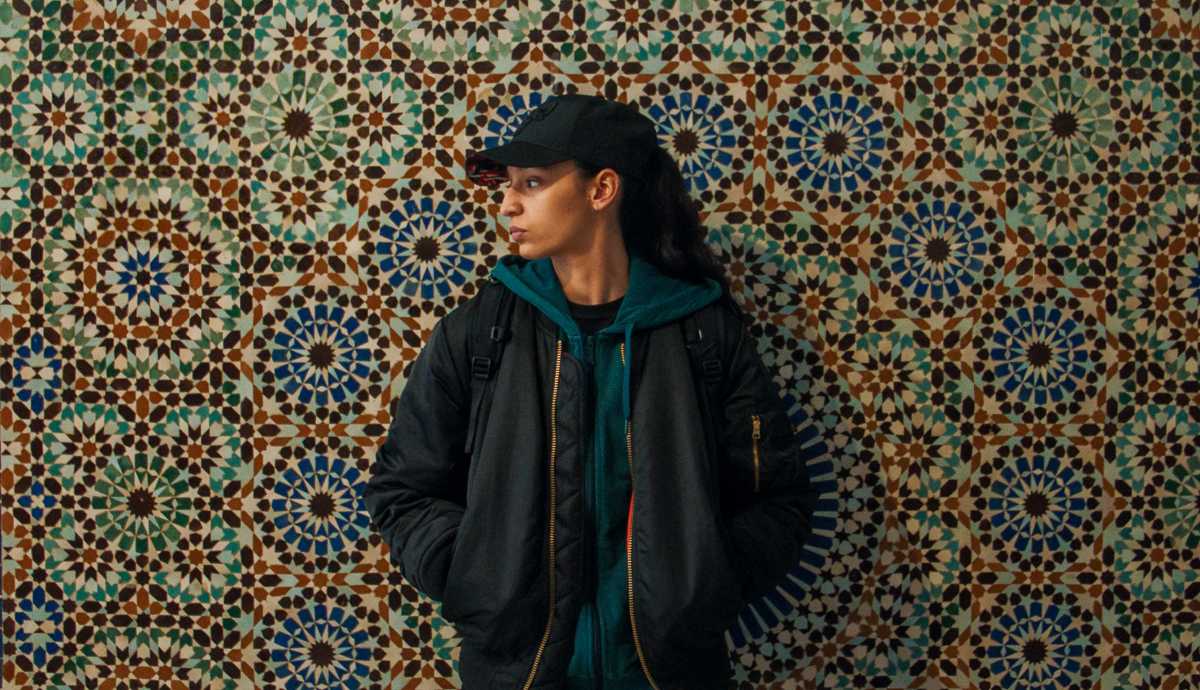
Writer/director Hafsia Herzi’s “The Little Sister” is an outstanding coming-of-age story — it won the Queer Palm at Cannes last year — about 17-year-old Fatima (Nadia Melliti), a French-born Algerian. Fatima projects a tough exterior that masks her internal conflict about being a lesbian. She is reluctant to commit to her boyfriend, who sees a future for them. She hangs out with guys at school and bullies a gay classmate when he clocks her as queer. Fatima starts investigating her sexuality by meeting women online to get both knowledge and experience. She soon connects with Ji-Na (Park Ji-Min) and begins an intense relationship with her.
“The Little Sister,” which is based on Fatima Daas’ autofiction, traces Fatima’s life over the course of a year and includes a rollercoaster of emotions. Herzi’s intimate approach allows viewers to become as invested in Fatima as Melliti is in playing her. (The actress won Best Actress at Cannes; it was her film debut.) Fatima has moments of queer joy at a pride parade and a lesbian nightclub, but also the pain of heartbreak. These scenes, and others, including Fatima trying to reconcile her religion and sexuality with an Imam (Abdelah Manoun), build to an emotional chat Fatima has with her mother.
In an interview during this year’s Rendezvous with French Cinema program, Melliti spoke with the assistance of interpreter Nicholas Elliott about “The Little Sister,” an empowering story of emancipation.
Had you read Fatima Daas’ autofiction before you became involved with the film, or did you read it after you were cast? And did you meet with Daas to discuss the character?
I discovered Fatima Daas’ novel after I went through the casting process, but before I was chosen for the part. The casting director suggested that I read it. If I had the opportunity to go on a quest to understand the character, it would be important for me to read the novel. In the book, I would find all the elements to work with to create Fatima since the film is an adaptation of the novel. I read it after I was cast, and I met Fatima Daas for the first time in a café, which was a major and fundamental influence on my development of the character. I was able to take elements of how she moves, how she dresses, her tone of voice, and the gestures she has to compose the character. Earlier, when I had read the book, I had an imaginary vision of Fatima — her spirituality, duality, and especially her loneliness. But once I met Fatima Daas, I was able to move beyond this imaginary portrait of her.
Since this was your film debut, I’m curious what prompted you to pursue this film, and this role in particular?
The first thing was curiosity — the curiosity to discover a world totally unknown and distant from my own. I studied sports and I have always been more oriented towards physical activities. It was the casting director who approached me initially; I didn’t think it would lead to anything. I was just saying “OK,” to her various requests, not knowing that it would eventually lead to casting sessions. There was also a desire to accompany this character in a quest for emancipation. After I read the novel, and worked with other actors, I understood the character was on a quest for emancipation, and that was something I lived through when I was younger. I identified with very strongly with that theme.
Fatima is very deliberate in how she dresses, and she is often poker faced, hiding her emotions, expressions, and feelings. Can you talk about that aspect of her character and how you portrayed that?
Fatima is an introverted person. She has interior or internal questions and struggles, notably through this duality between her nascent desire for women and her religion. When I read the book, I noted that poetry and spirituality were very important. I was feeling her struggles and her questioning. I think introverts have the ability to question themselves without needing to express it externally. I imagined Fatima as someone in a solitary bubble. That is how I built the character. To do that, I did something that was actually challenging. I chose not to speak to the people in my life about what I was embarking on with the film. This helped me get the energy of the character. Fatima is having these experiences living through things that she was not talking about with the people who surround her, and I was doing the same thing. I think that helped me on the shoot.
Fatima obviously struggles with being queer and religious. What are your thoughts on that and how the film presents her faith?
Religion is treated as a backdrop in the film. It’s not a film that is aiming to categorize religion. Religion is very important to Fatima. It is her identity. She loves her religion. She doesn’t want to choose between her faith and her homosexuality. Despite what the Imam says to her, she chooses to make her own path and embrace both. She is a stubborn young woman and wants to live in both those worlds despite the dogma.
Fatima seeks out what she feels are safe spaces, which range from an abandoned lot during her first “date” with a lesbian she meets on an app, to a pride parade where she experiences queer joy with her girlfriend. What are your thoughts on how she moves through the spaces in the film? She is isolated and connected at different times.
I think she always feels safe. The moments when she is isolated are moments where she is questioning herself. She doesn’t have people to talk to. The Imam is like a psychologist. He is the only person she opens up to — even though it is through a lie. It’s not about “safe space,” since we see her family is cheerful, and her mom is loving and joyous. She doesn’t come out to her mom because it is her personal fear of rejection and disappointment. When she is isolated, it is an internal process. She is not looking for places to hide. When we see her with another person, often women, she is going to experiment with them or learn from them. The director did research on the kinds of parties in the film, where people feel safe and liberated. I had this idea of the safe space for the party sequence. Over the course of party, Fatima evolves. At the beginning, she looks around and questions what is happening in this queer world and see that people are free. She wants to experience that and is surrounded by people who are respectful and expressing themselves freely.
Fatima tries to hide her sexual identity and code switches with the people she is interacting with — be it her family, her friends, or lesbians she meets. What observations do you have about her interactions with others?
We worked several months and rehearsed a lot of scenes and asked ourselves about symbolism what we wanted to express though our characters. For the many intimacy scenes, we agreed that we didn’t need an intimacy coordinator because we trusted each other. The scene with Fatima’s boyfriend, we thought about how we would do the scene so the audience would feel she wants to leave him, but it would happen without violence and the lack of respect. It would be a healthy breakup.
Regarding Fatima’s family, it was her fear of deception and rejection that prevented her to come out. She was, above all, a very loyal person, and while everything seemed good in the family, she didn’t have the ability to come out to them because of her loyalty. She didn’t want to be rejected despite the fact that it was a healthy environment. We see, without words, that her mother could feel the truth about her. There was a context of respect and benevolence, and Fatima didn’t need to talk about her identity — which she did with others who helped her evolve. It was quite fantastic for me to play the father/daughter relationship because I lost my father quite young. It was challenging to create the loyalty around this father.
How does “The Little Sister” reflect your life?
Some things about Fatima were personal to me. My parents are immigrants to France, and I come from an Algerian background. That spoke to me, as does the idea of social ascension. And soccer, which Hafsia Herzi added to the film for me!
“The Little Sister” | Directed by Hafsia Herzi | Opening June 5 at the Film Society of Lincoln Center | Distributed by Strand Releasing