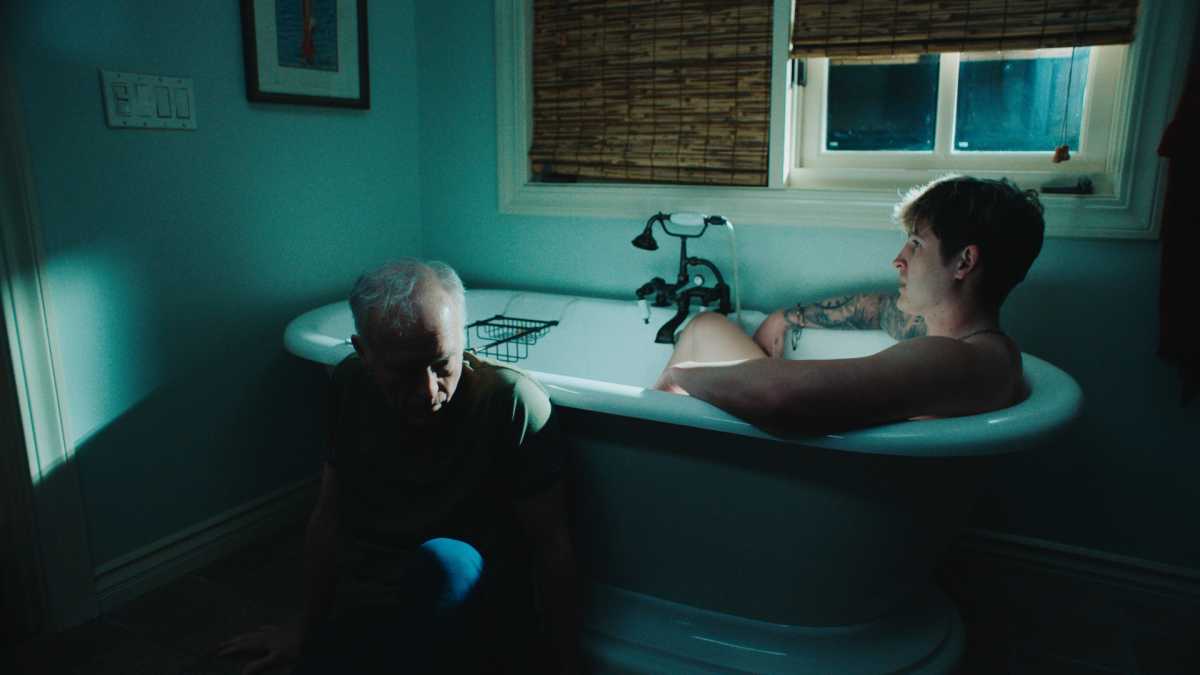
The potent (and potentially triggering) “Blue Film” is writer/director Elliot Tuttle’s stunning two-hander. Aaron Eagle (Kieron Moore) is a camboy who accepts $50,000 from Hank (Reed Birney) for an overnight. It’s a typical set up — Hank likes to watch Aaron, and Aaron likes to be watched — but there is much more between them, of course. Both men knew each other years ago, when Aaron was named Alex. As they reconnect, they discuss and navigate ideas about sex and desire.
“Blue Film” is both disturbing and cathartic as it addresses themes of purity and perversion. As Aaron and Hank talk, they alternately feel comfortable and uncomfortable with the other, especially during sexual situations. But it is when the men are truly honest that the film is most shattering.
Birney delivers a very thoughtful, nuanced turn as a man with a secret and an agenda, while Moore gives a star-making performance as the brash Aaron, capturing his insouciance well. His monologue about how he became a camboy is spellbinding. Tuttle shoots the film very carefully, creating a tone and mood that enhances the uneasy power dynamics between Hank and Aaron. This is a hard film to shake.
Tuttle, Birney, and Moore chatted with Gay City News about making “Blue Film.”

Elliot, what was the impetus to tell this story, which is provocative not just in concept, but in the language, and the imagery?
Elliot Tuttle: In order for this film to work you have to learn kind of a new thing about the character every minute. Everything has to be revealing until nothing is left but their most naked, honest self. I had been craving to see a film where sex was not conceptual, or sex felt very laced with desire, or rife with potential meaning or significance. I think that’s the way that we live our sexual lives. I had been really eager to see the film that kind of capitalized on a lot of the honesty and vulnerability shared by a lot of these great European filmmakers, like Catherine Breillat, or Pasolini, or Fassbinder — these agents of provocation. But really what they’re doing is something that is so beautiful, and is so truthful, and vulnerable. There is so little that is feeding that appetite for genuine transgression and genuine honest conversations and thoughts about the taboo. I wanted to commit my voice to that with this film. I also wanted this film to work on its own merits. The subject matter’s taboo nature felt intertwined with the construction of the film itself — that in some way it mirrored the vulnerability that I’m asking the actors and the audience to meet it in earnest.
Can you each talk about the ideas of truth and lies in the film? The characters have interesting ideas of fantasy and reality.
Elliot Tuttle: I think that creating the framework of the film, where a lot of the conflict is driven by this dissonance between their true self and their assumed identity — or what they present to other people — is so rife with richness to me. That is essentially what sustains the film.
Kieron Moore: I think Aaron has become his own fantasy in a way. When you tell yourself lies for a certain amount of time, do they ever become truth? Because you are living in that lie, it is your truth. As the story progresses, Aaron has to face himself on a deeper level. We see Alex sort of cracking through, and that is massively due to Hank’s persistence, but also his vulnerability. There is a certain point when Alex chooses to let Alex through. Aaron is so used to being everyone else’s fantasy that it gives him an extra thick armor or idea of himself — that there’s almost an element of fearlessness. Then he is faced with real fear. I wish I could have a percentage of his comfort in himself — even if that self isn’t real. There’s a line in the movie that’s always deeply challenged me, which is, “If you look like me, you’d want to be naked all the time, too.” I cannot resonate with that line at all. I love having clothes on, so, there’s something in that.
Reed Birney: I think Hank’s an interesting character in that he is very aware of how dangerous his fantasies are in a way that not everybody is. He lives in a weirdly naked place, knowing that everybody around him [in his hometown] knows everything about him. His fantasies are both incredibly exposed for the world to see, and yet also there’s probably a little tiny part of it in the dead of night, that he still can keep private, even though he can’t act on it. But he’s very self-aware in a way that Aaron is not.
Reed, I see Hank as a man at war with his desire and trapped by his impulses. What observations do you have about his character?
Reed Birney: He knows he can’t do anything — whatever the impulse is. It is like being in AA, you know? You want to drink every day, and yet you make the decision every day not to. I think he makes the decision to stay in that town part of it, because he’s got the whole town to monitor him and keep him in check. That might be a very self-protective thing for him. He knows how dangerous he is. He slipped once.
Kieron, Aaron goes from full on swagger to being unsettled by his encounter with Hank. Aaron is someone who craves attention — but the more attention he gets from Hank, the more he short circuits. What can you say about calibrating your performance?
Kieron Moore: Aaron is aware of the attention he gets, and he controls it, he molds it. He dictates it in a way, especially to his [online] audience. He expects the same thing here, but Hank is interested in a different part of him. Hank is interested in this truth and what’s underneath it all. The first time we see Aaron enter that room compared to the last time when Hank has left is that full journey inwards. Aaron is so used to projecting his persona that it’s almost a distraction. It’s so encompassing to his audience that no one ever wants to see what’s underneath.
I think it’s just a deep human experience, when someone genuinely listens to you. I just think that Hank becomes Aaron’s first real audience member, and that is deeply terrifying to him. And the audience can decide at the end of the movie whether they feel it will be of use, or whether Aaron will circulate back to what he has always been.
Can you talk about the power dynamics between Hank and Aaron? There are some very intimate moments, but each man struggles to maintain control.
Reed Birney: Hank keeps saying, “I want to want you. I want to want to have sex with you.” So, I think he’s come there with some idea of fulfilling, or consummating, this relationship with Alex. The bigger overreaching thing is that I think he has a real need to remind Aaron who he was — who Alex was. The simpleness and the innocence and the beauty of that young boy that, in Hank’s opinion, has been lost. The role-playing, I think, is probably where thinking back, Hank might say that was a bad idea. I shouldn’t have done that. But, again, we’re not always in control of our impulses, and I think he’s come a long way and spent a lot of money and, he knows this is the only opportunity he’s ever going have to have this moment with Alex.
Keiron Moore: Sex is where Aaron feels his strongest and his safest. His monologue at the beginning is like, “I’m the worst thing that exists, and I’m almost like turned on by it.” There’s something deeply revealing in that, and quite erotic. Some of us would argue the least important parts of ourselves, or the least interesting thing, is our sex. It depends on who you are. I think the power dynamic and the exchange is constantly a battle for Aaron, because it is happening within him. Once he realizes who Hank is, there’s a conflict internally with Aaron/Alex — the boy that he once was and the man that he now pretends to be.
But I also think the power dynamic on a surface level, is that Aaron is usually the dominator in all of his endeavors in his life — that’s his armor. He goes to Hank expecting to do what he’s always done, which is to demoralize this man, take his money, and be celebrated for his sex. In every moment there is an exchange of that for him. Gaining power is to sort of pretend you’re giving it away, and I think there are moments where Aaron is deeply manipulative. That was my way in, but I would never try to tell the audience what to think. The archetype of being the sex worker and how much of ourselves do we give away in every exchange is constantly happening within the movie. Why does Aaron stay? I think there’s a curiosity and that big paycheck is looming. How far do you dance with the devil? He is constantly navigating where he feels comfortable and I don’t know if he always ends up sitting in that comfort, but I think that is really exciting. He asks all these questions that I wish I was brave enough to ask.
“Blue Film” | Directed by Elliot Tuttle | Opening May 8 at the IFC Center | Distributed by Obscured Releasing