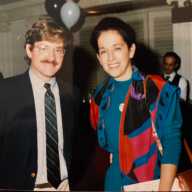

Ronnie Eldridge, who died at 95 on March 4, 2026 after a short illness, is mostly remembered as the West Side reform Democratic political and feminist leader who was a valued adviser to Robert Kennedy as he ran for the US Senate from New York in 1964 and for President in 1968, was the highest ranking woman in the administration of New York Mayor John Lindsay in the early 1970s, ran the State Division for Women for New York Governor Mario Cuomo in the ‘80s, served in the New York City Council from 1989 to 2001, and went on to host a weekly TV show on CUNY-TV on NYC issues — first called “Eldridge & Co.” and then “Keeping Relevant” which she last taped three weeks before she died. It was her 628th episode of the show.
A mother of three from her marriage to psychologist Lawrence Eldridge, who died in 1970, she was also famously married to muckraking tabloid columnist and author Jimmy Breslin from 1982 until his death in 2017.
But Eldridge was also beloved in LGBTQ communities for her 56-year history as one of the strongest LGBTQ allies in the city’s history. Less than a year after the Stonewall Rebellion, she was the person in City Hall that early gay activists turned to in order to push the Lindsay administration to codify protections for gay New Yorkers.
Eldridge once shared with me her work in the early 1970s with Marc Rubin of the Gay Activists Alliance (GAA) and a co-founder of the Gay Teachers Association. “He came to see me because police were telling them a parade permit was required for men to hold hands in the street!” She was Lindsay’s liaison to the first Christopher Street Liberation Day March in June 1970.
She also recalled when Allen Roskoff, also with GAA and now president of the Jim Owles Liberal Democratic Club, “chained himself” to her desk to get the mayor’s attention to gay rights.
When Roskoff co-authored the nation’s first gay rights bill in 1971, he said that at a GAA strategy meeting on who might support them, “Ronnie’s name was at the top of the list. I met with her and we clicked.”
With GAA, Roskoff also disrupted a fundraiser for Lindsay for President in 1972 in Radio City Music Hall by chaining himself to a chair in the balcony — and that led to Lindsay’s executive order on gay rights covering city employees, a process overseen by Eldridge.
They remained lifelong friends and allies on a range of causes, especially seeking commutation of sentences from the governor for long-incarcerated inmates.
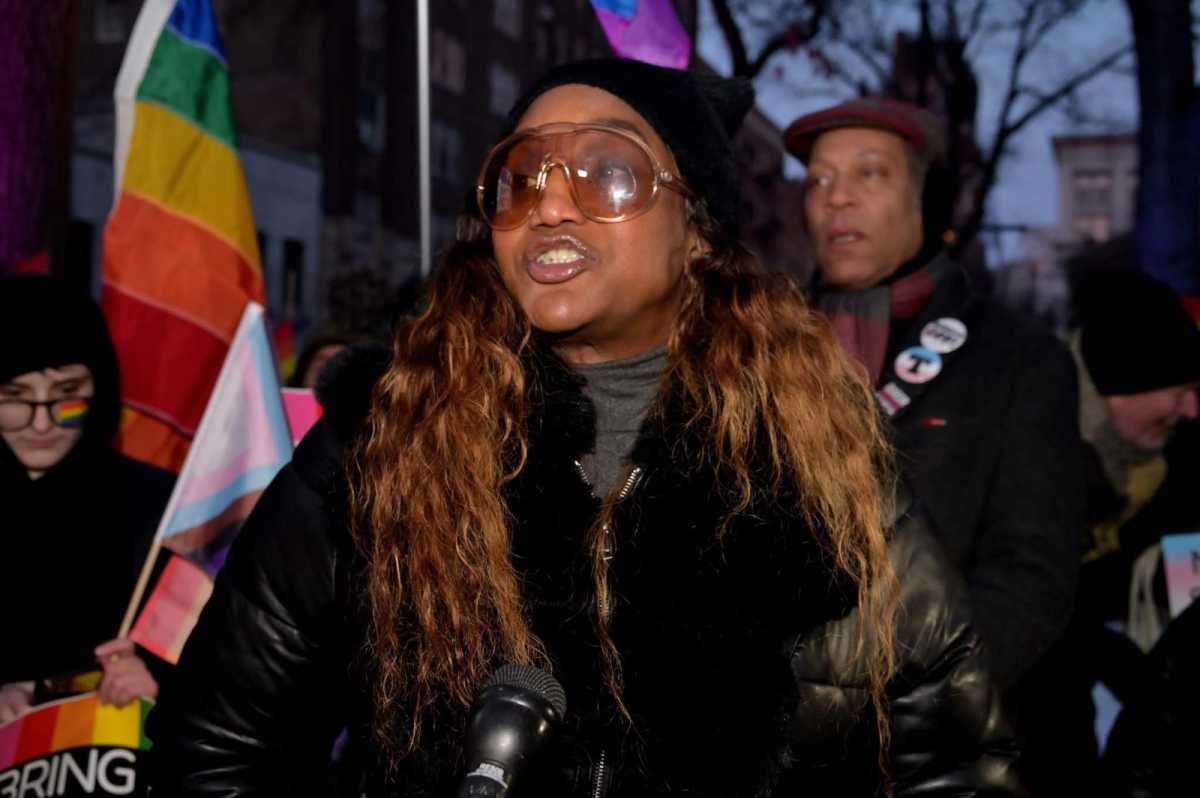
At the packed memorial for Eldridge at the Society for Ethical Culture on March 11, Eldridge’s friend, lesbian and AIDS activist Ann Northrop, co-host with me of “Gay USA,” said, “I first met Ronnie in a lesbian bar on the Upper West Side” in 1977 when Eldridge was campaigning to be Manhattan borough president.
“Ronnie was very invested in the health and life and happiness of the LGBTQ community,” Northrop said, recounting Eldridge’s engagement on LGBTQ and AIDS issues at the grassroots level. “What I saw in Ronnie was someone who was eternally curious. She never stopped wanting to know about things. ‘Keeping Relevant’ wasn’t about keeping herself relevant it was about keeping up with the world.”
(Northrop also quipped, “I’m glad you all showed up for the Ronnie Eldridge look-alike contest,” in a hall dominated by greying, second-wave feminists.)
Longtime LGBTQ activist Rev. John Magisano said, “One of my fondest memories of Ronnie is of her speaking at the memorial service for Jim Owles” in 1993. Owles had been the first president of the Gay Activists Alliance in 1970 and the first openly gay person to run for public office in 1973. “She spoke so fondly and personally of Jim lobbying her during the Lindsay administration.”
Tom Duane, the first out gay person elected to the NYC Council in 1991, said, “In truth, serving with Ronnie Eldridge on the New York City Council was, at times, challenging. It was impossible to completely follow or emulate Ronnie’s leadership for reforming the New York City Council. Her passion for this was almost too much to keep pace! On every issue, Ronnie was articulate, logical and 99.99% of the time, frustratingly correct. Ronnie was knowledgeable and brilliant regarding how the government should work for people.”
Tony Glover of OUT-FM on WBAI wrote on Facebook, “As a progressive White Jewish woman, her solidarity with Black folk and Black freedom movements domestically and internationally, like the anti-apartheid, pro-divestment, Free South Africa movement was on point. She often offered that support without calling attention to herself, simply as a denizen of the city who supported grassroots-focused organizing.”
Veteran gay and AIDS activist Bill Dobbs said, “I was an ACT UP lawyer and Ronnie [was] a first termer on City Council. She was always ready and willing to push the NYPD — that was how we became friends. For protesting, AIDS activists usually got minor charges, but NYPD liked to keep them in jail for three days before they saw a judge. Ronnie was great at quickly calling the precinct and urging, often successfully — give them a ticket or summons and release them now! When a police commander attacked an ACT UP member, landing him in the hospital, Ronnie quickly gathered the facts. Shortly after, she went over to a policy community council meeting to make all aware of this terrible incident. ACT UP’s 1991 Day of Desperation featured a protest at Grand Central. Media hype had everybody on edge. Ronnie didn’t wait for arrests, she had already called an MTA official to let them know, ‘Those protestors are my people.’”
Barbara Turk, who first met Eldridge when Turk was working for David Dinkins when he was Manhattan borough president in the late 1980s, said, “Most of my memories of Ronnie are from her time working in the administration of Mario Cuomo, heading up a very vibrant and effective office advocating for the rights of women in New York State. She and her staff raised visibility for women with HIV/AIDS and incarcerated women starting in the mid-1980s. She was a real champion, a mensch, a role model.”
Gloria Steinem wrote an article in New York magazine in 1970 titled “That Woman in City Hall” and subtitled, “It was no surprise when Ronnie Eldridge was named a special assistant to the mayor. Some even think she should be mayor.”
Eldridge told Steinem, ““The more you meet political leaders, the more you’re convinced it can’t be as difficult as you thought. It just seems strange to be inside an administration, getting paid; turning professional for the first time. I guess I’m losing my cover as a nice Jewish housewife.”
Eldridge spearheaded Democrats for Lindsay in 1969 after the right-wing Comptroller Mario Proccacino won the Democratic primary with 33% of the vote and Lindsay had to run for re-election on the Liberal line after he had lost the Republican primary to the conservative Staten Island State Senator John Marchi. Eldridge was, by then, a veteran of the Dump Johnson movement that edged the president out of the race in 1968.
Eldridge was born Roslynn Myers in Manhattan on Jan. 30, 1931. She graduated from Barnard College in 1952. She is survived by her children — Daniel, Emily, and Lucy — from her marriage to Lawrence Eldridge, who died in 1970. All these children spoke eloquently at her memorial, as did three of her grandchildren, Glynnis Eldridge, Nathaniel Eldridge, and Soph Silberman and her longtime chief of staff, Lisa Gugenheim.
When someone dies at 95 we’re usually expecting it. But Eldridge’s sudden death sparked a lot of grief at her memorial for someone who was so loved and who gave so much love to her family, friends, city, and country.
Video of the March 11 celebration of the life of Ronnie Eldridge at the NY Society for Ethical Culture is online here.