Lucio Castro is a cinematic trickster whose films play with time. His sophomore feature, “Drunken Noodles,” continues to explore themes he presented in his outstanding debut, “End of the Century,” with a slyer, but no less interesting approach.
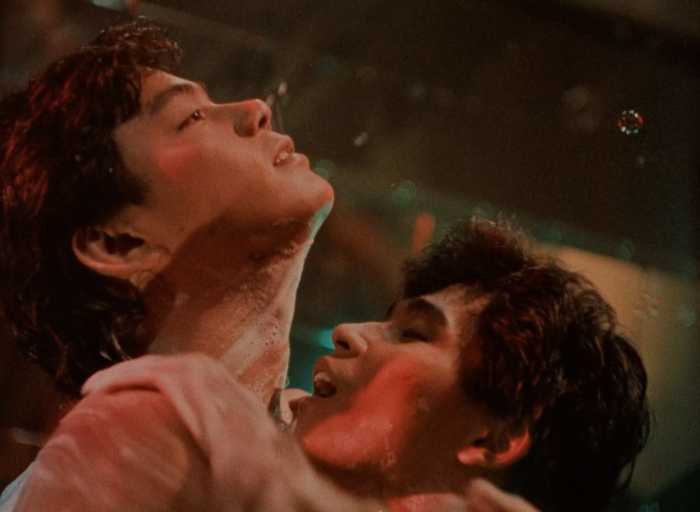
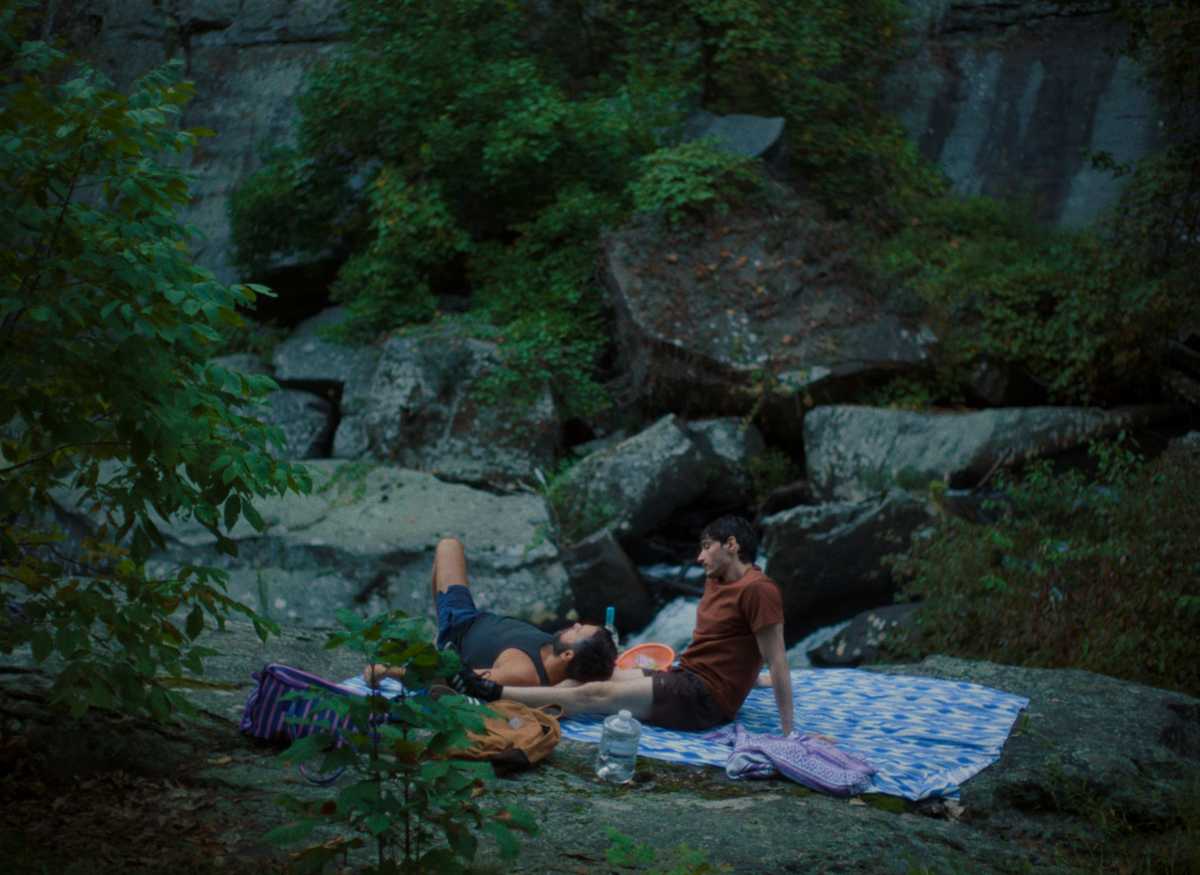
Adnan (Laith Kalifeh), a grad student at Bard, is first seen arriving in New York. He is staying at his uncle’s place while interning at a gallery for the summer. He orders take out. He goes out cruising for sex. And he meets Yariel (Joél Isaac), who delivers food and later has sex with Adnan. But then, “Drunken Noodles” shifts back in time and shows how Adnan met Sal (Ezriel Kornel), the artist whose embroideries are being displayed at the New York gallery where Adnan is an intern. A third section of the film goes back in time further to Adnan’s getaway with his boyfriend, Iggie (Matthew Risch), which precedes Adnan’s encounter with Sal. The film ends with another segment with Adnan back in New York City.
Castro’s film investigates the frictions and connections Adnan has in these various, intimate encounters. There are moments of fantasy, such as one episode involving a Faun (Guillermo García Arriaza), alongside quotidian scenes of Adnan just staring out the window watching cute guys walk by. But what makes “Drunken Noodles” so captivating is spending time with Adnan and piecing together his experiences.
Castro met with Gay City News to talk about his magical and sexy new film.
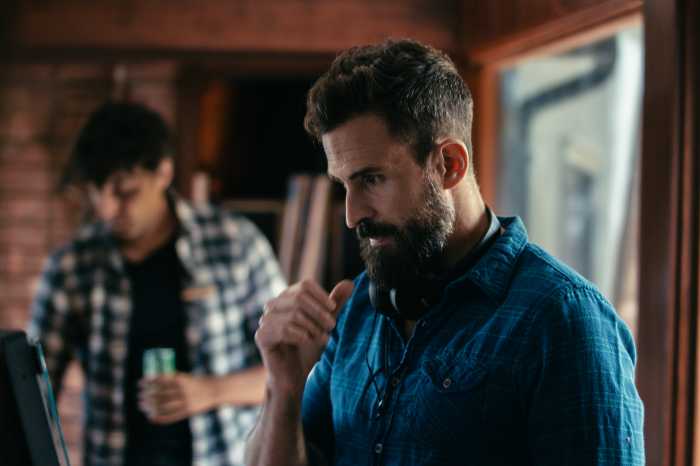
What was the inspiration for this film as well as the episodic narrative structure?
When I saw [embroidery artist] Sal Salandra’s work at a friend’s gallery, I was impressed. There is something very childlike, sexual, obscene, but also warm and tender. It depicted scenes of BDSM and hardcore sex. I like the idea of taking sex cultures that are supposed to be in the dark, or the dungeon, and bringing it to the light and showing the warmth and fantasy and connection in it. When I learned Sal had started making these works in his late 70s, I went to his house with a camera and some sound equipment to maybe do a short documentary. But talking to him, I realized that the reason that I liked his work was not something I could answer in an interview. I felt I was performing the questions, and he was performing the answers. What I was looking for wasn’t coming that way. So, I spent three years thinking how could I make a fiction film that was my film but also used his work. It was very intuitive. As I wrote, I came across moments and scenes. At first, I liked the idea of a four-part film, almost like four short stories, but then I realized the stories were naturally connected over two summers. It was written that way. I like characters who are arriving somewhere and are not sure how they are feeling. The information gets to the viewer as the movie progresses. I like when a film takes time to understand the face of the actor and then more of the story.
The film to me is very sensorial. I felt the heat of the summer, the texture of the embroidery, Adnan’s skin, the current of the water Iggie swims in, the musty smell of Yariel’s gloves and the light of the bike. Can you talk about creating the film’s tone and mood? It is very hypnotic and sensual.
I worked with Barton Cortright as my director of photography. This is a film where a lot happens at night. We wanted this warm, greenish nights to be part of the lushness, and to have nature in every scene. Even in New York City, the apartment has plants. We wanted it to be a green, lush film to take it away from the industrial darkroom vibe — the hard and cold depiction of hardcore sex. We wanted it to feel very lush, sensorial, approachable, warm, tender. It is a really sweet film and all the characters like and protect each other. Even the first encounter in the park, the characters don’t know each other’s names, but one asks, “Do you want to cum too?” We wanted even the smallest interactions to be warm.
“Drunken Noodles” is about loneliness and connection. What prompted you to explore these themes, which are so palpable in the visual compositions? They are inviting. I wanted to be in that space with your characters.
There are queer directors that tell stories that are about our rights being in danger as we speak. But I like to assume that everything is fine. I think there is something empowering in that. I think the straight world is happy when gay characters suffer; they feel safe. I don’t want to feel that. I want to present the opposite — we’re doing great! Of course, there is a sense of projection and fantasy in that as well, but I think that reinforcing that in a way, to me, is more threatening and more interesting than showing a gay character as a victim. In that sense, I wanted the sex to feel inviting and spaces to feel beautiful. There is a beauty in the film, to me — from the aspect ratio to the colors—that we wanted to replicate the idea of looking at paintings. When I look at Sal’s paintings, I like the colors, the vibrancy of the textures, the compositions, there is something really pleasurable. The instinctual pleasure of looking at something beautiful.
Adnan is often shot in his underwear, and sometimes nude. There is a tableau of still shots that express sex that recreate some of the bodies in the explicit embroidery art. There is the half-naked Faun, and the film also includes a scene where Iggie’s naked body is deliberately posed. What can you say about all this objectification of male bodies?
I think it is really important to project the stories and images and things you love. There is definitely an objectification of the male body, but I think that comes from a place of desire. Not just personal, but the way my gaze looks at those bodies, it is celebratory, and not exploitative. I am not doing it for effect; I am seeing real pleasure and real beauty in all these characters, including Ezriel, who plays Sal. I wanted to be open and see beauty in all these male bodies. We are told that we shouldn’t be that naked, but why not? I think there is beauty in that as well. It’s a gaze that is very much linked to the simple pleasure of looking at something for its own beauty. Bodies, too, and the queer body as well, is something that has so many politics ingrained into it, I wanted it to be a celebration of the queer body and less of a speculative look.
Adnan is apparently very horny! [Castro laughs] What decisions did you make about his character?
The film started with Sal’s work, which is very based on sex, so Adnan had to have a sex drive. The first thing we get is that horniness, but as the film goes on, we understand why that happens, why he hasn’t had sex. I see Adnan as someone really curious and open minded and someone who looks at the world like an artist. I think I am an open and accepting and curious person. Adnan’s approach as a character is someone open to the world. I like characters that are a little bit hard to read at first. He is like a machine that is recording what he is seeing.
Adnan is also quiet and observant. We understand him more after we know what came before. Can you talk about this approach or theme in your films?
There is a conventional way to making movies where the more you know about the character as soon as possible, the better, so as you go along for the hero’s ride, you know exactly what they are made of. I like the other approach, when a character is a blank canvas, or observant and quiet. As the film progresses, you understand the character, so you get pulled back into the film and understand the action from the beginning. The experience of knowing retroactively, the viewer, at the end, can make sense of the movie in a way that everything comes together in a very surprising way.
The film features wondrous scenes of magical realism. One episode, with the Faun, is really charming, but another sequence, involving Iggie is more mysterious. What was your intention with playing with reality here? That is also a signature of your work.
This goes back to Sal’s work. Even though it is based on sexual acts and desire, there is always a sense of the mythical. There are fauns, some “The Wizard of Oz,” and Dorothy’s shoes, some “Snow White,” and “Alice in Wonderland.” I love the idea of a fairy tale as a structure—to go on an adventure. I wanted to take these four segments and go into this fairy tale and deviate in a way that doesn’t feel like it’s a dream—now they go to crazy world—I wanted to slip into a fantasy world as if we were in their world as well, as if we are jumping or falling into a hole. I like when a movie presents itself as something very realistic and suddenly slips into a fantasy world. The whole movie becomes slightly more unstable. The fantasy becomes real, which I like, but what happened before becomes more unreal. Everything becomes slightly contaminated. There is something interesting in that.
What response do you have for viewers who may be perplexed by the film? Are you deliberately obfuscating?
I like to be a little bit lost in movies. I like to be slightly behind the characters at points. I like to be surprised. I like to be moved, of course. To me, it is important to allow the viewer to be slightly confused sometimes, like the character maybe is. That is an interesting experience for me as a viewer, so that’s what I do in my movies as well. I make movies because I don’t have the answer. My movies are questions. It’s like a peek into the abyss and the unknown. That’s the reason why art exists. If there is no mystery, there is no art to me. I think it is tapping into something that I am interested in — this image, this world — hopefully it is surprising and moving.
“Drunken Noodles” | Directed by Lucio Castro | Opens June 26 at the IFC Center | Distributed by Strand Releasing