Maddie jogs her way to work, pausing cheerfully to look at a poster for erectile dysfunction meds and sniff flowers. Few people would be this happy about turning up for their shift as a dishwasher at a fashionable restaurant, the GourMet Test Kitchen. Even in a workplace with toxic dynamics, she avoids getting exploited by her boss. (Actor Conner O’Malley delights in his boorishness without taking his behavior too far.) When the restaurant learns that she posted a vegetarian cooking videos, she finds out that her contract entitles them to use all her work as their IP. Rather than getting fired or ripped off, she gets a promotion, leading to a degree of success and recognition. If all this seems too perfect to last, that proves to be the case. Her titular secret is bulimia.
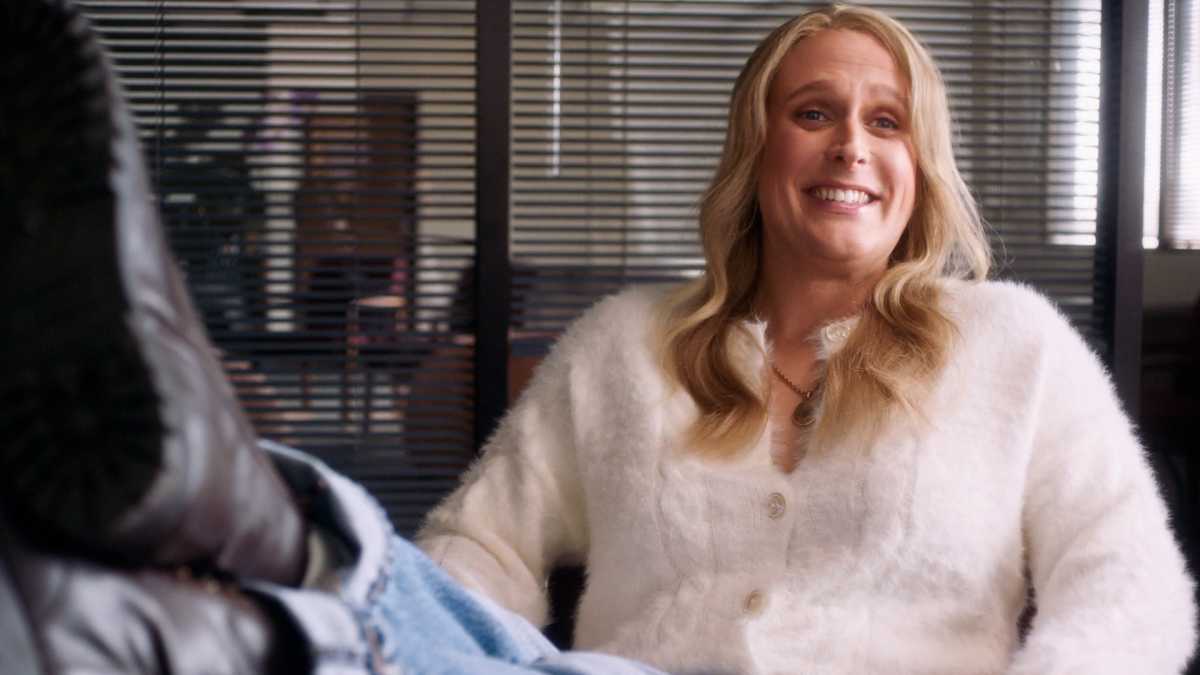
Gay actor/director John Early plays Maddie in drag. His performance winks at the audience without becoming entirely ironic. His embodiment of Maddie is layered, showing both her best qualifies and an underlying insecurity. Even at her most cheerful, one can sense that a deeper trouble exists beneath her surface bubbliness. Becoming a public figure and receiving comments about her weight leads her to return to spiral downwards.
“Maddie’s Secret” serves as a pastiche of the 1986 made-for-TV movie “Kate’s Secret,” in which Meredith Baxter played a housewife suffering from bulimia, but it’s not exactly a parody. The film exaggerates its more ridiculous aspects by taking them at face value while amplifying them. Its frankness about sex would not have been possible then. (Maddie’s relationship with her schlubby husband is developed through a sex scene where she starts out looking up at him from a low angle and winds up riding on top of him.) The 1999-2000 Comedy Central series “Strangers With Candy,” which starred Amy Sedaris, did something superficially similar with message-laden TV aimed at children, but “Maddie’s Secret” resists cheap laughs.
In less capable hands, its campy elements might have wound up as a form of contemptuous mockery. That would play with fire, because this film addresses a very real, serious subject. It doesn’t joke about the health risks of eating disorders. Maddie suffers from a cardiac arrest and a gastrointestinal perforation. After she seeks treatment by entering a clinic, one of her fellow dies from her illness.
Bright colors decorate the early sections of “Maddie’s Secret.” Maddie’s face is bathed in a deep blue as she secretly eats a midnight snack from the refrigerator. The more dangerous her problems become, the flatter the film’s look gets. The cinematography becomes much more grey once she arrives at the clinic. By the end, her recovery is signaled by the vibrant colors of the fruits and vegetables she cooks.
Early strikes a difficult balance between comedy and melodrama. By the ‘70s, the latter had become a respectable form, reclaimed by feminist scholars and cinephiles and given more life by gay director Rainer Werner Fassbinder. In the period since then, many other gay filmmakers have been attracted to it: Pedro Almodovar, Todd Haynes, Stanley Kwan. If Douglas Sirk’s ‘50s films were perceived as trash upon release, they’ve gotten an upgrade. “Maddie’s Secret” also takes seriously work that’s still seen as beneath serious consideration, although appreciation for Lifetime movies is growing.
Melodrama has been a form queer male directors use to engage with women’s lives. In “Maddie’s Secret,” one senses how genuine this dimension is. The behavior of everyone around Early is exaggerated without becoming arch. Her mother puffs on a vape while they meet with her psychiatrist. The dialogue is packed with sharp phrases like “elevated Game Day snacks.” The film’s one big misstep is its simple explanation for Maddie’s problems, but its dance with genre and tone keeps one guessing. Early’s affection for its source material is clear, but so is his awareness of the limitations of the way made-for-TV movies saw American women’s lives. The casual queerness of Maddie’s social circle is a corrective. As critic Brian O’Connell wrote, “he and his actors refuse to admit any distinction between comedy and melodrama, rather than get caught up in the binaristic ‘irony/sincerity’ push-and-pull so much comedy, and ‘camp’, gets caught up in.” The mood of “Maddie’s Secret” sinks in deeper because it walks such a thin tightrope.
“Maddie’s Secret” | Directed by John Early | Magnolia Pictures | Opens June 19th at IFC Center