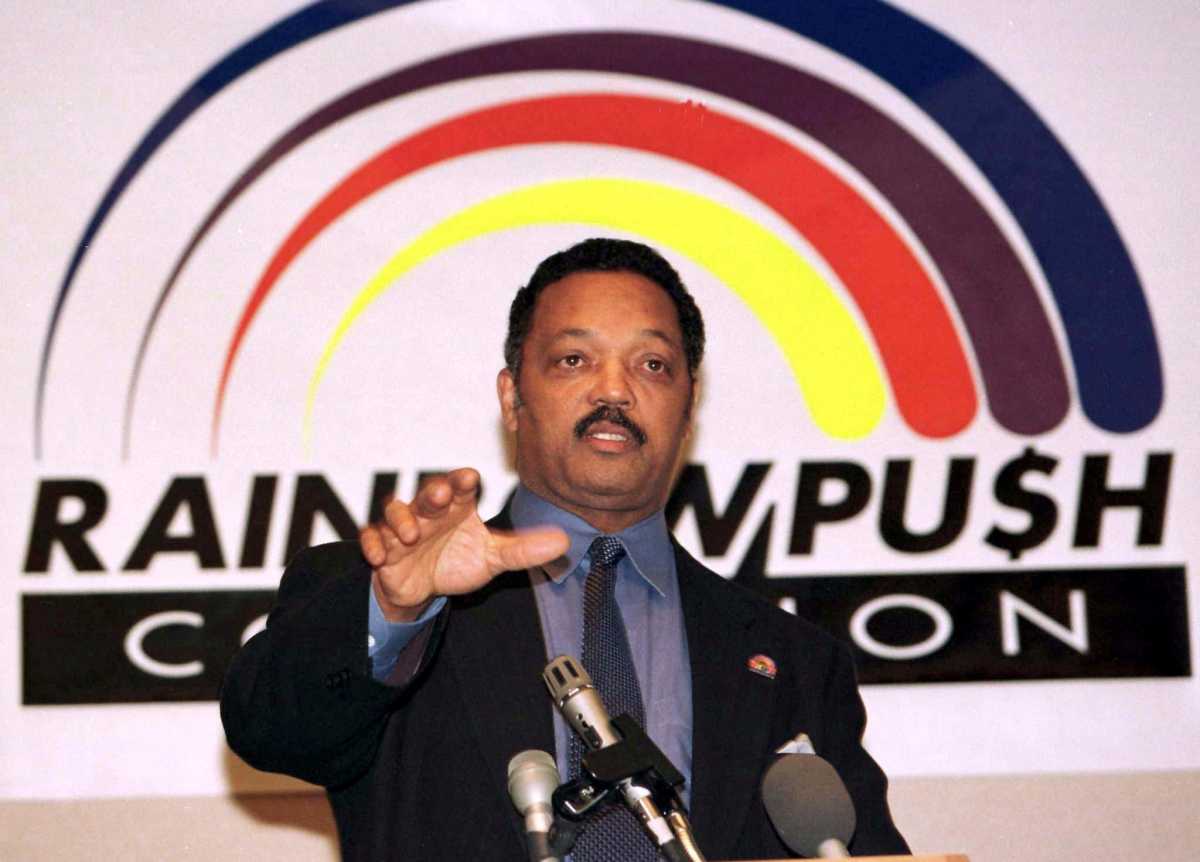
The late Rev. Jesse Jackson — a revered civil rights activist, LGBTQ ally, and former presidential candidate — died on Feb. 17 at age 84, prompting an outpouring of tributes across the nation.
Jackson’s path to prominence ran through the civil rights movement, where he worked with Martin Luther King Jr. and subsequently emerged as a key leader, founding organizations like the National Rainbow Coalition and PUSH, which later merged. He went on to mount historic campaigns for president in 1984 and 1988 — just over a decade after New York Congressmember Shirley Chisolm became the first Black candidate to seek a major party’s nomination for president in 1972.
During his address at the 1984 Democratic Convention, Jackson specifically mentioned gay and lesbian individuals as he described the diversity of America.
“America is not like a blanket — one piece of unbroken cloth, the same color, the same texture, the same size,” Jackson said in the speech. “America is more like a quilt: many patches, many pieces, many colors, many sizes, all woven and held together by a common thread. The white, the Hispanic, the Black, the Arab, the Jew, the woman, the Native American, the small farmer, the businessperson, the environmentalist, the peace activist, the young, the old, the lesbian, the gay, and the disabled make up the American quilt.”
In 2010, when Jackson called on the Ninth Circuit Court of Appeals to strike down California’s discriminatory ban on same-sex marriage, he made the case that marriage “is based on love and commitment — not on sexual orientation,” according to Pink News.
“I support the right for any person to marry the person of their choosing,” he said, adding: “We stand together today to uphold the principles of due process, of equal protection under the law, of fighting against discrimination against any and all people based on race, religion, gender or sexual orientation.”
Human Rights Campaign president Kelley Robinson said in a written statement that Jackson embodied the fight for justice, which she said requires courage, hope, and relentlessness.
“From disrupting political systems and building people power to helping this country imagine a freer future for all of us, Rev. Jackson was a force,” Robinson said.
Robinson added: “His historic presidential campaigns paved the way for generations of Black leaders to imagine ourselves in rooms we were once told were closed to us. Reverend Jackson also stood up when it mattered; when it wasn’t easy and when it wasn’t popular. His support for marriage equality and for LGBTQ+ people affirmed a simple, powerful truth: our liberation is bound together.”
PFLAG, which was founded as an organization to foster family support of LGBTQ individuals, praised Jackson for his willingness to stand up for the queer community.
“When many refused to acknowledge the existence and struggle of LGBTQ+ people, Rev. Jackson saw us, affirmed us and demanded equality inclusively,” Brian K. Bond, PFLAG’s CEO, said in a written statement. “In his address to the Democratic National Convention in 1984, Rev. Jackson named us specifically as part of the fabric of the ‘American Quilt.’ He has shown up for and marched with the LGBTQ+ movement through the AIDS crisis, marriage equality, and ever after. Rev. Jackson’s leadership and allyship for LGBTQ+ people will be felt profoundly by his PFLAG family. We will honor his legacy as we continue to strive to achieve justice and equality for all.”
Out gay Congressmember Ritchie Torres of the Bronx, New York’s only out member of Congress, described Jackson as a “towering figure in the fight for civil rights and economic justice.”
“He spent his life speaking up for people who too often went unheard and pushing America to live up to its true promise,” Torres said. “We stand on the shoulders of his courage, faith, and lifelong commitment to equality.”