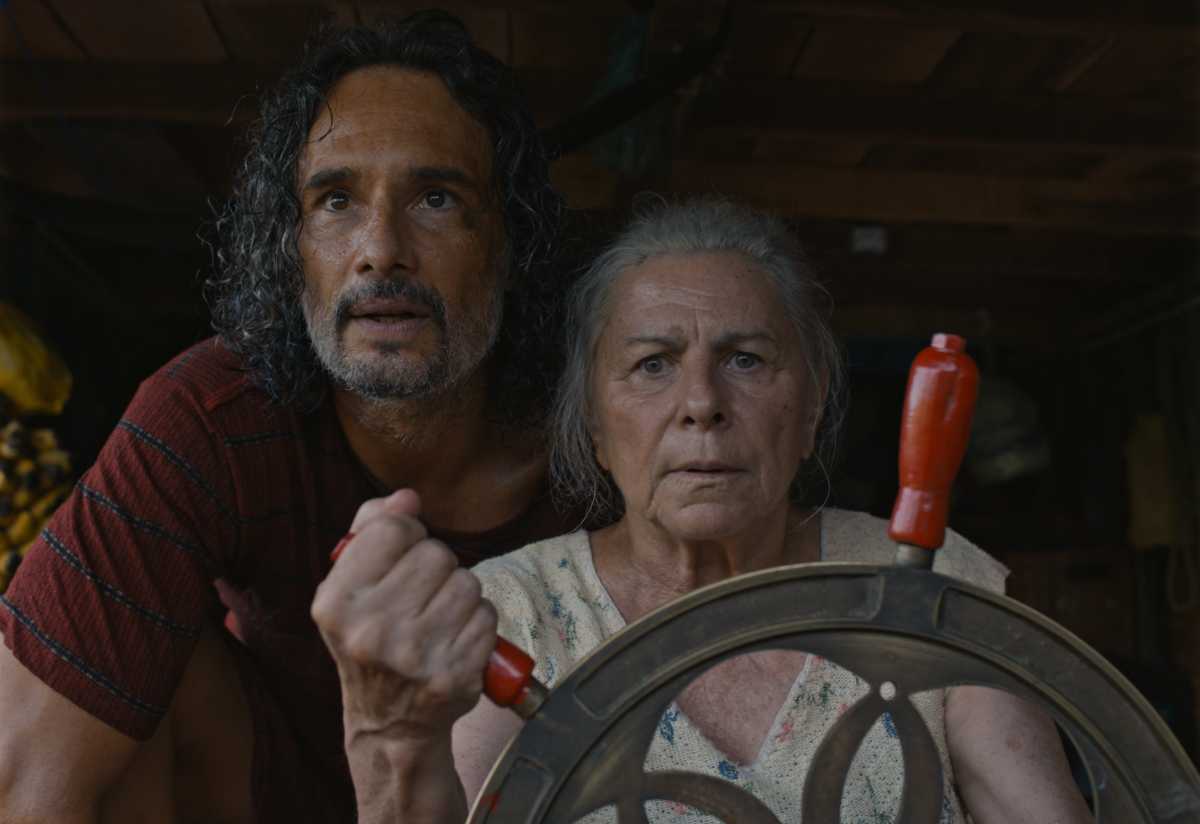
Bisexual writer/director Gabriel Mascaro’s (“Neon Bull”) fabulous new film, “The Blue Trail” is set in a dystopian Brazil, where everyone over the age of 75 is sent to “The Colony” to live out their remaining days. That prospect does not sit well with the indominable Tereza (Denise Weinberg, marvelous), a 77-year-old woman who has other goals. She wants to keep working—though she is forcibly retired from her job—and she wants to fly in an airplane. Alas, the rules of society dictate that her daughter, Joana (Clarissa Pinhiero) has to approve all her purchases, which limits her opportunities.
Tereza, however, asserts her autonomy in the face of authority, and goes on the lam, receiving help from Cadu (Rodrigo Santoro), who owns a boat; Ludemir (Adanilo), a gambler; and Roberta (Miriam Socarras), who sells bibles. As Tereza travels down the Amazon, she experiences the frustration of a blocked route, a psychedelic trip involving secretions from a Blue Drool Snail, and develops new friendships.
Mascaro spoke to Gay City News about his late-in-life coming-of-age drama, which won the Silver Bear Grand Jury Prize at last year’s Berlin Film Festival among other awards.
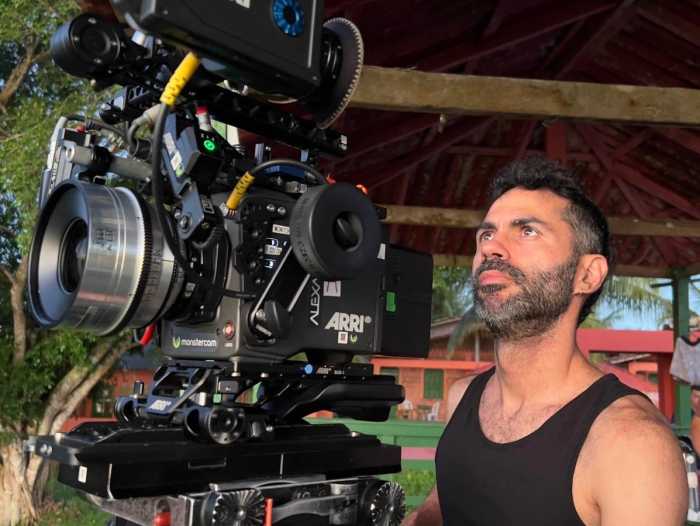
What inspired the dystopian worldview at the heart of “The Blue Trail”? You are critical of Brazilian authorities, how the elderly are treated, and are very class conscious, too.
My grandmother was eighty years old when my grandfather passed away, and it was then that she started painting. I was very inspired about this feeling of finding a meaning in life. I started researching movies about elderly protagonists, and I found that in general, the conflicts are associated to death or some illness or some kind of nostalgia about the past. I wanted to make a movie about the present. Dystopian, coming-of-age, and fantasy in general are genres associated with young people. It’s almost as if [we] do not allow elderly people to change, to have a rite of passage. The absence of elderly people in this kind of genre forced me to make a very playful movie with humor, but also address serious issues.
Can you discuss utilizing the road trip approach to tell Tereza’s late-in-life coming-of-age story?
We often associate elderly people with someone who is not open to learning anymore. I allowed this elderly woman to increase her understanding and keep learning. Tereza goes on a journey, and forges new friendships, creating new skills, and enjoying life. When she met Cadu, he tried the to get her to [ingest] the Blue Drool Snail, and she says, “No, I don’t want this;” she is uncomfortable. But when she meets Roberta, an even older woman, she feels comfortable to have that kind of experience.
What were your goals with the various characters Tereza meets—Cadu, Ludemir, and Roberta? There is a risk for them to help her, and there appears to be a real love that develops between Tereza and Roberta, that stops just short of sexual.
She is running away from the government, but that’s also the moment when she discovers herself and is still open to taking risks. There is this ambivalent feeling of seeing something that can be risky, but can also be very sexy in the same situation. That was challenging for us to be able to show that this elderly body is still open to discover lots of different emotions and feelings—even sexual feelings that have been dormant.
Animals play a very important role in this film. What meaning do you give to animals, such as the Blue Drool Snall that enables folks to see the future?
At the beginning of the movie, we have these alligators confined in this meat processing factory. You can feel this kind of heavy displacement of a reptilian icon that represents the wild fauna in Brazil. It is almost a cultural dystopic image, and we connect that idea with the main character also being confined.
When she starts her journey, Tereza is open to finding the utopia. The Blue Drool Snail represents some kind of utopic magic and the mysterious Amazonian power that can give the character a glimpse into [her future] life. The fighting fish [that are bet on] are also spectacular. The film plays with the different feelings of how these animals are being shown, and they resonate with what the character is facing emotionally.
Sound and music are used effectively here to convey emotions. Can you talk about your visual and aural approach to telling the story?
The soundtrack is very special because it allows us to play with genres that traditionally are not associated with each other. At the beginning of the movie, you have this almost dystopic opening, but the music is fabulist, almost picaresque, like there is some kind of like circus palette. The soundtrack is counter-intuitive which allows us go from reality to absurdism.
You are very deliberate in how you depict bodies. How did you consider presenting bodies here?
It was very important to allow these bodies to feel alive and open to new discoveries. We do not associate elderly bodies with that openness, so the movie works to allow Tereza to have a choice. Her body changes. Initially, she is conservative, and pro-regime, but she alters her perspective. She feels passionate about life. Her body is still pulsating. She has her first massage and her first [psychedelic] trip with the Blue Drool Snail. It is not like [the drug] ayahuasca, or something that already exists; it is a feeling we are creating from nothing to show how things affect her body in a positive way.
Several characters in the film gamble. Are you a gambler?
Actually, I’m not a gambler. My grandfather used to be a gambler. Every week he would gamble, and, of course, he lost so much more than he won. But sometimes he would win. Brazil is facing a huge gambling culture with online bets. I’m sure the U.S. is as well. It is really affecting a generation of young people in Brazil. I tried to reflect that as well—how gambling culture is part of our society again.
I appreciate that Tereza is determined to fly in an airplane before she dies. What is on your bucket list?
Oh, my gosh. Such a question! I want to think about it. I don’t have an answer, but I will think about that.
“The Blue Trail” | Directed by Gabriel Mascaro | Opening April 3 at the Angelika Film Center | Distributed by Dekanalog