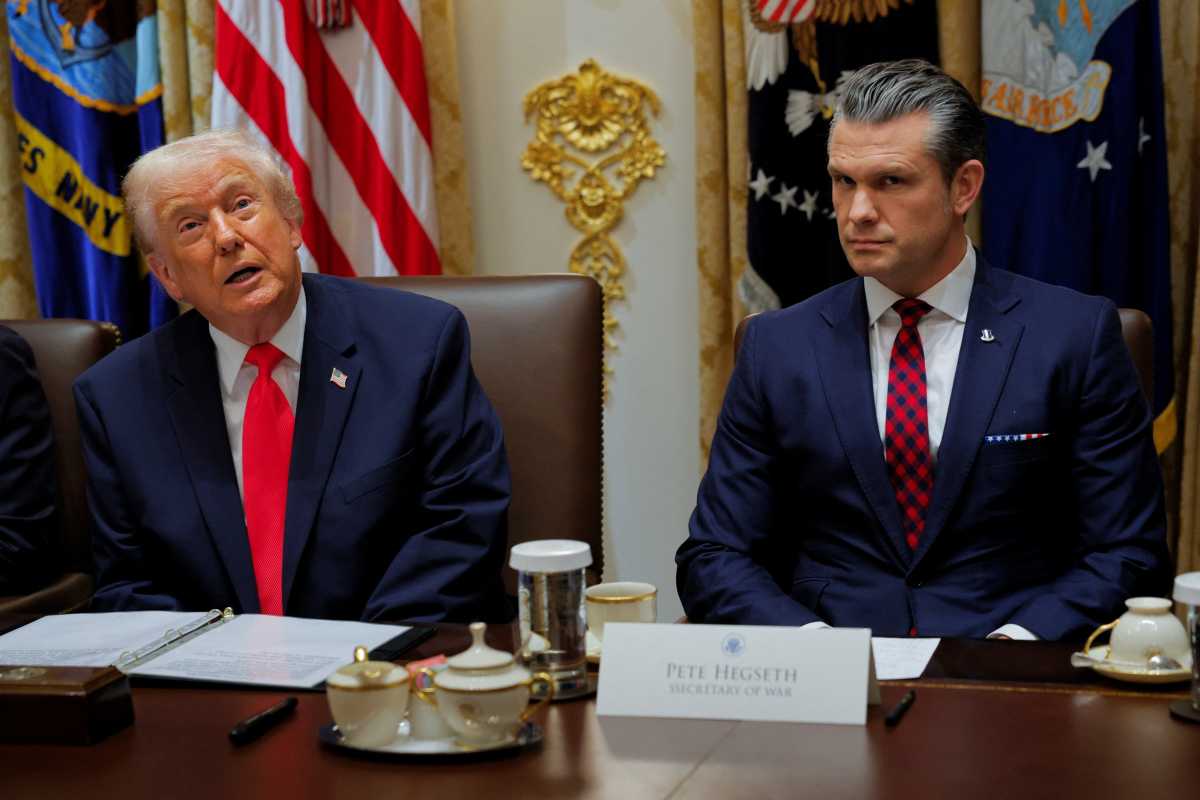
Ruling on Dec. 9 on the government’s appeal from a preliminary injunction against what the court calls the “Hegseth Policy” barring transgender people from serving in the military, two judges on a three-judge panel of the US Court of Appeals for the District of Columbia Circuit reversed the district court, claiming that it had “afforded insufficient deference to the Secretary [of Defense]’s considered judgment.” A dissenting judge pointed out that there was no “considered judgment” to which deferrence should be made. Although undoubtedly Secretary Pete Hegseth agrees with the policy he issued, it should be called the Trump Policy because it was directed by the president.
Judges Gregory Katsas and Neomi Rao, both appointed by President Trump during his first term, make up the majority of the panel, with Katsas writing the opinion. Judge Cornelia Pillard, who was appointed by President Obama, issued a lengthy dissenting opinion that completely eviscerates the order issued by the panel majority. District Judge Ana C. Reyes, an appointed of President Biden, issued the preliminary injunction.
On “Day 1” of his term on Jan. 21, President Trump issued an executive order denying the existence of transgender people, proclaiming as federal policy that there are only two sexes, male and female, as identified at birth and immutable. Trump’s executive order declared that “adoption of a gender identity inconsistent with an individual’s sex conflicts with a soldier’s commitment to an honorable, truthful, and disciplined lifestyle, even in one’s personal life,” and was “not consistent with the humility and selflessness required of a service member.” Trump gave Secretary Hegseth 60 days to carry out the executive order, and Hegseth moved quickly to issue the policy before the president’s deadline.
Hegseth’s policy says that anybody diagnosed with gender dysphoria, or exhibiting symptoms consistent with such a diagnosis, would be considered disqualified to enlist or to continue serving. According to Judge Pillard’s dissent, the Defense Department assigned personnel to go through service records to identify who would be dischargeable under this policy, as the Department did not actually have that information easily accessible and did not necessarily know of all the transgender individuals currently serving. The plaintiffs’ evidence showed that there are thousands, many of whom have won commendations and promotions for their work, thus giving the lie to Hegseth’s assertion that all transgender individuals are unfit to serve.
Hegseth’s policy was immediately attacked in US District Courts in Washington, DC, and Seattle, Washington, with district judges in both courts issuing preliminary injunctions, finding it likely that plaintiffs could prove constitutional violations of equal protection and that failing to block the policy would irreparably harm the plaintiffs.
The government quickly sought “stays” to block the preliminary injunctions from going into effect and appealed the district courts’ rulings. In the Seattle case, Shilling v. United States, an emergency request to the US Supreme Court resulted in a stay of the district court’s injunction. In the Washington DC case, Talbott v. United States, the US Court of Appeals in DC issued an “administrative stay” pending a decision on the government’s appeal of the preliminary injunction order. The Dec. 9 ruling dissolves the administrative stay, reverses the preliminary injunction, and sends the case back to the district court for a ruling on the merits.
The Supreme Court has long instructed lower federal courts that they should defer to professional military judgment in personnel matters, but that has never meant an automatic rubber stamp of whatever the military wants to do, since the Constitution is not suspended for military personnel. However, the courts are not expert in military matters, and due regard for national security and defense readiness has led courts to be deferential. The issue here is whether there is actually “considered military judgment” at work, but rather a knee-jerk implementation of Trump’s command based on Trump’s defamatory and unfounded statements about transgender people.
Judge Pillard points out at length and in detail that Judge Reyes compiled a substantial evidentiary record upon which she based her decision that the Hegseth Policy was not defensible under even a deferential standard of review, mainly because it ignored the best evidence pertinent to this case: the experience of the military beginning when President Biden, upon taking office in 2021, reversed the Trump Administration’s anti-trans military policy. It then became possible for trans people to “come out” and transition in the military and to enlist. Thousands have done so, and over the ensuing four years have compiled an admirable record of service. Indeed, senior military personnel from those years provided testimony upon which Judge Reyes relied in finding that Trump and Hegseth’s statements about transgender unfitness for the military service are not supported by the evidence, and that the military has benefited from the influx of transgender personnel.
Judge Reyes found that allowing the policy to go into effect would cause immediate harm to presently serving transgender people and would damage military readiness by abruptly removing thousands of trained military members who were rendering highly valued service. She found that public statements by Trump and Hegseth added to the conclusion that the policy was based on animus against people who identify as transgender, and not on any evidence that such people are unqualified for military service. Judge Pillard characterized the government’s arguments in support of the policy as “pretextual.”
On the other hand, even taking into account that the majority of the Talbott appellate panel are Trump appointees, they have the example of the Supreme Court’s unexplained decision to stay the preliminary injunction in the Shilling case, which means that a majority of the Supreme Court considers the Hegseth Policy probably does not violate the Equal Protection rights of transgender military personnel, at least as seen by the conservative super-majority of the Court. Judge Katsas’ opinion mentioned in passing the Court’s recent decision in Skrmetti v. US as providing additional support for Hegseth’s policy by raising questions about the efficacy and appropriateness of gender-affirming care as a treatment for gender dysphoria.
The Talbott plaintiffs could ask the full D.C. Circuit to reconsider this ruling. At present, the 11 judges of the Circuit include seven Democratic appointees and four Republican appointees. But such an appeal would run up against the Supreme Court’s stay in the Shilling case, so even the majority of Democratic judges in the DC Circuit might be deterred from rejecting the government’s appeal of Judge Reyes’ preliminary injunction.
Now that the “administrative stay” that the court of appeals had issued has been dissolved, the Defense Department can begin processing transgender personnel for discharge. According to the court’s description of the Hegseth Policy, these will be “honorable” discharges, but they are liable to have other adverse consequences for the discharged individuals beyond the loss of their employment. They may essentially “out” them to confront anti-trans bias in the civilian workforce, for example.
The plaintiffs in this case are represented by Jennifer Levi and Michael Haley, of GLBTQ Legal Advocates & Defenders, Boston; Shannon P. Minter and Christopher F. Stoll, of the National Center for LGBTQ Rights, Sacramento; Joseph J. Wardenski, New York City; Sara E. Kropf, of Kropf Moseley PLLC, Washington, DC.