At this year’s Sundance Film Festival — the last one being held in Park City, UT — there were more than a dozen features, documentaries, and shorts that were either created by LGBTQ filmmakers or addressed queer themes. Here is a rundown of a handful of titles that were available for preview.
“Public Access” is an entertaining documentary about the Manhattan Cable Television’s “experiment” that gave people the freedom for self-expression. Back in the early 1970s, anyone with an idea for a TV show could create their own programming — and they did. Director David Shadrack Smith traces the evolution of the medium of public access TV (and the power it had) with commentary by staff members and content creators. While providing a platform for alternative culture was a strength of public access TV, tensions around transgressive programming ignited First Amendment debates and lawsuits. Anton Perich pushed boundaries early on with one of his programs featuring a man being anally penetrated with a lightbulb. Another show, “Midnight Blue,” showcased pornographic content that raised all kinds of censorship issues. Smith’s documentary provides a handful of fascinating case studies, with the most interesting being about the content targeted to the LGBTQ community. This included the first gay talk show, “The Emerald City,” and Lou Maletta’s “Gay Cable Network” in the 1980s, which showed salacious content, but also provided programming that featured AIDS education and information during the height of the epidemic. (“Gay USA,” cohosted by Gay City News contributor Andy Humm, is very briefly seen in this segment.) “Public Access” certainly predicts the phenomenon of YouTube, as this well-edited documentary offers a quaint, nostalgic trip back to interesting and not-so-innocent times.
“Tell Me Everything,” by out gay writer/director Moshe Rosenthal is a compelling drama about the fraught relationship between a father and son in Israel. The first half, set in 1987, has 12-year-old Boaz (Yair Mazor) drawing away from his dad, Meir (Assi Cohen), after he spies his father having sex with another man at their local swimming pool. Boaz actively resists Meir, avoiding his touch and even ignoring him — especially as news of the AIDS epidemic spreads and Boaz fears his father has the disease. As his bar mitzvah looms, Boaz begins to further question ideas of masculinity and manhood. “Tell Me Everything” then jumps to 1996, where Boaz, now a young adult (Ido Tako), tries to reconcile his unresolved feelings about his father. He expresses his pain in a homophobic manner toward a male sex worker, but also tries to track Meir down. Seeking solace with an older man in a cruising area, Boaz has a series of encounters that may provide him with some catharsis. Rosenthal and his superb cast deftly convey each character’s intense emotional state, creating a palpable sense of loss and longing. This is a sensitive, touching drama.
Another film about catharsis is “TheyDream” by openly bisexual filmmaker William D. Caballero. This poignant documentary is made using various animation styles that are occasionally interspersed with home movie footage. Caballero builds miniature sets of his mother’s trailer home in Fayetteville, NC and uses them to animate and recount the experiences of his Puerto Rican family, including his father, who is diabetic, his late Gran’pa and Gran’ma, as well as his dog, Gustav. Caballero and his mother, Milly, find strength in each other, as they reflect on their lives, losses, and issues of mortality and art. Despite its emotional moments, “TheyDream” is often uplifting; it is especially charming when the filmmaker coaches his mother on how to record dialogue, or they recall her attending LA Pride one year. And watching them cut out rainbow wings that come to life through animation in one sequence is adorable. This is a heartfelt film about love and family.
“Barbara Forever” is a warm, elegiac, and celebratory documentary about the groundbreaking lesbian avant-garde filmmaker, Barbara Hammer, who passed away in 2019. She is first seen in director Brydie O’Connor’s film posing naked and flexing. It’s an apt metaphor for her life and work; she documented herself and her lovers in her films, and “opened a space for queerness” as there was little to no visibility for lesbians in cinema. Her shorts, such as “Dyketactics,” were invitations to explore female bodies and pleasure. Hammer’s significant body of work has been sold to the Beinecke at Yale, and “Barbara Forever” shows her partner Florrie Burke managing that undertaking. The documentary also recounts Hammer’s claim that she “was born” when she became a lesbian. She lived and worked in San Francisco and New York City creating films that were as experimental as lesbian and queer lives. She had a breakthrough with her first feature film, “Nitrate Kisses,” in 1992 (which played Sundance back in the day), and continued to make shorts right up until her death from cancer. Hammer talks with candor about trying to find a work/life balance, and it is engaging watching her negotiate with a lover about filming her or meditating on horses and dying. “Barbara Forever” is an illuminating portrait of the pioneering filmmaker.
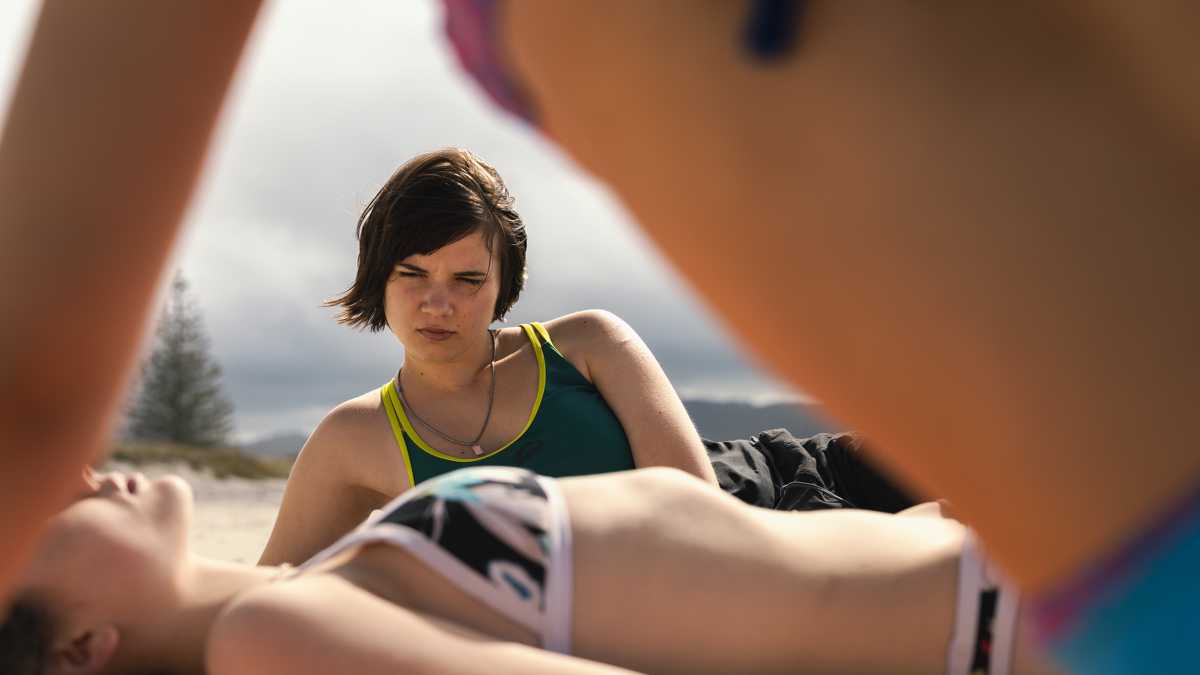
“Big Girls Don’t Cry” delicately captures 14-year-old tomboy Sid’s (Ani Palmer) painful coming of age during a hot New Zealand summer. Curious about sex, and desperate to fit in, Sid impulsively heads off to the beach with her sister, Adele (Tara Canton) and their American exchange student, Freya (Rain Spencer), leaving behind her bestie, Tia (Ngataitangirua Hita).
At the beach, Sid is able to befriend cool girl Lana (Beatrix Rain Wolfe), who invites her to parties, but Sid may be in over her head. While she claims to have experience with guys, Sid is quietly crushing on Lana and Freya, the latter of whom gives Sid some attention that empowers her. “Big Girls Don’t Cry” does not explicitly address Sid’s sexuality, but Palmer, in her film debut, is fantastic at expressing her teen angst — especially in her exchanges with her inept father (Noah Taylor).
In addition, a trio of shorts playing at Sundance featured queer content and characters.
The fantastic “Callback,” written and directed by Matthew Puccini, has boyfriends and actors Max (Justin H. Min) and Will (Michael Hsu Rosen) come to some hard truths about their relationship when one gets a callback for a role. The “good news” sets off a chain of conversations, and an acting contest that lays bare the power dynamics of their relationship — which involve issues of control, jealousy, truth, and trust. Darkly funny and featuring crackerjack timing by the two leads, “Callback” is a sharp short that blurs the lines between being sincere and being polite.
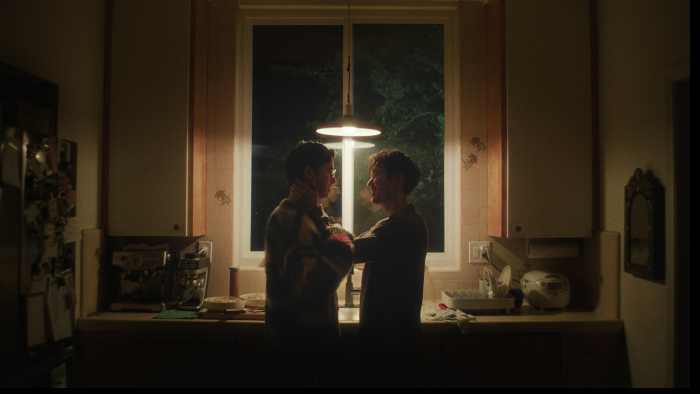
“Seniors” is a cute short about Tom (Noah Pacht), a gay teen, going on a college tour of Vassar with his parents, Nancy (Brooke Bloom) and Pete (Matt Walton). When Pete asks the campus’ colorful tour guide (Dan Thompson) about the school’s LGBTQ community, it embarrasses Tom, but Pete is really trying to be supportive of his son — because there are tensions between Pete and his wife. “Seniors” mines its humor out of the awkwardness of its situation and the cast’s performances are perfectly pitched. Writer/direct Adam Curley’s short is a bit slight, but it serves as a strong calling card for an idea that hopefully will be developed into a feature.
“Together Forever” depicts a Mormon couple, Sydney (Lindsey Normington) and Caleb (Samuel Sylvester), who are determining how to have sex on their wedding night. It is an initially fraught encounter, with her ready and willing, and him trying to work up the courage — and his manhood. Then Caleb suggests they try “roping,” a practice where they mutually masturbate in their garments and with a wall between them. This elaborate, amusing sequence, deftly edited and shot in closeup, has Sydney giving herself over to pleasure while Caleb fantasizes about the male DJ at their reception. “Together Forever” provides a clever depiction of how Sydney and Caleb manage to express their love both individually and as a couple. Writer/director Gregory Barnes’ comedy uses music and visuals to convey ideas of self-awareness and longing, but it stings with irony.