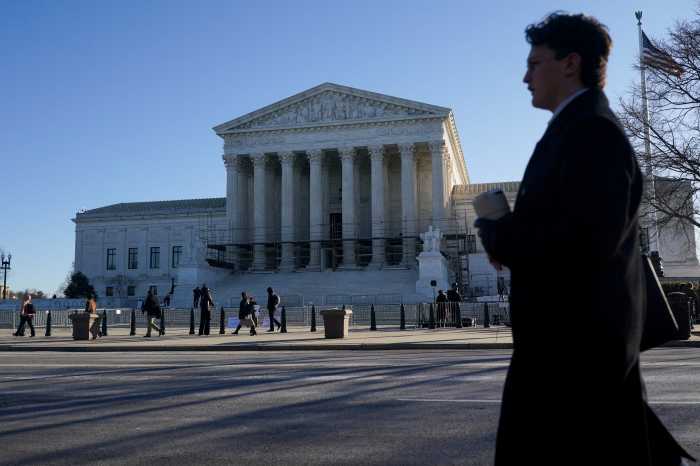
On Oct. 7, the US Supreme Court heard arguments in Chiles v. Salazar, a lawsuit challenging Colorado’s ban on licensed health care professionals practicing “conversion therapy” on minors. A similar lawsuit was pending before the Sixth Circuit Court of Appeals posing an identical challenge to Michigan’s conversion therapy ban, as to which the district court had denied the plaintiffs’ motion for a preliminary injunction to block enforcement of the law.
The state urged the Sixth Circuit panel to put the plaintiffs’ appeal on hold and wait for the Supreme Court’s decision in Chiles before ruling. But the Sixth Circuit three-judge panel, by a vote of 2-1, decided to go ahead anyway, held oral arguments on Oct. 23, and issued its decision on Dec. 17, less than two months later. Meanwhile the Supreme Court continues to deliberate about Chiles, and being on holiday break, is unlikely to issue a decision until sometime next year, perhaps as late as June.
The majority of the Sixth Circuit panel, Circuit Judges Raymond Kethledge (appointed by President George W. Bush) and Joan Larsen (appointed by President Donald J. Trump), reversed the district court, holding that the conversion therapy ban involved pure speech and most likely violated the First Amendment rights of licensed health care practitioners, and sent the case back to the district court “for prompt entry of a preliminary injunction consistent with this opinion.” The opinion by Judge Kethledge was relatively brief.
Circuit Judge Rachel Bloomekatz (appointed by President Joe Biden) dissented in a lengthy opinion — twice as long as the majority opinion — both opposing the majority’s decision to issue a ruling without waiting for the Supreme Court to speak and explaining why the district court’s decision to deny a preliminary injunction was correct.
Commentators were almost unanimous in predicting, based on hearing the oral arguments, that the Supreme Court’s 6-3 conservative majority of justices appointed by Republican presidents would strike down the Colorado ban, but doing so would be inconsistent with their ruling in US v. Skrmetti last June that the state’s power to regulate medical practice should prevail in upholding Tennessee’s law against licensed health care practitioners providing gender-affirming care for minors with gender dysphoria.
The Skrmetti decision, although greeted with dismay by advocates for transgender rights, gave some hope that the state laws banning conversion therapy for minors could be upheld, consistent with the power of the state to regulate the practice of medicine, but there is no “law” that the Supreme Court has to be consistent in its application of the Constitution, as it has shown frequently in ruling on Trump Administration motions seeking to stay district court injunctions against blatantly unconstitutional actions by the administration.
Judge Kethledge’s opinion for the panel majority, following the lead of an 11th Circuit ruling on a local government conversion therapy ban in Florida, Otto v. City of Boca Raton, took at face value the allegations by plaintiff Catholic Charities of Jackson, Lenawee and Hillsdale Counties (Michigan), which employs counselors who provide conversion therapy to minors (usually at the insistence of the minors’ parents), and co-plaintiff Emily McJones, an independent conversion therapy practitioner, that their practices consisted entirely of psychotherapy conducted by speech, and did not involve any of the “aversive” techniques of the bad old days when practitioners used electric shock treatment or induced nausea in patients in an attempt to change their sexual orientation or gender identity.
As such, Kethledge’s opinion insists, this is only about content-based regulation of speech, which invokes “strict scrutiny” requiring the state to show a compelling interest that was sufficient to justify outlawing the practice entirely. Judge Bloomekatz explained in detail that Kethledge’s opinion is a flawed use of precedent, and counters a long history of state regulation of the practice of psychotherapy, which is traditionally considered a form of medical practice.
Under the extensive body of precedent cited and explained by Judge Bloomekatz, states have long prohibited psychotherapeutic practices that have been shown to be harmful, and the Michigan legislature was presented with strong evidence that conversion therapy had harmful effects on minors who were subjected to it, sufficient to justify the incidental burden of practitioner speech. She criticized the lack of any “limiting principle” in Kethledge’s opinion, which could result in all psychotherapeutic practice being exempt from any state regulation.
Furthermore, she noted, what the Michigan law prohibits is using psychotherapy to attempt to change a minor’s sexual orientation or gender identity, but the law makes no prohibition on practitioners expressing their opinions about conversion therapy outside of the context of treatment. They are free to speak publicly and to their patients, just forbidden to practice a form of medical treatment. And, the judge points out, the plaintiffs treat this like any other medical treatment, requiring written informed consent from both parents and the minors. The important point, according to the dissent, and to federal courts that previously upheld conversion therapy bans in New Jersey and California, was distinguishing between conduct (providing a medical treatment that uses speech as its methodology) and pure speech.
Acknowledging that the Michigan ban had an incidental effect on practitioner speech, Judge Bloomekatz would subject it to heightened scrutiny, not strict scrutiny, and found that the Michigan legislature received substantial evidence of the harm this treatment would cause, more than enough to meet the requirement that the law would substantially advance a legitimate state interest, in this case to protect minors from harm. She argued that the strong weight of professional medical association opinion against conversion therapy, which Kethledge’s opinion virtually ignores, provides significant backing to the legitimacy of the ban on this practice.
As the Chiles case was argued in the first week of the Supreme Court’s 2025-26 term, it is possible that an opinion will be issued when the court returns from its holiday recess in January. But most cases involving LGBTQ issues are not decided unanimously by the court and thus opinions are usually not issued until the spring, regardless of how early the arguments are held, because it takes more time to generate the majority, concurring, and dissenting opinions from cases about which the court is divided, and the oral arguments made it clear that the court will be divided about Chiles v. Salazar.
Judge Kethledge’s decision suggests that the court would benefit from having another court of appeals decision to consider. What this reader hopes is that Judge Bloomekatz’s thorough and persuasive dissent might persuade some of the Republican appointees on the court to join with the Democratic appointees in upholding Colorado’s statute, in which case Michigan could then seek to get the full Sixth Circuit to vacate the panel decision and issue a decision consistent with the Supreme Court’s ruling in Chiles. But perhaps this writer is too optimistic.