This year’s edition of Queering the Canon, a festival dedicated to promoting classic LGBTQ films, offers seven features about queer lives in small towns.
The program opens March 26 at 7:30 pm with a 2K restoration of the “Desert Hearts.” Director Donna Deitch’s film, set in 1959 Reno, respectfully depicts the love that develops between Vivian (Helen Shaver), an English professor waiting out a divorce, and Cay (Patricia Charbonneau, in a remarkable debut), who works at a casino and lives on the ranch where Vivian is staying. Vivian is prim and proper and wants to “be free of who I’ve been,” while Cay is reckless; the sexy young woman is seen driving backward when she first meets Vivian. Their slow-burn attraction heats up when the women kiss in the rain, but their relationship soon has local tongues wagging. The film’s sensual love scene is why the film still melts hearts decades later. “Desert Hearts” is beautifully made and acted and worth seeing or re-watching.
Deitch will participate in a Q&A following the screening.
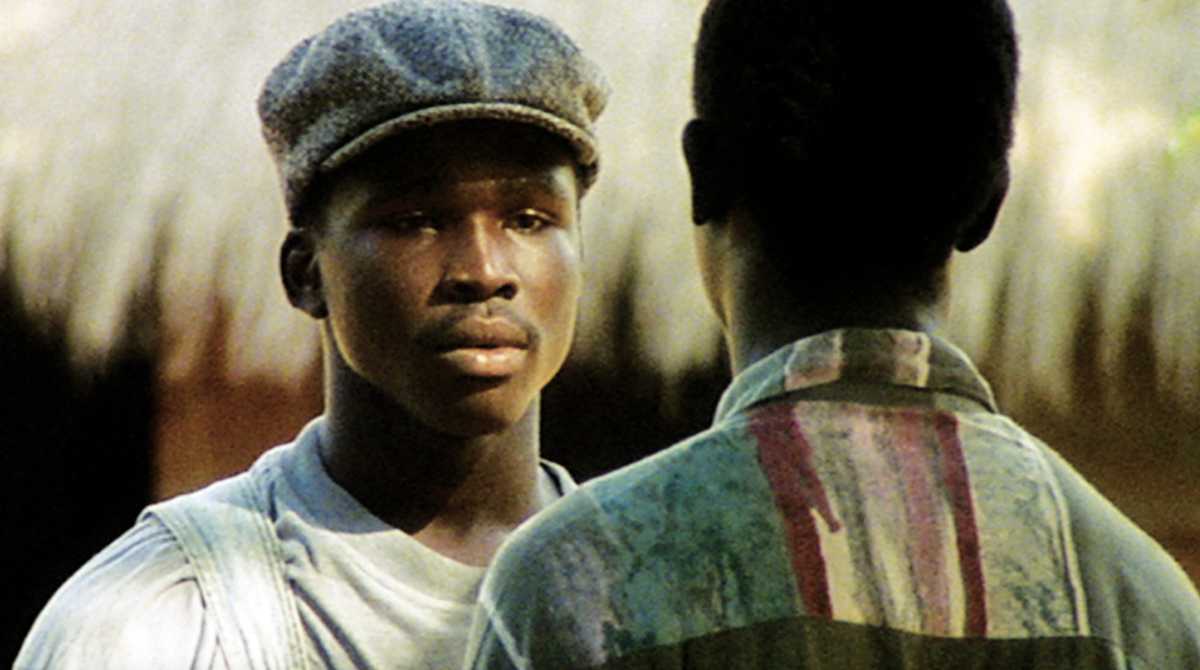
“Dakan” (aka “Destiny”), the first queer film from West Africa, opens with Manga (Abdoucare Touré) and Sori (Mamady Mory Camara) kissing passionately in a car. These teenagers are in love, but their parents react badly to that news. Manga’s mother (Koumba Diakite) tries to “cure” her son with witchcraft; Sori’s father (writer/director Muhammad Camara) forbids the teens to be together. When Manga later meets Oumou (Cécile Bois), a white woman, he tries to have a relationship with her, but he insists he is, “not made for women.” He just can’t quit Sori. “Dakan” is an important and worthwhile film for its depiction of homosexuality in Africa, and Camara tells this story well.
The in-person screening, on March 27 at 7:30 p.m., will feature an introduction by Amir Adem. “Destiny” will also be available virtually nationwide March 26-30.
Queering the Canon will present a 30th anniversary, in-person only screening in 35mm of the quirky comedy, “Waiting for Guffman,” on Saturday, March 28 at 4 p.m. In Blaine, MO, Corky St. Clair (Director/cowriter Christopher Guest) hopes to impress the titular Broadway representative with his homespun sesquicentennial musical, “Red, White, and Blaine,” starring local (and amateur) actors, including travel agents Ron and Sheila Albertson (Fred Willard and Catherine O’Hara), dentist Allen Pearl (Eugene Levy, who cowrote the screenplay), and Dairy Queen employee Libby Mae Brown (Parker Posey). The cast is inspired, with an especially amusing scene unfolding at a Chinese restaurant. Another highlight is Corky coming on to Johnny Savage (Matt Keeslar), who participates in the show’s rehearsals. The final production is fun, but the post-production sequence may yield some of the film’s biggest laughs.
Lukas Moodysson’s auspicious feature debut, “Show Me Love” will screen in a new 2K restoration. When the sullen Agnes (Rebecka Liljeberg) has her 16th birthday party, she gets an unexpected kiss from her crush, Elin (Alexandra Dahlström). But the kiss was a bet Elin made with her sister, Jessica (Erica Carlson). When Elin and Agnes spend some real time alone together, they bond and kiss for real. However, Elin also (fake) dates their classmate Johan (Mathias Rust) as a cover for her budding same-sex longings. “Show Me Love” depicts the pain Agnes feels as Elin ignores her and the pressure Elin experiences not being able to express herself authentically. Made in 1998, the film delivers a happy ending, which is why this raw look at teen love is so beloved.

“Show Me Love” is screening in person March 28 at 7:00 pm and available virtually nationwide March 26-30.
Queering the Canon will also host a 25th Anniversary of the celebrated, award-winning 2001 documentary “Southern Comfort” on March 29 at 5 p.m. Director Kate Davis chronicles the last year of Robert Eads, a terminally ill trans man in the Toccoa, GA. This life-affirming film spends time with Robert and his chosen family, which includes Lola, his trans girlfriend, as well as his trans friends Cas and Max and their partners. They talk about surgeries and a healthcare system that largely fails them by refusing treatment or treating them poorly. Robert also spends time with his son and grandson and talks about the struggles he had as a young girl — what he calls his “cross-dressing phase” — along with the difficulties he had with his biological parents. Near the end of the film, Robert and his friends attend Southern Comfort, a trans conference which he describes as “the cotillion of the trans community,” likening it to a “coming out party.” Davis’ film effectively and empathetically presents its subjects as they are — and they are endearing.
“Southern Comfort,” will screen in person March 29 at 5:00 pm with a Q&A with director Kate Davis. The film will also be available for streaming March 26-30.
Screening March 30, at 7 p.m. is “The Place Without Limits,” Arturo Ripstein’s 1978 screen adaptation of Chilean writer José Donoso’s celebrated, 1966 novel, “Hell Has No Limits.” This absorbing melodrama centers around the trans Manuela (Roberto Cobo) eking out life in a dying Mexican town. Don Alejo (Fernando Soler) plans to buy the whole town so he can resell it — but the lone holdout is a bordello owned by La Japonesa (Lucha Villa) where Manuela dances. When Manuela performs one night, a group of men throw her into the river. Then La Japonesa makes a bet with Don Alejo that she can have sex with Manuela; if she wins, she gets to save her establishment. “The Place Without Limits” provides a marvelous showcase for Cobo’s delicate performance. It is offset by the macho Pancho (Gonzalo Vega), a trucker who returns to town and causes trouble for Manuela. Ripstein films this hothouse drama with noticeable elan, especially in an artfully composed sequence where Manuela spies on Pancho through a broken window.
The film’s March 30 screening will be followed by a Q&A with Nicholas Pedrero-Setzer. The film will also be available for streaming virtually March 26-30.
Lastly, Queering the Canon offers a virtual exclusive March 26-30 of “Greetings from Out Here,” Ellen Spiro’s affectionate 1993 documentary. The film provides a snapshot of queer people in the American South “being who they are where they are.” Exploring Southern gay subcultures, Spiro attends a gay rodeo in Texas, and then heads to Beaver, Arkansas, to visit with the gay men who publish “Monk Magazine.” At Mardi Gras in Louisiana, she meets a funeral director by day and drag queen by night, before trekking to Okolona, Mississippi, where she talks to John, a man living with HIV. She also attends both a women’s festival in Georgia and Atlanta’s gay pride parade. These and other encounters documented in “Greetings from Out Here” celebrate queer life, even though some interviewees recount facing discrimination, and Spiro is a marvelous tour guide.
For tickets or more information, visit https://newfest.org/queering-the-canon-were-out-here/
“Queering the Canon” | BAM Rose Cinema | March 26-30.