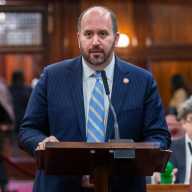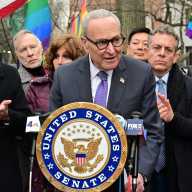

Brian Romero, a progressive queer activist whose background spans from social work to the State Legislature, is taking his own shot at a campaign for State Assembly in his hometown district in Queens — and the Democratic primary race is heating up.
Romero is running in Queens’ District 34 (Astoria, Corona, East Elmhurst, Jackson Heights, and Woodside) in a bid to succeed his old boss, Assemblymember Jessica González-Rojas, for whom Romero served as chief of staff before moving over to work for State Senator Kristen Gonzalez. González-Rojas, for her part, is leaving her Assembly seat to mount a primary challenge against State Senator Jessica Ramos in District 13.
Some of the top issues for Romero’s campaign include taxing the wealthy, building affordable housing and protecting tenants, funding the MTA and making buses fast and free, enhancing protections for immigrants, passing the New York Health Act to deliver universal healthcare throughout the state, and expanding access to gender-affirming care.
“I spoke to some neighbors, including Jessica [González-Rojas], and they all thought, you know, you grew up in the district, you went to school in the district, and you’ve served it,” Romero said in a recent interview with Gay City News, highlighting his local roots across the district. “I grew up in the community. I care deeply for it. It is somewhere where I grew up as a queer kid, but I also grew up in a basement apartment in East Elmhurst. I went to school in North Astoria and I’ve lived in NYCHA. Jackson Heights is really important to me for the activism that helped raise me as a queer activist and later as a professional advocate and a legislative staffer.”
The Assembly race in District 34 has kicked into high gear in the new year. Outgoing Congressmember Nydia Velázquez threw her support behind Romero’s campaign, while a New York Daily News story indicated that Mayor Zohran Mamdani expressed support for another Democratic candidate, Aber Kawas, who was endorsed by the Democratic Socialists of America (Romero is also member of the Democratic Socialists of America). Still, Mamdani has not made a public endorsement in the race.
Meanwhile, Romero’s endorsements include the Working Families Party, Make the Road Action New York, and several queer political leaders, such as González-Rojas, Manhattan Assemblymember Tony Simone, Bronx Councilmember Justin Sanchez, and former Councilmember Danny Dromm, who previously chaired what is now known as the City Council’s LGBTQIA+ Caucus.
This year’s election coincides with the departure of multiple out state lawmakers, including State Senator Brad Hoylman-Sigal, who is now the Manhattan borough president, and Assemblymember Deborah Glick, who is New York’s first out state lawmaker. Glick announced last fall that she was not running for re-election. Out Assemblymember Daniel O’Donnell also left office at the end of 2024 after he opted against running for re-election.
Romero’s campaign follows years of dedicated political involvement at the intersection of policy and activism. Before working in the State Legislature, Romero built up a foundation of community work experience, including serving as the policy and census manager at GMHC, where he advocated for key LGBTQ issues like legislation to provide free PrEP to survivors of sexual assault and a campaign to repeal a discriminatory loitering law known as a ban on “walking while trans,” which was used to unfairly target transgender women, particularly trans women of color. Romero said he was recruited to GMHC by the late Cecilia Gentili, a beloved trans activist whose tragic death in 2024 devastated New York City’s LGBTQ community.
Romero, who received a Gay City News Impact Award in 2021, also served in other influential roles, including as president of the Stonewall Democratic Club of New York City, a citywide LGBTQ political club, though he subsequently resigned from the club in 2021 — when he was no longer president — after Stonewall’s membership voted to uphold its endorsement of then-mayoral candidate Scott Stringer, who was facing sexual misconduct allegations.
By then, Romero had made further inroads in mainstream politics. Already working in the State Legislature, he went on to become a Democratic state committee member, further laying the groundwork for a future political run.
Romero’s government work stretches back to his internship with the City Council more than a decade ago — a role that paved the way for him to explore a career in social work. In fact, Romero makes no secret of his background in social work — his Instagram profile lists his name as Brian Romero, MSW — even as his career has moved in a different direction. His internship in the City Council, Romero said, showed him there was a real need to provide direct services in the community, so he pursued what he described as “the social worker route” in school and became a psychotherapist.
“I think what [my social work background] has provided me is a couple of things that make me a stronger candidate: Social workers are trained automatically to think about things in the personal environment and context, so we don’t just see the person in front of us,” Romero said. “We don’t just see the person who comes in for constituent services. We see them in a broader context of, this person is coming to us to apply for SNAP or healthcare because maybe they don’t have access to services or non-profits in the area that speak their languages, or they don’t know how government functions and how to apply for these services, or they just don’t know where to go.”
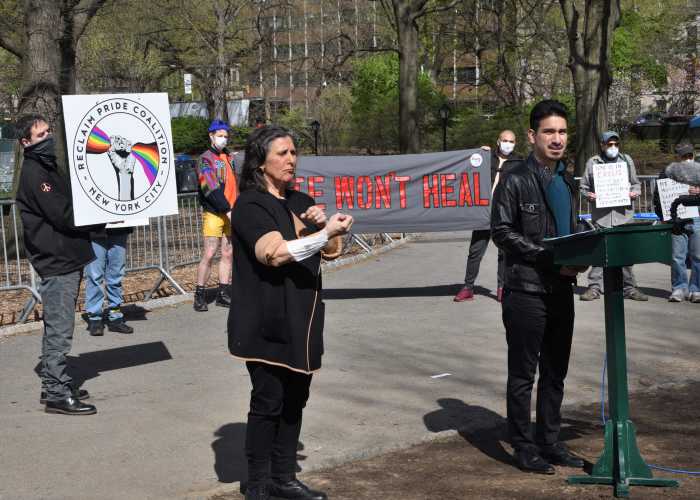
In speaking about some of the most pressing issues facing the district and the state, Romero emphasized the importance of standing up for transgender individuals during an era of relentless attacks from the Trump administration.
“When I was in Jessica González-Rojas’ office, I drafted a bill that she now holds with Senator Kristen Gonzalez to establish a gender-affirming care fund, which would provide state dollars to non-profits and providers who are trying to provide gender-affirming care services or therapies or treatments to individuals who need them,” said Romero, who added that cuts to Medicaid and the broader attacks on trans individuals further demonstrates the need for such a fund.
Romero further stressed that the passage of the New York Health Act would help support trans New Yorkers by ensuring that the community can access gender-affirming care.
Among other issues impacting the LGBTQ community, Romero envisions the state taking a more active role in combating bullying. He acknowledged that the passage of the Dignity for All Students Act — a measure intended to protect students from bullying, discrimination, harassment, and more — was “great and important,” but said it wasn’t implemented or funded as well as it could have been.
“I think we need to go back to that issue, look at its efficacy, and provide real funding and support for our students who are experiencing bullying, who need support, who need to feel safe in school in order to do well academically and be mentally well,” Romero said.
Romero also underscored the need for New York State to double down on the campaign to fight HIV/AIDS, which he said requires a multi-pronged effort that includes healthcare campaigns, like expanding PrEP access, as well as housing support.
“For some time, we had a road map to end the HIV epidemic in New York State, but we have sort of diverted from that,” Romero said. “And with the federal government cutting funding for HIV and AIDS, I think it’s time for us to reinvest that work here. That goes back to housing. We have HASA (the HIV/AIDS Services Administration, which assists individuals living with HIV or AIDS) in New York City, but we don’t have it statewide.”
Housing issues hit close to home for Romero, who lived in NYCHA for over a decade and whose family became homeless when he was seven years old — a traumatic experience that led him to fall asleep in class and struggle to eat well.
“It was a really difficult time, and I don’t think that in a city or a state that has as many millionaires and billionaires as we have, that should even be a thing,” Romero said. “So I am deeply committed to working to support the mayor in his mission to ensure that no student, no child, is homeless in our city or state.”
The Democratic primary election will take place on June 23 — just days before Pride Sunday in New York City. Until then, Romero plans to blitz the district and convince voters that he would be the candidate who “will be ready on day one.”
“My campaign is different from the others in that I have five years of state legislative experience, which I think is very important, especially now,” Romero said. “I know my neighbors. I know the neighborhoods. I know their different policy interests because we have surveyed them.”
Romero touted his Spanish language fluency — “It’s a majority Latino district,” he said — and said he plans on talking with his neighbors and listening to them about their needs.
“I’ll win by doing what I’ve always done, which is to be an organizer in government who knows how to deliver for every day people,” he said.