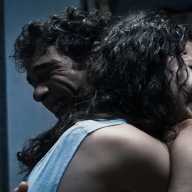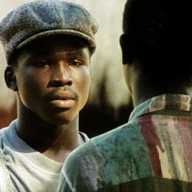
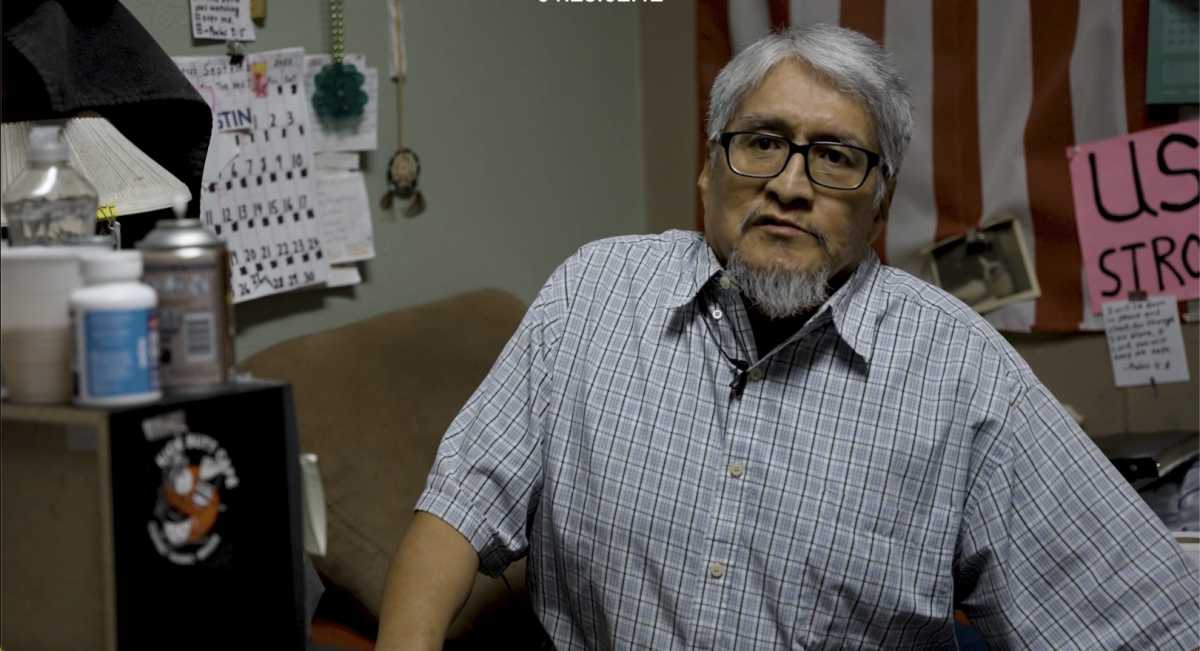
The sad case of James Harry Reyos is the subject of the adequate true crime documentary, “Night in West Texas.”
Back in 1981, Reyos was convicted and sentenced to 38 years in jail for killing Father Patrick Ryan, a Catholic priest, in a hotel room in Odessa, Texas. Father Ryan, who was closeted, had met Reyos the night before his murder. After an unwanted sexual encounter, Reyos, who was also gay and closeted, returned home. However, the next day, Reyos asked Father Ryan to drive him to New Mexico to retrieve his truck. Father Ryan obliged, and after leaving Reyos, returned to Texas. The priest was later discovered naked, with his hands bound with rope behind his back, and beaten to death in a hotel room.
Reyos claimed innocence, but 11 months after the crime, he gets drunk and high and calls the police to confess — only to recant after he sobers up. Now, 20 years after serving 20 years of his sentence, Reyos is seeking justice with the help of Allison Clayton from the Innocence Project of Texas.
“Night in West Texas” chronicles the days leading up to Reyos’ exoneration hearing with flashbacks to the past that shed some light on Reyos’ life and story. He describes being afraid to come out as gay even when asked about his sexuality in 1983 in the trial that convicted him. Reyos neither confirmed nor denied his sexual orientation, he explained, because his father was sitting in the courtroom, and he feared his response.
The film emphasizes the dangers of being gay in West Texas in 1983 as Buzz Bissinger (author of “Friday Night Lights,” which was set in Odessa) inexplicably appears as a talking head stating that he wouldn’t be openly gay in that town. Moreover, while questions are raised about why Father Ryan was naked, bound, and beaten, no one considers that the crime was a sexual assignation gone wrong. Instead, it is suggested that Reyos was a fall guy to protect the reputation of the Catholic priest.
Reyos explains that guilt prompted him to confess, but he also suffered from alcoholism, which had already cost him his job working in the oil fields of West Texas by the time he met Father Ryan. Reyos has other benders, including one coming during a critical time that becomes concerning for Clayton and her case.
Regrettably, the film shows too little of the psychological impact that Reyos has suffered during his ordeal. It would have been more powerful if director Deborah S. Esquenazi got him to talk about how he processes his situation. Instead, much of the documentary is focused on Clayton. This makes the film feel like an 83-minute advertisement for Innocence Project of Texas. Still, their work is important, and there are a few insights, as when Clayton explains that in cases such as this one, it is not enough to prove wrongful conviction, one must also provide evidence that points to the guilty party — a sometimes near impossible task.
To this end, the film reveals that a true-crime podcast spurred Odessa Police Chief Mike Gerke to help reopen Reyos’ case 40 years later. Moreover, Sergeant Scottie Smith found fingerprints of three men from the crime scene who are likely the men who murdered Father Ryan. (The system used to identify the fingerprints did not exist in the 1980s). That said, if any real investigation of those men was pursued, “Night in West Texas” does not show it. But it does provide an emotional moment for Reyos when he is informed about three suspects hours before his exoneration hearing. Why he wasn’t informed about them sooner is curious. Esquenazi also doesn’t provide much detail about what happened after the exoneration hearing — especially since it is stated that Reyos is entitled to a cash settlement if freed.
“Night in West Texas” builds little suspense as Reyos’ case heads to its conclusion and its aftermath, but perhaps it does not need to because the story does not feel especially complex. There are very few surprises here; apparently Reyos was convicted back in 1983 just because he was gay and Native American.
Reyos’ story is a shameful travesty of justice. Unfortunately, Esquenazi’s film is an oddly underwhelming feature. It could have been more potent as a documentary short.
“Night in West Texas,” Directed by Deborah S. Esquenazi. Opening December 5 at the Cinema Village. Distributed by The Film Collaborative.