During Sophie Hyde’s “Jimpa,” a director wonders if it’s possible to make a compelling film setting conflict aside. The character’s a stand-in for Hyde herself, and her ideas resemble the film she went on to make. Alas, the passion Hyde must feel about staging a version of her own life got lost along the way.
The president of their LGBTQ student club in Adelaide, Australia, non-binary teenager Frances (Aud Mason-Hyde, the director’s child) chafes at the constraints of provincial life. They’ve long romanticized their grandfather, nicknamed Jimpa (John Lithgow), who fled Australia for Amsterdam after coming out as gay. They idolize Jimpa, giving a presentation about him as their hero. When their family plans a trip to visit, Frances springs the notion of staying with him for a full year. Their mother Hannah (Olivia Colman), a filmmaker, plans a project about the marriage between Jimpa and her mother. Once Frances arrives in Amsterdam and talks with Jimpa, the differences between a cis gay man in his ‘70s and a non-binary 16-year-old become quite visible. They also experience their first relationship, dating a slightly older queer girl.
Dialogue representing these conflicts tends to be blunt and on-the-nose. Jimpa doesn’t believe bisexuality is real, and he struggles with the concept of non-binary identity. For him, everyone’s sexuality and gender can be neatly summed up in a word, and he’s suspicious of the complicated way Frances explains their desires. (They like women, trans men and non-binary femmes.) He struggles with the use of “they” as a singular pronoun. His friends may not entirely agree, but they’ve become used to such bloviating over decades.
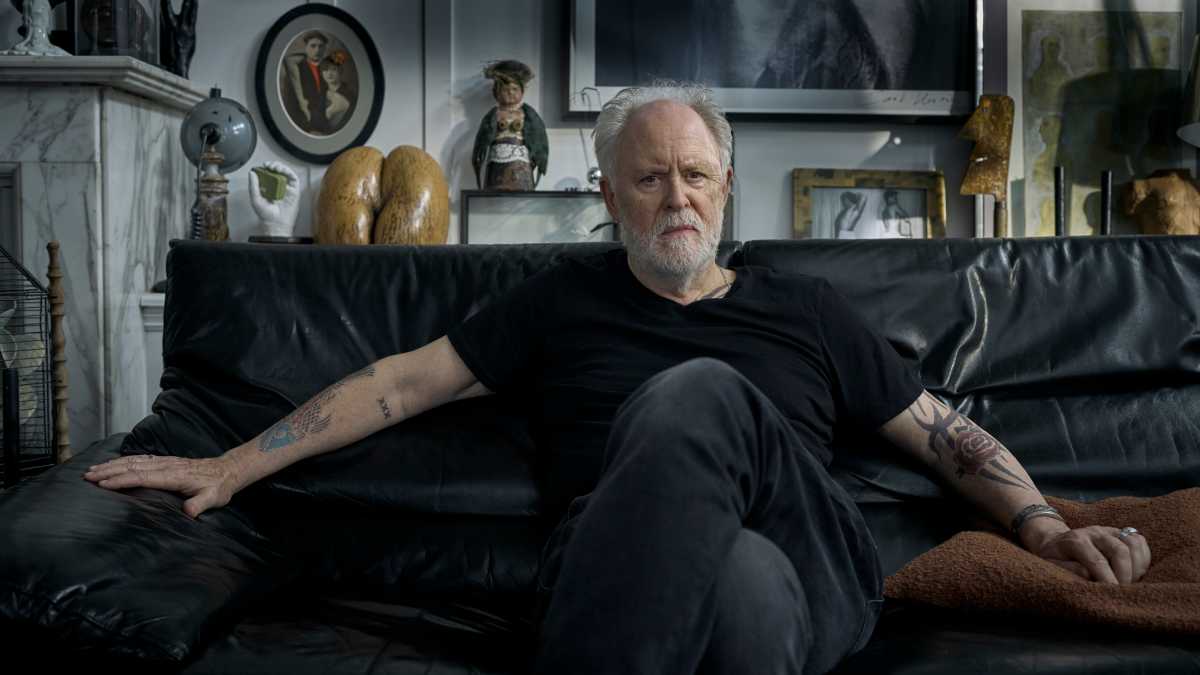
As portrayed by Lithgow, Jimpa’s a man who expects to be at the center of attention. He’s very proud of his opinions. He holds court rather than simply having conversations, turning them tiresome and arrogant. Lithgow does a decent job with the character’s Australian accent. His look, including elaborate tattoos, was taken from the real man Jimpa’s based on. Lithgow gets a kick out of playing daddy, including nude scenes.
Even in old age, Jimpa and his friends have a very clear picture of their younger selves. Flipping between the present and brief scenes of her characters’ memories, “Jimpa” never risks getting lost. The past only intrudes upon the present in the most schematic ways. Hyde cranks up kitschy slow motion shots that drain the vitality from her images. (Critic Siddhant Adlakha compared them to a Ford car commercial.) When Jimpa and Frances eat weed gummies and dance, the effect would be punchier if we heard something stronger than tepid ambient music.
To return to Hannah’s Zoom conversation, “Jimpa” does generate drama from conflict, but it’s all rather pat. The film intends to demonstrate how people can disagree while still loving each other. Even more so, it shows that family history can become a tissue of half-truths. It’s not exactly unrealistic for a man in his 70s to hold narrow-minded opinions, but Frances and Jimpa bond in a manner that feels too quick and convenient. They’re not nearly as hurt by his enbyphobia as they might be. A real non-binary person might be less than thrilled to be called “grandthing” by their grandfather. “Jimpa” lays out how queerness has come to be about gender as much as sexuality, without delving into the ramifications.
AIDS defined Jimpa’s generation of gay men, but rather than expressing its impact in more subtle ways, “Jimpa” stages a conversation that sounds like an explainer. Jimpa is HIV-positive and has a background in activism. He also cuts his hand while chopping vegetables with a knife, bleeding over them, and bringing up the spectre of Hannah’s possible reaction.
Several other scenes, like the one where Jimpa shows Frances a “Dorothy’s best friend” button, feel even more like pretexts for a TED Talk.
After “Jimpa” premiered at Sundance in January 2025, to so-so reviews, 10 minutes were trimmed. Despite the edit, the film still juggles its runtime clumsily. The desire to avoid the trauma plot is laudable. While Frances faces many challenges, their parents are accepting and their high school experience is more alienating than overtly oppressive. But in order to present a happy family, “Jimpa” has to defuse the very tensions it summons as soon as they’re brought up.
“Jimpa” | Directed by Sophie Hyde | Kino Lorber | Opens Feb. 5th at the Quad