Backlashes say as much about culture as the media they’re aimed towards. With her first two films, “Raw” and “Titane,” French director Julia Ducournau was a rising star. In 2021, “Titane” won the Palme D’Or at Cannes, only the second film made by a woman to do so. Although both these films fit into body horror, “Titane” found her working on a larger scale. The Cannes premiere of “Alpha” last year was a far different experience. Critics treated it as a major letdown. Reviewing it for “The Guardian,” Peter Bradshaw gave it one star out of five, damning it as “strident, oppressive, incoherent and weirdly pointless.”
Watching “Alpha” the day after I saw Ian Tauson’s “Undertone” proved instructive. His film is about a podcaster who lives alone with her dying mother while investigating haunted audio files. Although grounded in his own experience as a caretaker, it transforms the sting of parental death into a meaningless gimmick. Introducing Lincoln Center’s “Alpha” screening earlier in March, Ducournau said she’d given up trying to look cool by holding back from showing emotion, in life and her work. It’s paid off.
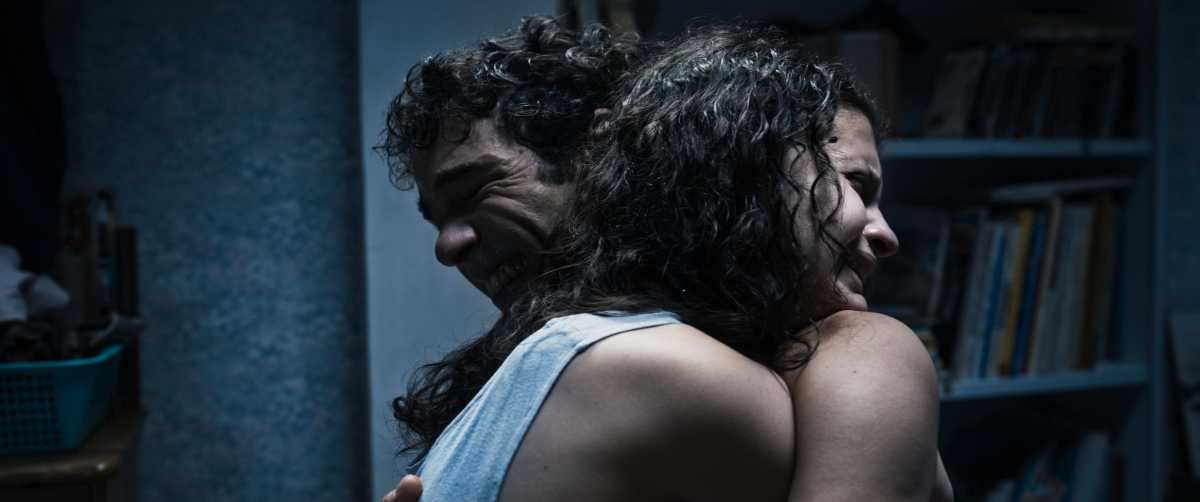
Shot with a sickly yellow pallor, “Alpha” begins with the title character drawing a black line between her uncle Amin’s (Tahar Rahim) needle marks. After living with heroin addiction for years, he’s contracted a new virus that turns human bodies to stone. Alpha (played by Mélissa Boros as a 13-year-old) puts herself at risk for it when she gets a poke-and-stick tattoo of the letter “A,” representing her name, at a party. The same needle is used on several teens. While Alpha’s unconcerned at the time, her mother (Golshifteh Faraneh), who goes unnamed, panics when she discovers it. At school, she starts bleeding from the scabs, frightening her classmates. She heads to the bathroom for a tryst with Adrien (Louai El Amrousy). Amin returns to her life, turning up unannounced at her mother’s apartment one day. Still using heroin, he’s extremely thin and looks sickly. The film goes back and forth between Alpha’s life at 5 and 13.
“Alpha” is a story about growing up when AIDS hit Western Europe in the ‘80s. The crucial difference is that some details about AIDS have been changed, which lets Ducournau introduce a degree of fantasy without insulting people who’ve suffered and died from it. Although it doesn’t spell everything out, dirty needles and unprotected sex appear to spread this virus. The hysteria over bodily fluids, even ones as harmless as spit, returns. Alpha’s body revolts against this conformism, spewing blood at the jerks at her school. Even the letter “A” is central to the film. Three characters’ names start with it. After Alpha gets tattooed with “A,” it’s a symbol of her marginalization, whether or not she carries the virus. Her body starts to revolt against the jerks at her school, spewing blood at them. She and Amin take the A bus line through nighttime Paris. As much as it places these themes at center stage, it filters them through a child’s uncertain perspective and an ambiguous notion of time.
While Ducournau does not speak about her own sexuality, she told “Vulture” “my vision of the world is queer.” With a protagonist who disguises herself as a man and becomes accepted in an all-male workplace, “Titane” can easily be read as a trans narrative. In any case, there’s something inherently queer, beyond sexual orientation, about a film where a person has sex with a car. The one out gay character in “Alpha” is the girl’s English teacher. The class can figure out his sexuality and taunt him for it. One boy tells him “you sound faggy.” Alpha runs into him in a clinic, meeting his partner, who’s dying from the virus and can barely sit down. The film’s treatment of him is its weakest aspect, falling into the trope of the sad gay man whose pain teaches the audience a lesson. He has no life beyond his suffering. The treatment of Amin’s sexuality is much more open. His life before heroin use — and its libido-destroying effects — is never explained, but the scene where he takes Alpha to a queer-coded nightclub where most patrons are living with the virus makes one wonder.
Ducournau’s films have always been invested in the family, nuclear or chosen. “Raw” ended with a college student who has become a cannibal, taking a bite from her father’s chest. In “Titane,” a middle-aged man comes to believe that a woman really is his son. In “Alpha,” both female characters try to help Amin, which includes reviving him from overdoses. As hard as he is to live with, the film avoids reducing him to a stereotype.
While “Raw” was an excellent debut feature, “Titane” felt rather tryhard, as though Ducournau was working too hard to join the body horror canon alongside David Cronenberg. Although “Alpha” has become a film maudit, its sentiment represents something new for her work. It certainly includes ill-judged and heavyhanded elements, but the film uses its narrative trickery to enhance its depth of feeling rather than detract from it. The dust which fills the finale has real texture. One isn’t entirely sure what actually happened, as the degree of fantasy steadily increases near the end, but it resonates emotionally, which matters far more.
“Alpha” | Directed by Julia Ducournau | NEON | In French with English subtitles | Opens March 27th at IFC Center